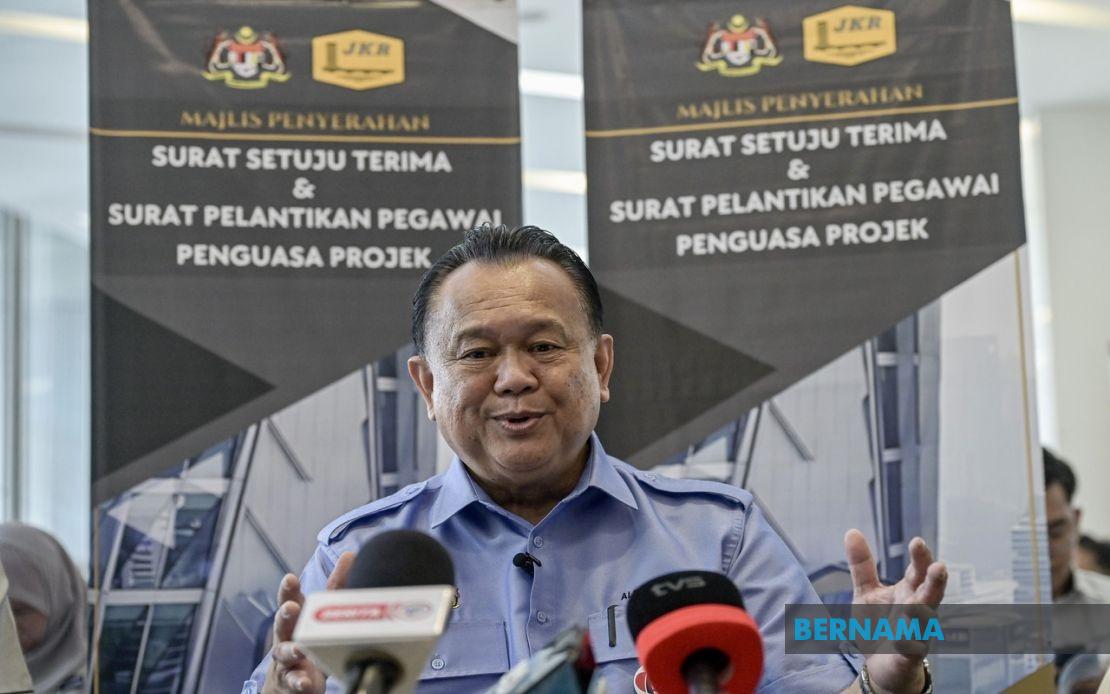
Works Minister Datuk Seri Alexander Nanta Linggi has pushed back against the notion that finishing infrastructure projects ahead of schedule constitutes success, arguing instead that genuine achievement requires contractors to simultaneously satisfy three equally critical dimensions: budget adherence, timeline compliance and quality delivery. Speaking after launching the Perak police headquarters and housing development initiative here on August 21, Nanta made clear that rushing to complete work while incurring cost overruns or delivering substandard infrastructure represents a failure rather than a triumph for the Public Works Department (JKR).
Contractors working on JKR-supervised projects face mounting pressure to deliver results efficiently, but Nanta's remarks signal a deliberate recalibration of performance expectations within Malaysia's infrastructure sector. He underscored that a project finished months early has achieved nothing meaningful if quality deteriorates or expenditure spirals beyond approved figures. "It is not ahead of time if there are problems with quality," Nanta explained to reporters, emphasising that acceleration gains legitimacy only when tied to financial discipline and construction standards. This holistic approach to project management reflects growing awareness among federal agencies that the true cost of shortcut-driven delivery extends far beyond initial savings, eventually burdening taxpayers with remedial works and structural failures.
The Ministry of Works (KKR) and JKR have embedded this philosophy into their operational framework through key performance indicators specifically designed to eliminate sick and abandoned projects from their portfolios. Standardised operating procedures and monitoring guidelines now govern how contractors execute their responsibilities, creating accountability mechanisms at multiple levels. Deputy Minister Datuk Seri Dr Ahmad Maslan revealed the previous day that sick project rates within JKR's supervision have improved, falling to 4.13 per cent from five per cent previously, though 36 of 871 currently active projects still remain troubled. While progress is evident, the persistence of problematic schemes across the department underscores why Nanta felt compelled to restate fundamental principles to industry stakeholders.
The newly launched Perak police contingent headquarters and associated housing complex exemplifies the scale and strategic importance of projects now entering JKR's pipeline. Valued at approximately RM366 million and sprawling across a 25-hectare parcel adjoining Bulatan Sultan Azlan Shah in Bandar Meru, Ipoh, the development will be executed by Serada Realty Sdn Bhd over a 42-month implementation window with completion targeted for February 2030. This venture, classified as a strategic initiative by the Ministry of Home Affairs (KDN), represents the kind of high-visibility, high-stakes infrastructure work where the integration of speed, cost control and quality standards becomes particularly consequential for public confidence.
The rationale for this ambitious construction undertaking stems from the deteriorating condition of existing police infrastructure in Perak. The current IPK complex, at 58 years old, has crossed the threshold where piecemeal renovation remains economically defensible, prompting authorities to greenfield a replacement facility entirely. Beyond simply providing modern accommodations and operational spaces for Perak's Royal Malaysia Police contingent, the new complex is projected to generate measurable improvements in law enforcement effectiveness across the state. Planners anticipate the facility will enhance security operations and coordination capacity while simultaneously reducing the state's crime index by five per cent annually and compressing police emergency response times from 15 minutes to 10 minutes.
For Malaysian stakeholders monitoring JKR's performance trajectory, Nanta's emphasis on balanced metrics should prompt deeper reflection about what success really means in government-led infrastructure delivery. Domestic contractors frequently face contradictory signals: accelerate timelines, manage costs strictly and maintain pristine quality, all within compressed project cycles. Yet the minister's framing suggests that attempting to optimise all three variables simultaneously, rather than sacrificing any single dimension, constitutes the genuine competitive advantage. This philosophy, if genuinely embedded within JKR's project governance systems, could reshape how Malaysian firms approach large public works contracts.
Nanta directed stern guidance toward contractors accepting letters of acceptance for JKR projects, reminding them that custodianship of public resources demands unwavering integrity, responsibility and commitment. Contractual obligations extend beyond formal compliance to encompassing a broader stewardship ethic where delivering results within specifications and timelines reflects accountability to taxpayers funding these ventures. The minister also elevated the profile of superintending officers tasked with monitoring construction sites, urging them to adopt proactive stances toward identifying emerging problems and implementing rapid corrective interventions before schedule pressures or cost pressures cascade into larger systemic failures.
Regional observers and infrastructure analysts across Southeast Asia may find Nanta's articulation of balanced project criteria instructive as they grapple with similar implementation challenges. Many countries in the region struggle with infrastructure delivery, frequently experiencing cost overruns, timeline slippage and quality compromises that ultimately erode public trust in government capabilities. Malaysia's documented effort to establish and enforce clear benchmarking standards—particularly the measurable decline in sick project percentages—suggests that systematic, disciplined governance frameworks can yield improvement even within historically problematic institutional contexts. The question for JKR will be whether this recalibrated philosophy can sustain momentum across an expanding portfolio of strategically important projects.
The Perak police complex will serve as a visible test case for whether the ministry's commitments to balanced delivery translate into tangible results. Should the RM366 million project unfold according to specifications, meeting its 42-month timeline without significant cost expansion or quality degradation, JKR would accumulate practical evidence supporting Nanta's assertions. Conversely, slippage on this marquee initiative would undermine the credibility of recent policy pronouncements and fuel scepticism about whether sick project rates have genuinely declined or merely shifted within the broader portfolio. Success here carries implications extending beyond Perak, effectively validating the institutional reforms and performance frameworks that KKR has implemented across the entire JKR project ecosystem.

