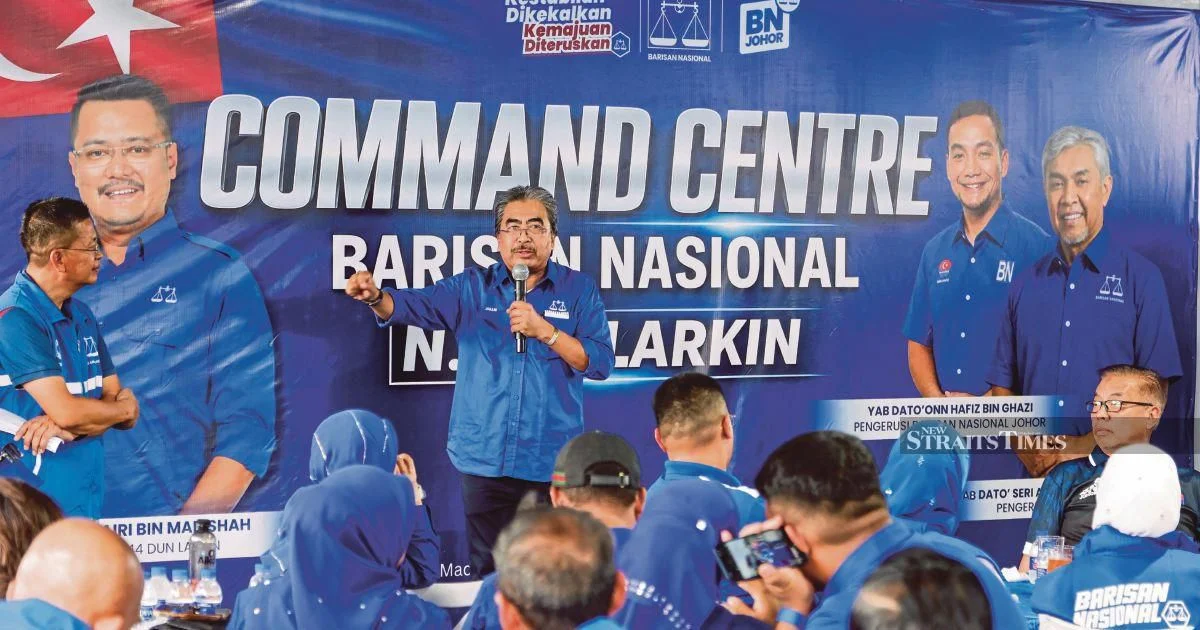
Datuk Seri Johari Abdul Ghani has delivered a pointed message to Barisan Nasional (BN) operatives and candidates contesting the Johor state election, urging them to resist the temptation of engaging in public disputes with political opponents. His remarks come as the coalition readies itself for what is expected to be a closely fought electoral contest, with the senior statesman emphasizing that internal discipline and strategic focus will prove far more valuable than reactive skirmishes on the campaign trail.
The messaging reflects a broader concern within BN circles about maintaining coherence and unity as the party machinery mobilizes across Johor. Political campaigns in Malaysia have historically seen tensions escalate when rival camps publicly contradict or attack one another, often resulting in a dilution of core messaging and erosion of voter confidence. By calling for restraint now, Johari appears to be signalling that BN's best path to electoral success lies in consistent, voter-centric communication rather than becoming drawn into tit-for-tat exchanges that can quickly spiral beyond the campaign apparatus' control.
Johor, as Malaysia's second-largest state by population and a traditional BN stronghold, represents a significant battleground for the coalition. Any fractures in party unity or perception of internal discord could prove costly in a political environment where opposition parties have grown more competitive at the state level in recent years. The electorate in Johor has demonstrated increasing willingness to split their votes across coalitions, making coherent messaging and unified front essential for BN's ambitions.
Johari's intervention suggests that there may already be pockets of concern about disciplinary breaches or candidates veering off message. State elections in Malaysia, which operate under different dynamics than federal contests, often see more localized and personalized campaigning. Without clear direction from senior leadership, individual candidates may pursue aggressive tactics against opponents, potentially undermining the broader coalition strategy. His statement effectively serves as a reminder to party members that such behaviour risks damaging the collective effort.
The timing of these remarks is significant. Early campaign phases are crucial for setting tone and establishing narrative dominance. If BN allows itself to become consumed by responding to opposition provocations or engaging in unseemly public disputes, it cedes the initiative on policy and voter outreach. Johari's guidance emphasizes that the coalition's energies should remain concentrated on articulating its vision, addressing voter concerns, and demonstrating capacity for governance rather than scoring quick political points through confrontation.
This approach also reflects evolving sophistication in Malaysian political strategy. Successful campaigns increasingly hinge on stakeholder management and maintaining discipline across thousands of party workers, volunteers, and office-seekers. A single candidate's inflammatory remark or disputed exchange can generate media coverage that overshadows carefully planned policy announcements or grassroots engagement efforts. By establishing clear expectations for conduct, Johari aims to create a professional campaign environment that prioritizes substance over spectacle.
For BN, which commands substantial organizational resources and institutional advantages in Johor, avoiding internal distractions allows the coalition to leverage its structural strengths. The party machinery's ability to mobilize voters, distribute resources efficiently, and coordinate across multiple party components becomes more effective when not derailed by public quarrels. Johari's message essentially privileges execution of a coherent strategy over the immediate satisfaction of confronting opponents directly.
Opposition parties will likely seek to provoke BN candidates and officials during the campaign, testing their discipline and attempting to generate negative headlines. Johari's advance guidance prepares BN members to resist such baiting and maintain composure. In modern elections, voters increasingly view such provocations and responses as indicators of candidate temperament and fitness for office. Maintaining decorum and focusing on substantive issues positions BN as the more serious, responsible option in the electorate's eyes.
The broader lesson embedded in Johari's remarks applies beyond Johor to Malaysian politics generally. Coalitions that fracture under campaign stress or allow internal divisions to become public spectacles typically underperform electorally, regardless of their structural advantages. Conversely, parties that maintain unified messaging and discipline, even when facing aggressive opposition tactics, demonstrate the kind of coherence voters associate with effective governance. His statement reflects hard-earned wisdom about the mechanics of successful state-level campaigning in Malaysia's contemporary political landscape.

