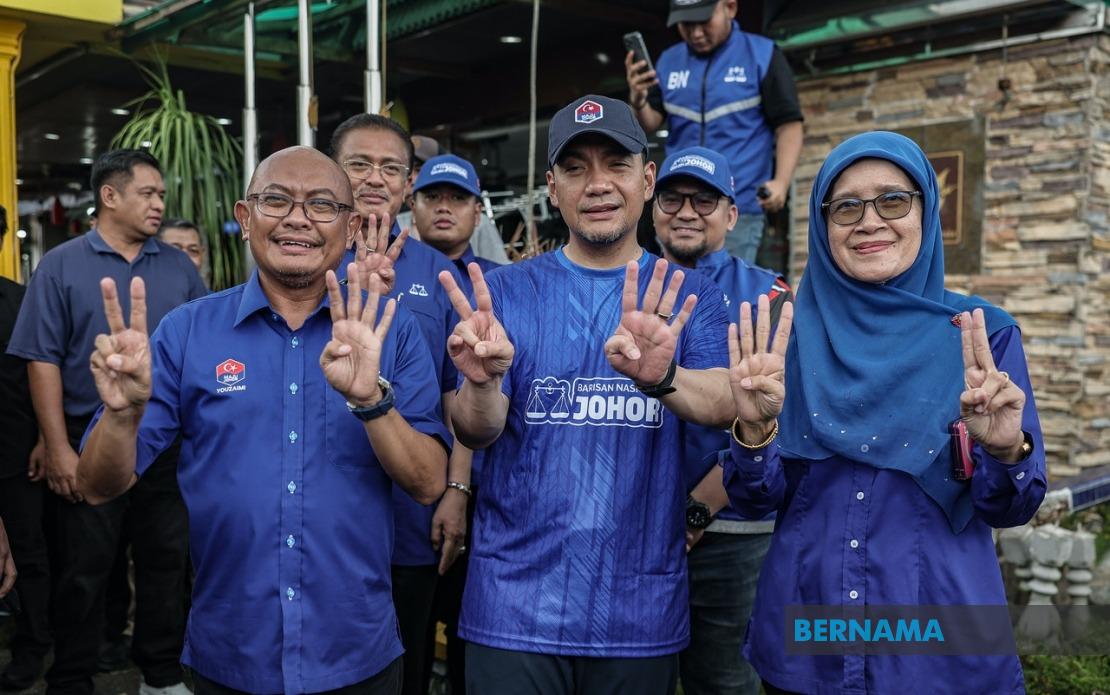
The Barisan Nasional coalition's survival and effectiveness depends fundamentally on a power-sharing arrangement that demands genuine sacrifice and disciplined commitment from every member party, according to Johor BN chairman Datuk Onn Hafiz Ghazi. Speaking at a machinery meeting in Mersing ahead of the July 11 state election, the Johor Menteri Besar articulated a vision of coalition governance grounded not in the pursuit of maximum individual advantage but in a collective determination to maintain political stability and strengthen inter-party cooperation across Malaysia's oldest ruling alliance.
The Tenggaroh constituency has emerged as a potent symbol of this power-sharing philosophy in practice. For more than four decades, UMNO has forgone the opportunity to field its own candidate in this seat, instead consistently backing the Malaysian Indian Congress (MIC) nominee despite persistent electoral defeats. This sustained loyalty across multiple electoral cycles, according to Onn Hafiz, demonstrates the mature institutional discipline that distinguishes established coalitions from fragile political arrangements held together by temporary interest. The decision to support MIC's candidate again in the upcoming election, even as UMNO machinery members might harbour personal or factional preferences for contesting the seat themselves, reflects an understanding that coalition longevity transcends individual or party-level ambitions.
Onn Hafiz recounted the historical record with evident appreciation for UMNO's restraint. Over the four decades since the coalition framework was established in Tenggaroh, UMNO's own efforts to capture the seat ended in defeat on each occasion they attempted to contest. Rather than viewing these defeats as justification for abandoning the power-sharing agreement or pursuing a competing agenda, UMNO continued channelling resources and machinery support toward MIC's candidacy. This pattern of behaviour, Onn Hafiz suggested, embodies the kind of long-term institutional thinking that separates mature political movements from opportunistic alliances. The implicit challenge to other parties, particularly those more recently aligned with Barisan Nasional following the 2020 political realignment, is clear: genuine coalition membership requires accepting periodic disappointment in the name of collective stability.
The composition of Tenggaroh's electorate underscores both the pragmatism and the principle underlying the allocation decision. With approximately 500 Indian voters among more than 39,000 registered electors, the constituency lacks a dominant Indian demographic that would conventionally justify reserving the seat for MIC on purely communal lines. Yet Onn Hafiz explicitly rejected any suggestion that this numerical minority status should override the power-sharing principle. By maintaining the Tenggaroh seat allocation for MIC despite the absence of overwhelming communal justification, BN signals that its multi-racial cooperation model rests on something deeper than demographic calculation—namely, a commitment to ensuring that each major Malaysian community retains meaningful representation within the governing structure, regardless of local electoral mathematics.
The allocation of seats within Barisan Nasional reflects carefully calibrated negotiations among UMNO, MCA and MIC designed to maintain equilibrium among the three dominant coalition partners. These decisions, according to Onn Hafiz, are not made hastily or unilaterally by the largest partner. Rather, they emerge from deliberative processes aimed at balancing the interests of all component parties while preserving the solidarity that has enabled BN to govern peninsular Malaysia for seven decades. This procedural emphasis on consultation and consensus-building, even when time-consuming, serves to legitimise outcomes that might otherwise appear arbitrary or imposed upon smaller partners by UMNO's numerical dominance.
The electoral context adds urgency to these coalition management challenges. The July 11 state election in Johor represents a critical test of whether Barisan Nasional can consolidate its position following the complex political realignments of recent years. The Tenggaroh race itself has become a three-cornered contest featuring BN's Mohd Youzaimi Yusof, Perikatan Nasional's Muhamad Amerul Muhamad from Bersatu, and Pakatan Harapan's Md Yusof Dawam from PKR. This crowded electoral landscape reflects the broader fragmentation of Malaysian politics, with Johor serving as a crucial battleground where BN's governing legitimacy will be tested against resurgent opposition forces and the challenges posed by Perikatan's inroads into traditionally BN-held territories.
Onn Hafiz has set an ambitious target for the Tenggaroh contest, aiming to more than double the majority achieved in the previous election. Where BN previously secured victory with a majority of 1,356 votes, the menteri besar has indicated that the coalition's machinery should aim for a majority of 3,000 votes—a significantly more demanding objective that reflects both confidence in BN's organisational capacity and recognition that tighter electoral margins represent an existential threat to coalition governance. This target-setting exercise serves multiple functions: it motivates the party machinery by establishing clear performance metrics, it demonstrates to component parties that their allocation decisions translate into concrete electoral gains, and it signals to the national leadership that Johor remains securely within BN's grasp.
The emphasis on machinery discipline and performance reflects broader recognition that coalition governance in contemporary Malaysia faces mounting pressures. The rise of personality-driven politics, the geographic concentration of opposition strength in urban areas, and the increasingly volatile nature of voter preferences have all challenged traditional coalition structures. Barisan Nasional's response, as articulated by Onn Hafiz, is to recommit to the institutional rigours that sustained it during previous transitions: careful seat allocation, subordination of individual ambition to coalition objectives, and investment in party machinery that can mobilise voters across diverse constituencies and demographic communities.
For Malaysian political observers and regional analysts monitoring Southeast Asia's governance trends, the Johor election holds significance extending beyond state-level politics. Johor has historically served as a bellwether for national political sentiment and as a crucial economic engine whose stability directly affects broader Malaysian prosperity. A decisive BN victory would reinforce the coalition's claims to national legitimacy following the uncertain period after the 2020 general election, while a narrower outcome or opposition gains would validate concerns that traditional coalition politics faces structural decline in the face of new political movements and voter preferences.
The early voting scheduled for July 7 precedes the main election by four days, providing an opportunity for advance polls participation and potentially indicating turnout patterns. Both timelines intersect with the mobilisation of BN's institutional machinery across Johor's constituencies, tested most visibly in contests like Tenggaroh where the coalition must demonstrate that power-sharing arrangements translate into effective political organisation and voter persuasion.
Ultimately, Onn Hafiz's emphasis on sacrifice and loyalty within the Barisan Nasional framework reflects an implicit argument about the costs and benefits of coalition politics at a moment when Malaysian political alignments remain unsettled. By celebrating UMNO's restraint and MIC's retention of the Tenggaroh seat, the menteri besar advances a vision of stable governance rooted in institutionalised power-sharing rather than winner-take-all competition. Whether this appeal to traditional coalition discipline proves persuasive to contemporary Malaysian voters, particularly younger electors accustomed to viewing politics through the lens of individual performance and policy responsiveness rather than communal representation, remains an open question that the July 11 election will begin to illuminate.

