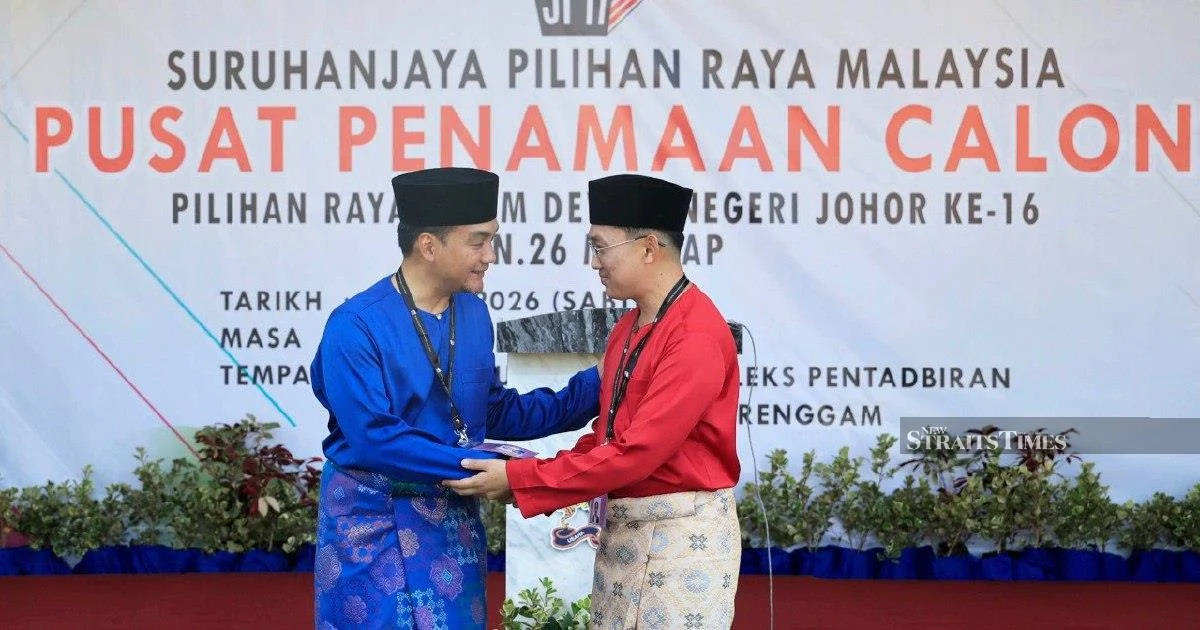
Caretaker Menteri Besar Datuk Onn Hafiz Ghazi has adopted a notably circumspect stance on his re-election prospects in Machap, publicly warning that the constituency contest remains too volatile to forecast with confidence ahead of voting on July 11. Speaking at Simpang Renggam, the senior Johor politician acknowledged that despite his pursuit of a second term as state chief executive, the electoral dynamics in his own seat defy easy prediction. This posture represents a departure from the customary confidence typically displayed by incumbent leaders seeking renewal of their mandates, instead reflecting an awareness of shifting voter sentiment across Johor.
The Machap constituency has historically served as Onn Hafiz's political base, and his performance there carries symbolic weight beyond the individual seat's parliamentary significance. The state's political landscape has undergone substantial transformation in recent years, with multiple coalition realignments and evolving voter priorities reshaping traditional voting patterns. The emergence of competing narratives around economic management, development priorities, and federal-state coordination has complicated the electoral calculus across Johor's diverse constituencies. Onn Hafiz's cautious framing of the contest suggests internal campaign assessments may be detecting resistance that earlier political assumptions underestimated.
The broader Johor election scheduled for July 11 represents a crucial test of political momentum following the 2022 national elections, which produced a fragmented parliament and necessitated unprecedented power-sharing arrangements at federal level. Johor, as Malaysia's southernmost mainland state and a significant economic engine, carries disproportionate weight in national political narratives. The state's voting patterns often prefigure broader shifts in Malaysian electoral sentiment, making the results potentially consequential for federal coalition dynamics and policy directions over the coming years. A weakened mandate for Onn Hafiz's administration could ripple through state governance capacity and influence negotiations within Barisan Nasional's internal structures.
Onn Hafiz's emphasis on unpredictability rather than anticipated victory also reflects demographic and socioeconomic pressures affecting Johor voters. Rising living costs, persistent concerns over employment generation, and infrastructure development expectations have animated political discourse throughout the state. The cost-of-living crisis that has gripped Malaysia since 2022 has proven particularly acute in urban and semi-urban constituencies where purchasing power erosion directly affects household decision-making. Machap, situated within this contested political terrain, sits at the intersection of traditional rural constituencies and expanding suburban communities, demographic complexity that resists straightforward electoral prediction.
The caretaker chief minister's gambit of tempering expectations while actively campaigning serves multiple tactical purposes. Public acknowledgment that the contest remains genuinely competitive can mobilise party machinery to maximize turnout among core supporters who might otherwise assume victory was assured. Simultaneously, such rhetoric insulates against allegations of arrogance or electoral complacency, positioning Onn Hafiz as a leader acutely conscious of accountability to voters. This rhetorical strategy acknowledges that Malaysian electorates in successive elections have proven willing to deliver unexpected verdicts, punishing perceived overconfidence and rewarding apparent humility and engagement with grassroots concerns.
Opposition parties contesting the Machap seat have positioned their campaigns around perceived governance shortfalls and promises of alternative development priorities. The specific vulnerabilities these challengers have identified within Onn Hafiz's record—whether related to service delivery, corruption perceptions, or development equity—apparently resonate sufficiently within the constituency to prevent the incumbent from claiming a clear advantage. The fragmentation of Malaysia's opposition across multiple coalitions has also complicated electoral mathematics, potentially creating three-cornered contests where no single candidate commands obvious majority support. This multiplication of contenders has increased inherent unpredictability across numerous constituencies throughout Johor.
For Malaysian and Southeast Asian observers, the Johor election outcome carries significance extending beyond state administration. The result will indicate whether the 2022 federal voting pattern—which saw voters punish incumbent coalitions perceived as corrupt or unresponsive—has solidified into a durable realignment or represents a temporary protest vote susceptible to reversal. Onn Hafiz's performance in particular will shed light on whether Barisan Nasional's efforts to rebrand itself through leadership renewal have achieved credibility with voters, or whether deeper institutional trust deficits persist. These questions resonate across the region, where democratic incumbencies everywhere confront public scepticism regarding elite accountability and governance competence.
The election also intersects with significant federal-state coordination questions relevant to Johor's strategic importance. Port Klang competition, digital economy development, semiconductor manufacturing investments, and cross-border regional integration initiatives all depend on stable state governance capacity and predictable policy environments. A decisive electoral outcome will clarify the mandate conditions under which Johor's administration must operate; ambiguous or narrow results would likely constrain ambitious state-level initiatives requiring sustained political capital and legislative coalition management. Investors and federal policymakers watch Johor elections partly through this governance stability lens, not solely through partisan political interest.
Onn Hafiz's cautionary remarks also implicitly acknowledge the shifting generational composition of Johor's electorate. Younger voters, particularly those who came of age during the 2018 political transition and subsequent instability, demonstrate voting behaviours that depart from their parents' patterns of straight-ticket party loyalty. These cohorts prioritize policy substance, personal integrity, and demonstrated responsiveness over inherited party affiliations or ethnic-religious bloc solidarity. Such voters concentrate disproportionately in constituencies where educational attainment and information access exceed earlier averages, creating pockets of political volatility where traditional majority assumptions no longer hold. Machap contains sufficient numbers of such voters to genuinely alter outcomes if mobilisation differs from baseline patterns.
The July 11 election will ultimately adjudicate between Onn Hafiz's record as caretaker and chief minister, spanning both the accomplished projects his administration credits itself with delivering and the unfulfilled expectations and governance challenges his opponents have emphasized. The contested interpretation of his stewardship, combined with the structural unpredictability characterizing contemporary Malaysian electoral dynamics, genuinely validates his publicly articulated position that "anything can happen." Such humility, whether strategically calculated or genuinely felt, reflects the political reality that electoral outcomes increasingly resist the confident predictions that patronage-dominated systems once facilitated. For Johor voters preparing to cast ballots, this acknowledgment appropriately centres the genuine stakes and genuinely open character of their electoral choice.

