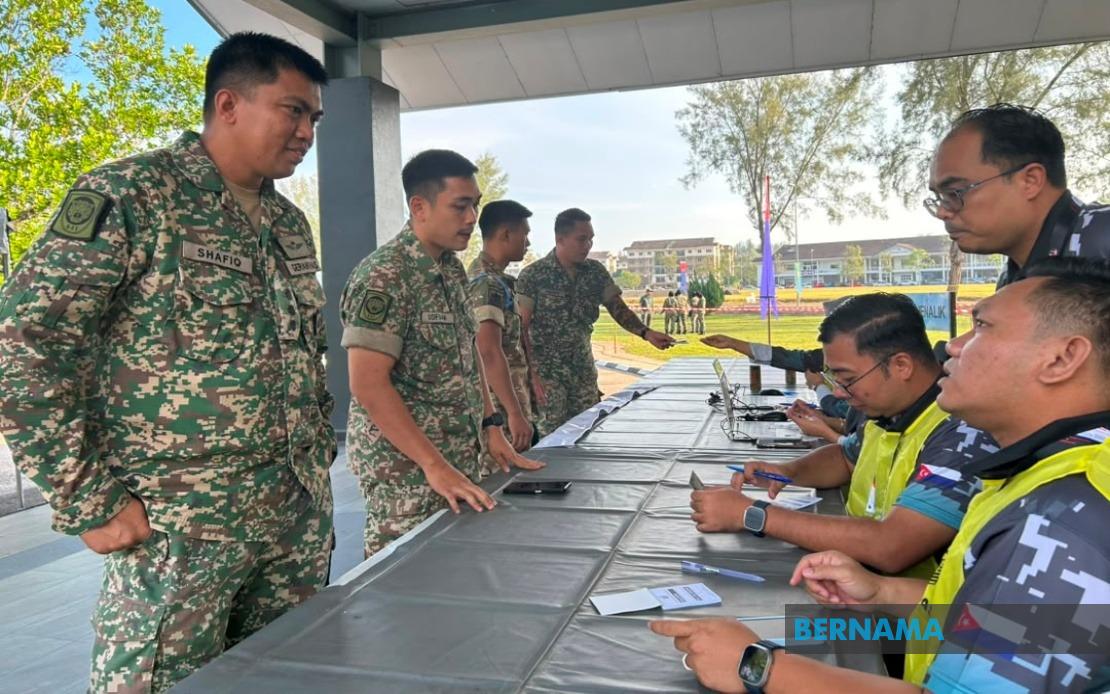
Early voting in Johor's 16th state election commenced on July 7 under bright skies, with security and police personnel exercising their franchise at designated polling stations from first light. The Election Commission had scheduled voting to begin at 8 am across the state, but security personnel arrived as early as 7.30 am to participate in the process, taking advantage of the clear weather that characterised the opening hours.
The favourable atmospheric conditions in the morning facilitated smooth operations at all polling locations. Election Commission staff and security personnel who reported early were able to move freely between centres without weather-related impediments, contributing to an orderly commencement of the electoral exercise. Officials conducted final preparatory checks before the doors opened, ensuring that systems and procedures were in place to manage the anticipated volume of voters efficiently.
The Election Commission had established 64 dedicated early polling centres across Johor to accommodate 24,751 early voters. This cohort comprised 12,041 Malaysian Armed Forces personnel and their spouses, alongside 12,710 Royal Malaysia Police and General Operations Force members and their spouses. The separation of early voting for security forces is a standard electoral practice designed to enable their participation while maintaining operational readiness, particularly given the upcoming main polling day scheduled for Saturday.
Field observations by Bernama at several major early voting venues, including the 5th Battalion GOF Camp in Simpang Renggam, Johor Contingent Police Headquarters, and Mahkota Kluang Camp, confirmed that the electoral process unfolded without significant disruption. Poll workers and security personnel collaborated to manage voter flow, verify documentation, and maintain the integrity of the voting process. The coordination between Election Commission officials and security establishments demonstrated the institutional preparedness that months of planning had achieved.
However, the Malaysian Meteorological Department cautioned that the benign morning conditions would deteriorate. MetMalaysia issued warnings of thunderstorms moving across Johor during the afternoon hours, prompting the Election Commission to stagger the closure of early polling centres. Polling stations were scheduled to close in stages between noon and 6 pm, with the specific timing dependent on individual centre locations and their registered voter populations. This flexible approach aimed to protect ballot security and voter safety as weather conditions potentially worsened.
The early voting phase represents the first substantive electoral activity in Johor's state polls, a significant political event in Malaysia's second-largest state by population. The broader election encompasses 2,727,926 registered voters spread across 1,140 polling centres throughout Johor, a distribution that reflects the state's diverse geography and settlement patterns. The sheer scale of the electoral machinery required to manage this participation underscores the substantial logistical undertaking involved in conducting state elections in Malaysia.
Saturday's main polling day will determine representation across all 56 state assembly seats in the state assembly. A total of 172 candidates from various political parties and independent backgrounds are contesting these positions, offering voters a range of political choices. The candidate-to-seat ratio reflects competitive dynamics in several constituencies, with some seats attracting multiple contenders while others face less contested races.
The Johor state election carries significance beyond the state itself, as it functions as a barometer of political sentiment in one of Malaysia's most important states. Results will influence the configuration of state government and may have implications for federal political dynamics, given Johor's electoral weight and economic prominence. Observers across the region are monitoring the contest closely to discern patterns in voter behaviour and political preferences.
The smooth execution of early voting procedures on July 7 provided reassurance that the main electoral event on Saturday would similarly proceed without major logistical problems. The Election Commission's ability to manage the early voting phase efficiently, despite the complexity of accommodating security personnel across multiple locations, demonstrated institutional capability. However, the weather warning introduces an element of uncertainty for Saturday's voting, as thunderstorms could potentially affect voter turnout and polling centre operations if the meteorological forecast materialises as predicted.
As Johor moves toward the culmination of its electoral campaign, the focus now shifts to Saturday when the broader electorate will exercise their voting rights. The early voting window provided security personnel with an opportunity to participate without disrupting operational commitments, a practical accommodation that reflects the demands of balancing democratic participation with security responsibilities. The Election Commission will now prepare for the main polling day, when the full apparatus of the electoral system will be deployed to facilitate voting by millions of Johor voters.

