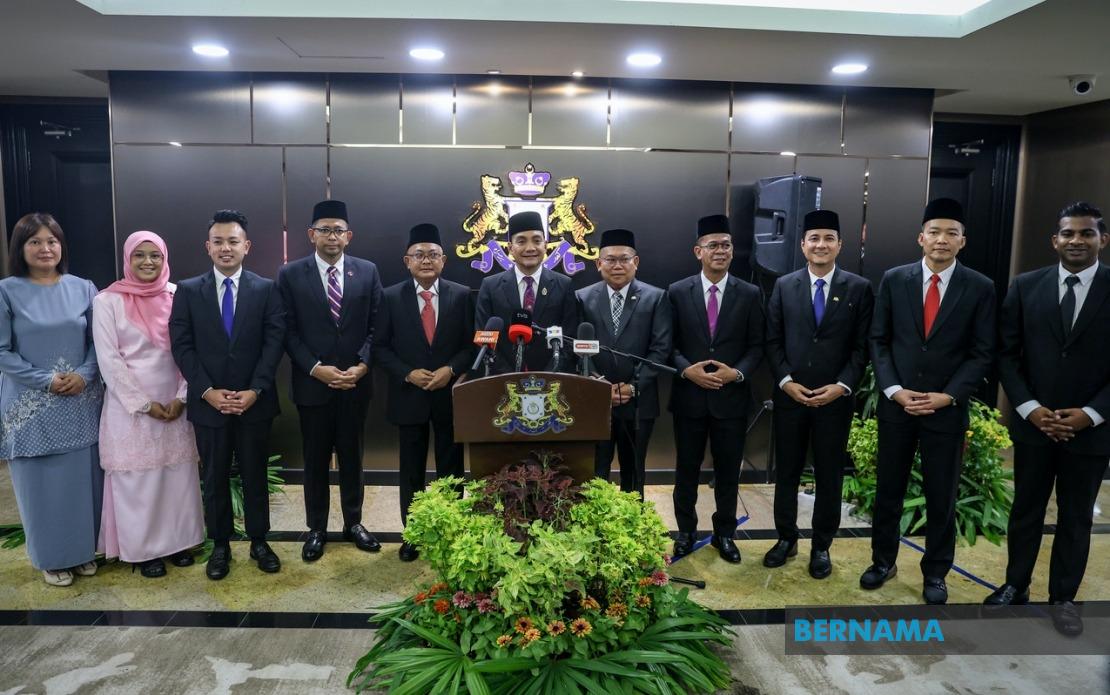
Johor has moved to reinforce its administrative capacity in the education portfolio by appointing a deputy chairman to the State Education and Information Committee, a position that signals an evolving approach to governance in Malaysia's southernmost state. The establishment of this new role reflects broader efforts to distribute leadership responsibilities and enhance the quality of service delivery across the public sector in Johor.
Dr Muhammad Naqib Md Ghazali, the committee chairman, characterised the appointment as a strategic measure to bolster internal coordination and widen the committee's engagement with the public. Speaking at an aspiration ceremony held at the offices of the Johor Talent Development Council in Kota Iskandar, he explained that the introduction of a deputy allows for clearer task distribution among team members and facilitates a more collaborative working environment. This structural change reflects a philosophy increasingly adopted by state governments across Malaysia: that distributed leadership can improve both the speed and quality of policy implementation.
The newly appointed deputy chairman, V. Rugendran, joins the administration at a moment when Johor is prioritising education as a foundational pillar for economic and social development. The appointment comes shortly after Johor Menteri Besar Datuk Onn Hafiz Ghazi announced a broader package of changes to the state administration, in which ten deputy chairmen were appointed across various state government committees. This concurrent reshuffle suggests a deliberate strategy to strengthen institutional depth and prevent critical functions from being overly dependent on single individuals.
Dr Muhammad Naqib, who attended his first State Executive Council meeting under the new administration, emphasised that the education sector remains central to his portfolio's mandate. He highlighted the importance of nurturing what he called "Bangsa Johor"—a generational cohort equipped with resilience and capability to navigate future economic and social complexities. This framing connects education policy to the state's long-term competitive positioning within Malaysia and the region.
Among the specific initiatives receiving attention is the Sekolah Rintis Bangsa Johor, a pioneering educational model designed to align curriculum and pedagogy with the state's development aspirations. Alongside this, the Johor Talent Development Council is slated for expansion, indicating a commitment to nurturing skills development beyond the traditional school system. These programmes suggest that Johor's leadership views education as a multi-institutional endeavour rather than something confined to classroom settings.
The appointment of V. Rugendran also reflects Johor's emphasis on inclusive governance. By distributing responsibilities across multiple leaders, the committee structure now potentially allows for greater representation of diverse perspectives in policy formulation. This approach carries particular significance in a state as geographically and demographically varied as Johor, where constituents span urban centres like Johor Bahru and more rural districts with distinct needs.
For Malaysian observers, the Johor restructuring offers insights into how state governments are adapting their administrative machinery to meet public expectations. The emphasis on task delegation and collaborative teamwork, articulated by Dr Muhammad Naqib, reflects global best practices in governance while remaining grounded in Malaysia's institutional context. The degree to which this structural change translates into measurable improvements in public services will be an important indicator of Johor's administrative evolution.
The timing of these appointments—immediately following a change in state administration—also signals continuity with an emphasis on fresh momentum. By creating new positions and distributing leadership roles, the Menteri Besar's administration demonstrates confidence in the capacity of the state apparatus to deliver on its mandates. However, such expansions also raise questions about resource allocation and whether the additional layer of bureaucracy enhances or complicates decision-making.
Dr Muhammad Naqib's appeal to all appointed officials to serve constituents equitably, irrespective of race or religion, touches on an important dimension of governance in Malaysia's plural society. This inclusive rhetoric, while standard in formal statements, gains significance when anchored to tangible policy areas like education, where decisions about resource allocation and programme design can have lasting impacts on community cohesion.
Looking forward, the success of this restructuring will depend on how effectively the committee chairman and deputy chairman coordinate in practice. The stated objective—to accelerate problem resolution and ensure equitable implementation of development policies across Johor's districts—is ambitious but achievable if institutional coordination functions smoothly. The committee's performance in the coming quarters will likely set a precedent for whether similar appointments in other states prove similarly beneficial.
For Malaysian education stakeholders and those tracking developments in Johor, this appointment represents a tangible commitment to strengthening the institutional framework that shapes educational policy in the state. Whether this translates into improved outcomes in student learning, teacher development, or infrastructure expansion remains to be seen, but the administrative groundwork has now been laid for more coordinated, responsive governance in the sector.

