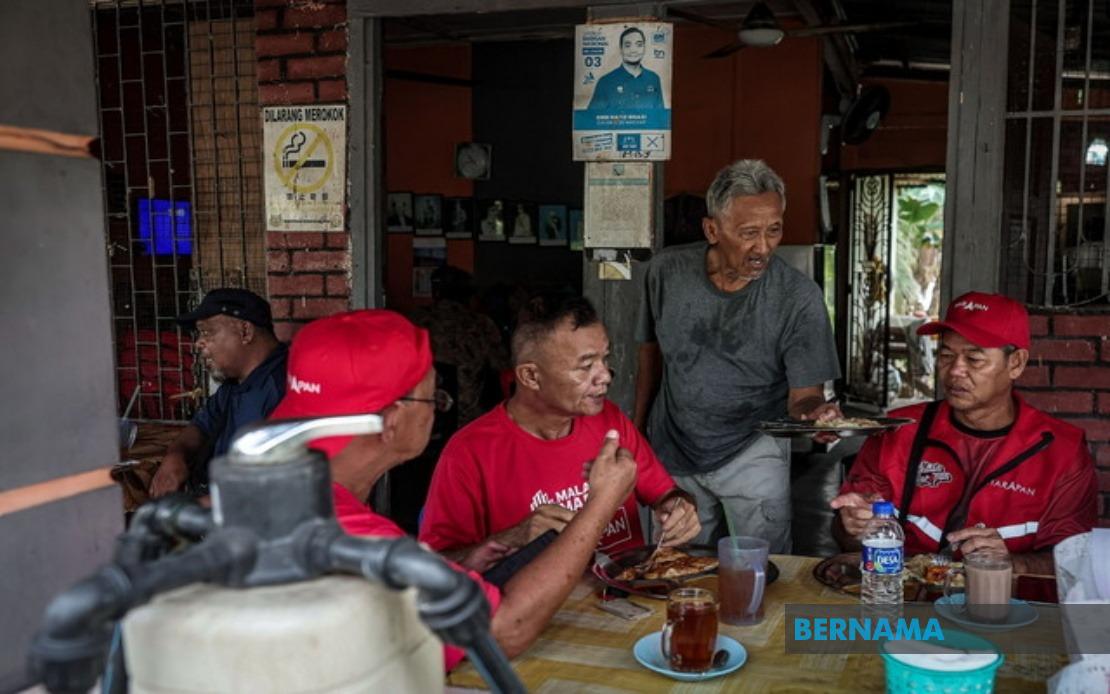
The Johor State Election campaign has delivered an unexpected financial gift to small business operators and food vendors across key constituencies, transforming what is primarily a political exercise into a genuine economic opportunity for those working on the ground. The influx of campaigners, political party officials, and election workers has created temporary but meaningful demand surges in areas such as Layang-Layang and Simpang Renggam, where traders who normally operate on thin margins are suddenly experiencing significantly improved business conditions.
In the Felda Layang-Layang settlement, 70-year-old warung operator Noorma Zafmeeden has witnessed her morning revenue climb well beyond the typical RM400 threshold that characterised her regular operating days. Her stall, which specialises in traditional Malaysian breakfast staples including roti canai and nasi lemak, has benefited from the stream of people moving through the constituency during campaign activities. Noorma, who has operated her establishment alongside her 76-year-old husband Bahari Madiran since they settled in the Felda community in 1987, attributed much of the recent success to the election season's ability to draw customers who might not otherwise visit her location.
The couple's experience reflects a broader pattern among food service operators who have traditionally relied on consistent but modest daily customer bases. What makes their situation noteworthy is not merely the increase in sales volume, but rather the consistency of demand and the relatively predictable nature of the election-driven customer flow. For families whose livelihoods depend on incremental daily earnings, even a sustained 50 to 100 percent increase in revenue can meaningfully improve cash flow and provide financial breathing room for several weeks.
Bahari has observed that his warung has evolved into something beyond a commercial transaction point—it has become a gathering space where the election campaign's diverse participants interact in a shared social environment. He notes with particular satisfaction that customers representing different ethnic and religious backgrounds converge at his establishment, creating a microcosm of Malaysian multiculturalism within the context of a political campaign season. This observation carries deeper significance for how election campaigns can facilitate cross-community interaction, particularly in rural and semi-urban settings where such mixing might not occur organically in everyday circumstances.
The economic stimulus extends beyond individual food stalls to encompass a broader ecosystem of small and medium enterprises. Ahmad Ridzuan Awang, a 45-year-old nasi campur vendor operating in Simpang Renggam, has experienced one of the most dramatic increases in business activity, with his daily sales volume effectively doubling since the campaign period commenced. Where his menu items would typically sell out gradually throughout the afternoon and evening, the surge in demand from campaign staff and party representatives has compressed this timeline significantly—his serving trays now empty by early afternoon, sometimes as early as 1.30 pm, due to bulk orders from various political parties and campaign organisations.
Ahmad Ridzuan's experience demonstrates how election campaigns function as temporary economic multipliers in small trading communities. The phenomenon he describes as "political tourists"—campaign workers and political party officials moving through constituencies—generates immediate demand that extends beyond food service operators themselves. Local suppliers of ingredients, packaging materials, and other supporting services benefit from increased orders, creating a ripple effect that spreads economic gains across the wider local business ecosystem.
The timing and geographic concentration of these gains warrant consideration for broader economic policy discussions in Malaysia. While election campaigns are periodic occurrences rather than sustainable economic drivers, they reveal important patterns about consumer demand, supply chain responsiveness, and the latent earning potential within small trading communities when circumstances create sudden demand surges. For traders who typically operate with minimal profit margins and irregular customer flows, the lesson is that substantial income improvements are achievable when the right conditions materialise, even if temporary.
From the perspective of election management and political campaign strategy, the economic engagement of local trading communities adds a secondary dimension beyond the primary political objectives. Campaigns that create positive economic experiences for local residents—particularly small business owners and hawkers who represent a significant portion of working people in rural and semi-urban Malaysia—may generate goodwill that extends beyond the specific political messages being promoted. The sight of local businesses thriving during an election period creates visible evidence of economic activity and opportunity, even if the causation is temporary and election-specific.
The 16th Johor state election represents one of the state's major recent political events, with 172 candidates competing for 56 seats across the constituency. The scheduled polling date of July 11, combined with early voting provisions on July 7, creates an extended campaign period that has allowed this economic activity to develop and compound over several weeks. During this concentrated timeframe, the accumulation of extra earnings can represent meaningful income for traders who operate on seasonal or variable business models.
For Malaysian policymakers and economists monitoring small business dynamics, the Johor election campaign presents an instructive case study in how temporary external stimulus can activate economic potential within small trading sectors. The traders profiled here do not require complex policy interventions or substantial capital investments to expand their operations—they have demonstrated capacity to serve increased demand through their existing infrastructure and skills. The challenge lies in identifying whether lessons from this temporary surge might inform strategies for supporting small trader communities during non-election periods, when external demand triggers are absent and operators must rely entirely on organic customer loyalty and local spending patterns.

