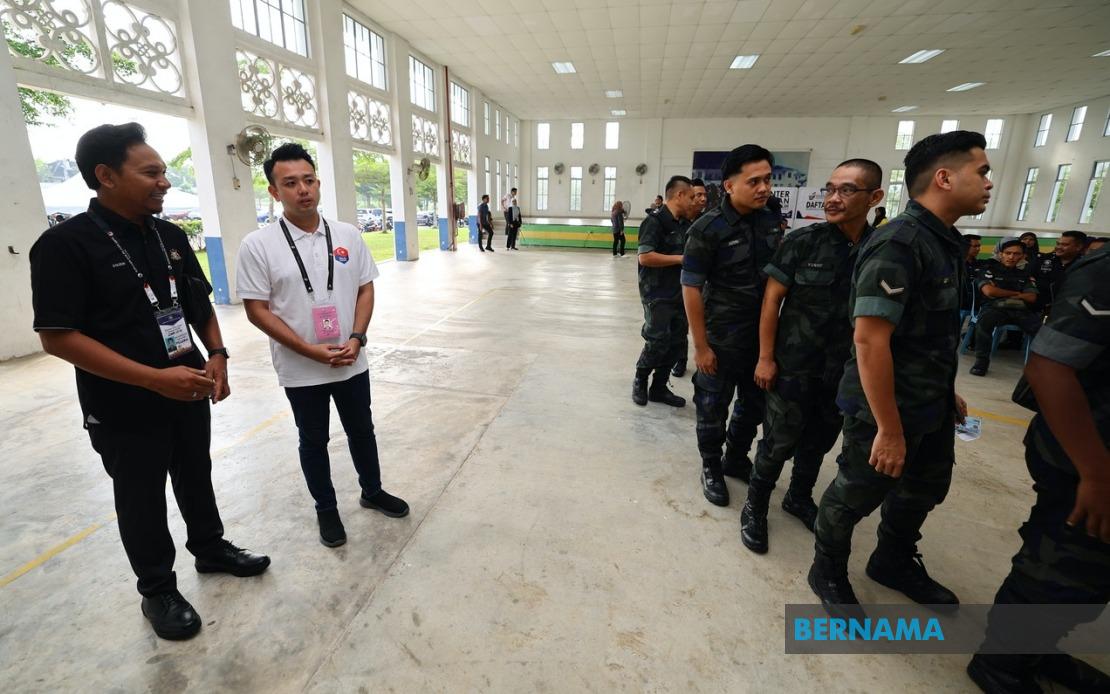
Johor's three main political blocs are witnessing a closely watched early voting process that offers insight into the mechanics and transparency of the state's electoral machinery ahead of Saturday's general poll. Representatives from Pakatan Harapan, Barisan Nasional, and Perikatan Nasional made the effort to attend early voting centres despite demanding campaign schedules, underscoring the competitive nature of the race and the symbolic importance parties place on observing democratic procedures. The decision by all three contenders in multiple constituencies to participate in these observations reflects both their commitment to electoral oversight and their desire to project images of engagement with institutional processes to the public and media.
At the Layang-Layang constituency, which has emerged as a closely watched three-way contest, all three major-party nominees appeared at the 5th Battalion General Operations Force Camp in Simpang Renggam. Guna Balakrishnan representing Pakatan Harapan, Chua Jian Boon from Barisan Nasional, and Abd Mutalip Abd Rahim of Perikatan Nasional each observed voting procedures as military personnel and their spouses exercised their franchise. This triangular contest, played out in a strategic location, reflects the fragmentation of Johor's political landscape beyond the traditional two-coalition framework that has historically dominated Malaysian electoral politics. The presence of all three camps observing the same process simultaneously illustrates the normalisation of three-way competition in contemporary Johor elections.
Similarly, the Tenggaroh seat in Mersing witnessed an identical display of cross-party observation, with Muhamad Amerul Muhamad of Perikatan Nasional, Mohd Youzaimi Yusof representing Barisan Nasional, and Md Yusof Dawam from Pakatan Harapan all present at the Iskandar Camp early voting centre. This pattern of tri-partite candidate attendance at voting locations across multiple constituencies suggests that no single faction is taking voter sentiment for granted, and that the competitive dynamics have shifted meaningfully from the binary confrontations that characterised earlier electoral cycles. The deployment of party representatives to observe security personnel voting indicates the tactical importance placed on institutional legitimacy and the visual communication of democratic participation.
Beyond the candidate-level participation, the election attracted high-ranking security and military figures who underscored the institutional significance of the voting process. Army Chief General Tan Sri Azhan Md Othman and 21st Special Service Group commander Major General Datuk Ahmad Shuhaimi Mat Wajab visited the Iskandar Camp centre, their presence lending official sanction and visibility to the proceedings. Johor police chief Datuk Ab Rahaman Arsad also cast his ballot at Dewan Dato Onn, Johor IPK, continuing the tradition of senior law enforcement officials publicly participating in electoral exercises. These institutional attendances serve multiple purposes: they reinforce the security and propriety of the voting environment, they provide reassurance to military and police voters that their participation is valued, and they generate visual affirmation of the election's legitimacy across institutional hierarchies.
The logistics of early voting for security personnel operated with notable efficiency despite challenging weather conditions. Rain briefly disrupted several locations yet failed to impede the orderly flow of voters, who arrived in scheduled phases and adhered strictly to Election Commission protocols from the opening of polls at 8 am. Field observations by Bernama confirmed that personnel moved through voting procedures in a disciplined manner, with security personnel and their spouses fulfilling their civic obligations without congestion or irregularities. This operational smoothness carries significance beyond mere administrative competence, as it contributes to public confidence in the overall electoral process and suggests that larger voting operations on Saturday should encounter few logistical impediments.
The scale of early voting for security personnel provides a substantial component of the overall electorate. A total of 20,607 voters, comprising 8,544 members of the Malaysian Armed Forces and their families alongside 12,063 police personnel and their dependents, were registered for early voting across the state. These numbers represent a significant bloc within the 56 state seats, and the preferences of security personnel historically carry disproportionate influence in determining outcomes in constituencies with large military or police populations. The fact that voters from both armed forces and police participated separately but concurrently across different centres demonstrates the logistical complexity of managing security personnel voting whilst maintaining segregation of voting operations.
The physical infrastructure supporting early voting extended across 64 designated centres operating across Johor, with staggered closing times between noon and 6 pm depending on voter registration volumes and geographic location. This distributed approach reflects Election Commission efforts to prevent bottlenecks whilst ensuring that all eligible security personnel can vote conveniently. The variation in closing times across centres accommodates the reality that military and police installations are dispersed unevenly across the state, with some areas hosting larger contingents than others. The coordination required to manage simultaneous voting operations across such a network, whilst accommodating candidate observers and senior institutional figures, illustrates the organisational demands of conducting credible elections in Malaysia's federal structure.
The broader electoral context encompasses 172 candidates contesting the 56 state legislative assembly seats, creating an average of just over three candidates per seat. This relatively high candidate density, compared to historical patterns in Johor elections, reflects the penetration of Perikatan Nasional as a competitive force alongside the traditional Pakatan Harapan and Barisan Nasional rivalry. The presence of multiple viable candidates across most constituencies has generated genuine three-way contests in many areas, fundamentally altering campaign dynamics and voter calculations. Candidates must differentiate themselves not merely from representatives of opposing coalitions but from potential rivals within their own political camps, creating incentive structures that emphasise local issues and personality-based campaigning over pure coalition loyalty.
For Malaysian observers and regional analysts, the Johor election serves as a bellwether for broader political trajectories across the country. The state's economic importance, its substantial population, and its position as a long-time Barisan Nasional stronghold make electoral shifts there particularly consequential for national political calculations. The apparent competitiveness observed through candidate engagement at early voting sites suggests that Saturday's results may not be foregone conclusions, and that voter sentiment in Johor remains genuinely contested rather than settled. The early voting process itself, conducted transparently with multi-party observation, contributes to the institutional legitimacy of the eventual outcome regardless of which parties prevail in any particular seat.
The involvement of senior military and police leadership in observing security personnel voting reflects deliberate institutional messaging that the armed forces and constabulary remain committed to democratic processes and non-partisan electoral administration. In contexts where security forces occasionally face perceptions of political partisanship, such visible participation in routine electoral procedures carries symbolic weight. The attendance of these officials alongside candidates from competing parties sends a signal that institutional actors operate within democratic norms and that electoral administration remains beyond factional capture. This institutional affirmation becomes particularly valuable in an election where one of the competing parties, Perikatan Nasional, has limited prior experience governing in Johor and where voter sentiment about the trustworthiness of various political alternatives remains fluid.

