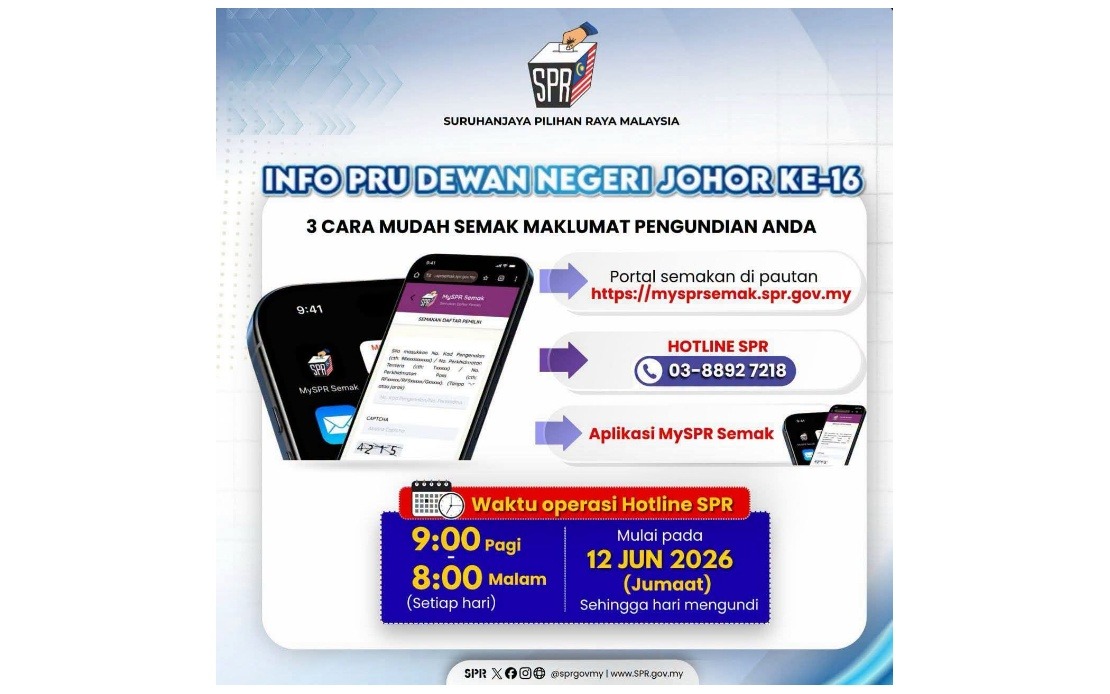
The Election Commission has issued a fresh reminder to registered voters in Johor to confirm their assigned polling stations and voting streams in the days leading up to the 16th state election scheduled for Saturday, July 11. The advisory comes as millions of eligible citizens prepare to exercise their democratic franchise, with the EC emphasising the importance of prior verification to ensure smooth voting procedures on election day.
Voters across the state can access their polling station information through two convenient digital channels: the MySPR Semak online portal or the dedicated MySPR Semak mobile application. This dual-platform approach reflects the Election Commission's push towards digital accessibility, allowing residents to confirm their details from home without needing to visit government offices. The move is intended to reduce confusion at polling centres and enable voters to plan their schedules accordingly.
Approximately 2.7 million ordinary registered voters are anticipated to participate in Saturday's election to select 56 state assembly representatives who will form the next Johor state government. This figure underscores the scale of the democratic exercise and the logistical complexity involved in managing such a substantial voter turnout across diverse geographic and demographic constituencies throughout the state.
Early voting has already commenced, with 19,471 personnel from security forces casting their ballots last Tuesday. This cohort comprised 7,960 military personnel and their spouses alongside 11,511 police officers, including members of the General Operations Force and their families. The early voting mechanism ensures that security personnel, who often work irregular shifts and may be deployed during regular polling day, can fulfil their civic obligations without operational disruption.
The election has attracted substantial political competition, with 172 candidates vying for the 56 available state seats. The major coalitions have fielded complete slates, with both Pakatan Harapan and Barisan Nasional presenting 56 candidates each. Perikatan Nasional has mounted a significant challenge with 33 candidates, while smaller parties and independent candidates round out the ballot. Parti Bersama Malaysia is contesting 15 seats, the Malaysian United Democratic Alliance has put forward four candidates, whilst Parti Orang Asli Malaysia and Parti Sosialis Malaysia are also participating, alongside six independent aspirants.
The diversity of candidates and political offerings reflects broader shifts in Malaysia's electoral landscape. Johor, traditionally a Barisan Nasional stronghold, has seen increasing political contestation in recent election cycles. The presence of multiple coalition groups and independent candidates suggests voters will have meaningful choices, though the outcome will likely depend on how effectively each coalition mobilises its base and appeals to undecided voters in key swing constituencies.
For Malaysian voters, particularly those in Johor, the Election Commission's emphasis on advance verification addresses practical concerns that often arise during polling day. Long queues, confusion over station locations, and administrative delays can suppress turnout if voters are unprepared. By encouraging early confirmation of polling details, the EC aims to facilitate a more efficient voting process where citizens can cast their ballots swiftly and with confidence.
The Johor election carries significance beyond the state level, as it represents a crucial test of political sentiment in one of Malaysia's largest and most populous states. The result will influence calculations at the federal level and may signal shifts in voter preferences regarding governance, economic management, and development priorities. For political analysts observing Malaysian electoral trends, Johor's outcome will provide insights into whether established political coalitions retain voter support or whether emerging alternatives are gaining traction.
Voters should note that the MySPR Semak platform provides not only polling station location information but also details about which voting stream they belong to. Voting streams are used to distribute voter flows across multiple stations and help manage congestion. Understanding one's assigned stream ensures that voters proceed to the correct queue upon arrival at their polling centre, further streamlining the voting experience.
The Election Commission's proactive communication strategy, utilizing both traditional media and digital platforms to disseminate election information, reflects lessons learned from previous electoral exercises. By engaging voters before election day with practical reminders and accessible tools, the EC seeks to cultivate informed participation and reduce administrative friction on the day itself.

