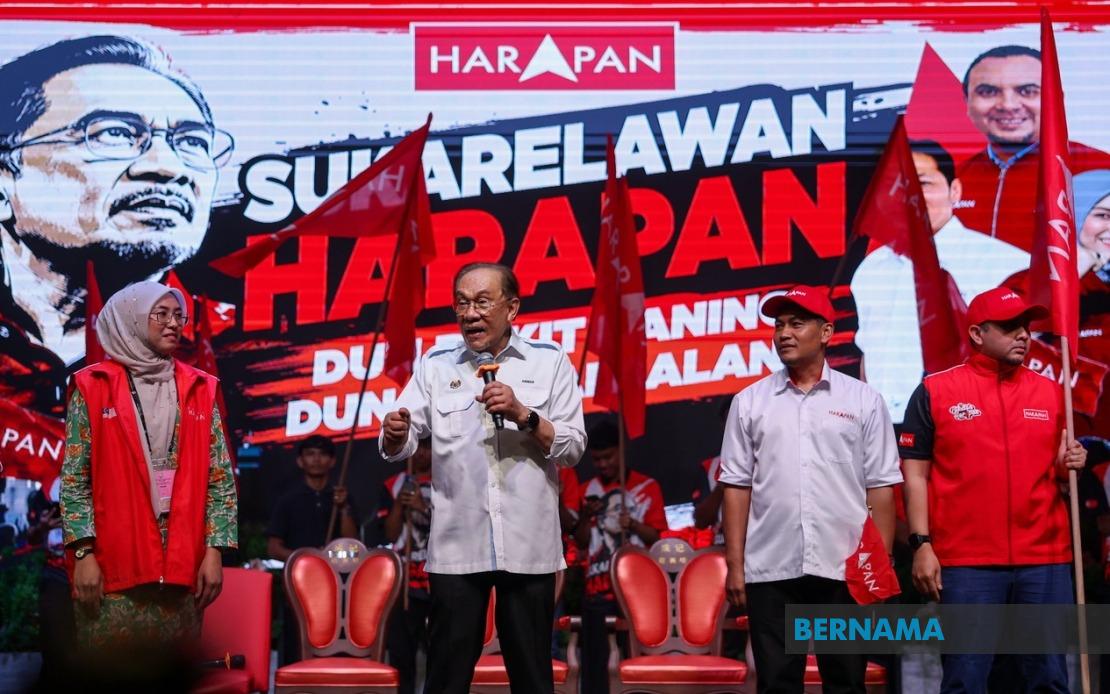
Prime Minister Datuk Seri Anwar Ibrahim has challenged young Johor voters to transcend the persistent rhetoric of racial division that has long characterized Malaysian politics, framing the upcoming state election as a decisive moment for the younger generation to take control of their collective destiny. Speaking in Muar while launching the Bukit Naning state constituency volunteer programme, Anwar positioned the election not merely as a routine political exercise but as a critical juncture where youth could demonstrate their power to reshape the nation's political landscape away from divisive fault lines.
Anwar, who also chairs Pakatan Harapan, articulated a vision where electoral choices would be guided by pragmatic considerations rather than sectarian loyalties. He stressed that voters should evaluate candidates based on their track record and capacity to deliver tangible outcomes in domains that directly impact daily lives—specifically education quality, labour market prospects, and broader infrastructure development. This framing represents a deliberate pivot from the identity-based appeals that have traditionally dominated Malaysian electoral contests, instead attempting to anchor political discourse in material concerns that transcend ethnic boundaries.
The Prime Minister delivered a scathing critique of what he characterized as deliberate efforts to weaponize ethnic anxieties for political gain. He explicitly named the tactic of stoking fear of Chinese Malaysians, cultivating resentment toward Indian Malaysians, and inflaming tensions between Malay and Chinese communities as strategies that serve only to distract ordinary citizens from the self-enrichment occurring at higher echelons of power. This candid denunciation, delivered to a diverse audience that included Malay, Chinese, and Indian youth, underscores growing frustration within PH circles about the efficacy of such narratives in mobilizing voters and their corrosive impact on national cohesion.
Addressing the young Malay, Chinese, and Indian attendees directly, Anwar positioned their generation as capable of rejecting what he termed the "rotten political system" that has perpetuated these divisive tactics. He framed the choice before them not as passive acceptance of established political orders but as an active exercise in agency—a moment to collectively determine which leaders deserve their mandate and which do not. This rhetorical strategy attempts to mobilize youth through appeals to their desire for meaningful change while implicitly challenging them to transcend the generational patterns of their elders.
The visible enthusiasm of younger attendees at the launch event served as a crucial backdrop to Anwar's messaging. The Prime Minister noted with visible satisfaction the unusually strong turnout of young people, characterizing it as evidence of growing awareness and determination among the younger generation to pursue transformative change. He contextualized this moment within his own decade-long political engagement, suggesting that the energy displayed at this particular gathering represented a qualitative shift in youth political consciousness that warranted serious consideration.
The broader context for these remarks involves the 16th Johor state election, scheduled for polling on July 11, with early voting commencing on July 7. A total of 172 candidates are competing for 56 state seats across the state, making this a competitive contest with implications for PH's position in one of Malaysia's most politically consequential states. The election carries particular significance given Johor's historical importance in Malaysian politics and its substantial electoral weight within the federal political system. Among the PH candidates mobilizing youth support are Nazri Abd Rahman for the Simpang Jeram seat and Md Ysahrudin Kusni for the Bukit Naning constituency.
Anwar's exhortation to young people extended beyond individual voting decisions to encompassing broader grassroots mobilization. He urged volunteer activists to penetrate every village, neighbourhood, and district with a consistent message about the capacity for transformative change. This emphasis on ground-level organizing reflects recognition that electoral outcomes depend not merely on media messaging or elite rhetoric but on sustained community engagement and peer-to-peer persuasion, particularly among demographic cohorts potentially sympathetic to calls for political renewal.
The Prime Minister subsequently elaborated on his critique of divisive politics within a framework of national identity and independence. He argued that narratives designed to splinter Malaysia's multi-ethnic fabric have become anachronistic in a nation celebrating decades of independent statehood. These narratives, he suggested, represent relics of an earlier era peddled by political figures resistant to evolution, carrying no legitimate place in contemporary Malaysia. By framing divisive politics as incompatible with mature national identity, Anwar attempts to delegitimize such rhetoric by associating it with backwardness and obsolescence rather than engaging its substantive claims.
Anwar emphasized that poison narratives instructing citizens not to befriend the Chinese, despise Indians, or trust Malays stand fundamentally at odds with the pluralistic coexistence that has underwritten Malaysia's relative stability and prosperity. He credited divine blessing for the nation's continued peaceful multi-ethnic cohabitation and expressed particular optimism about the trajectory suggested by observing contemporary youth who appeared less susceptible to these divisive framings. This appeal to both spiritual gratitude and generational hope attempts to create emotional resonance around his political message while positioning those who perpetuate division as acting against divine will and against the nation's demonstrated strengths.
Crucially, Anwar challenged the younger generation to move beyond passive observation of politics, instead assuming active responsibility for constructing the inclusive future they presumably desire. He rejected the notion that youth could simply remain bystanders in the political process while expecting desirable outcomes to materialize. This framing places considerable burden on young voters to justify their electoral participation through substantive engagement with campaign platforms and community organizing rather than treating voting as a occasional civic duty divorced from ongoing political involvement.
The messaging strategy evident in these remarks reflects Anwar's broader political positioning as champion of generational change and inclusive nationalism in opposition to what PH characterizes as regressive identity politics. By concentrating youth mobilization efforts in Johor—a state critical to federal political balance—PH appears to be testing whether explicit rejection of divisive rhetoric resonates with younger voters sufficiently to translate into electoral gains. The success or failure of this approach in the July 11 election will offer significant insights into whether Malaysian youth are indeed prepared to anchor their political choices in the pragmatic material concerns Anwar emphasized or whether established patterns of ethnic-based voting remain predominant.

