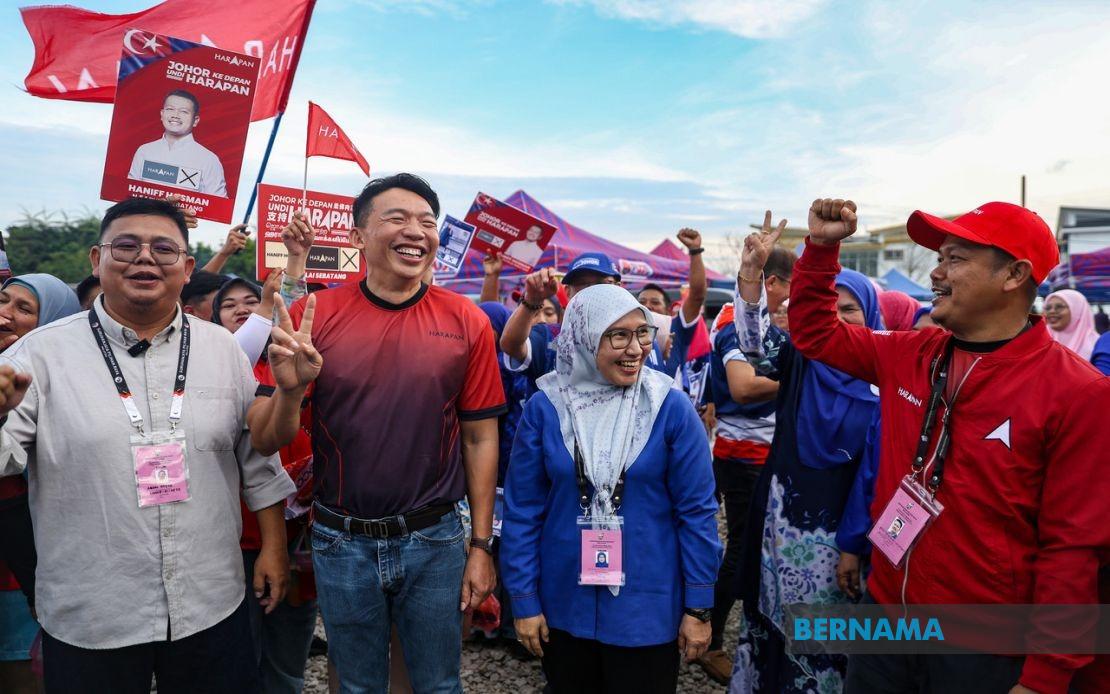
A moment of democratic civility unfolded at the Taman Megah night market in Pontian when candidates from rival political blocs crossed paths during their respective campaign activities on June 29. The encounter between Pakatan Harapan and Barisan Nasional representatives demonstrated the orderly nature of Johor's ongoing state election campaign, capturing the attention of market-goers who witnessed the polite interaction between political opponents.
The meeting involved three PH candidates—Haniff @ Ghazali Hosman contesting Pulai Sebatang, Abd Razak Ismail representing Benut, and Cheah Chee Hong from Kukup—who were conducting a joint campaign walkabout when they encountered Hasrunizah Hassan, the BN candidate for Pulai Sebatang. The potential for tension dissipated quickly as the candidates, despite carrying campaign flags in their respective political colours, exchanged greetings and pleasantries. For onlookers browsing the night market stalls, the scene provided a notable example of how Malaysian political competition can occur without confrontation or discord.
The significance of such encounters lies not merely in their superficial friendliness, but in what they signal about electoral maturity in one of Malaysia's most politically dynamic states. Johor has experienced considerable political volatility over recent election cycles, with power shifting between coalitions and internal political tensions occasionally boiling over. Against this backdrop, the peaceful coexistence of candidates from opposing camps demonstrates a commitment to maintaining civic order during what are typically high-stakes campaigns.
When speaking with journalists immediately after the encounter, Haniff underscored the normalcy of the situation, emphasizing that peaceful campaigning represents the foundation of democratic participation. He noted that the Pontian parliamentary constituency area had maintained calm throughout the campaign period, free from the kinds of heated incidents or confrontations that can mar election seasons. His comments suggested that mutual respect between candidates, regardless of their political affiliations, serves as a stabilizing force during elections when political emotions naturally run elevated.
Cheah, representing the Kukup state seat, used the opportunity to reinforce the PH message to constituents across the three constituencies being contested by his coalition colleagues. His remarks highlighted the collaborative approach that PH has taken in the Pontian area, with multiple candidates working in concert to build support among voters. The unified campaign strategy, combined with the civility shown toward opposing candidates, may reflect PH's efforts to project an image of disciplined, organized governance in a state where they remain a significant political force competing for power.
From the BN perspective, Hasrunizah characterized such chance encounters between candidates from competing parties as an expected and even healthy aspect of modern Malaysian electoral politics. Rather than viewing the meeting as awkward or confrontational, she presented it as evidence of democratic maturity within Johor's political culture. Her statement that the situation remains controlled despite the intensifying campaign rhetoric indicates that both major coalitions have managed to maintain decorum in their public-facing activities.
The observation that encounters between opposing candidates actually energize campaigning efforts, rather than undermining them, reflects a strategic understanding that Malaysian voters increasingly expect political civility. Hasrunizah's reference to campaigning harder for both Barisan Nasional and Maju Johor—the BN-aligned coalition formed specifically for this state election—demonstrates that competitive zeal and respectful conduct need not be mutually exclusive. This nuance matters as Malaysia navigates an era where electoral competition has intensified while institutional safeguards for democratic conduct have occasionally been tested.
The peaceful nature of the Johor campaign extends beyond symbolic gestures between candidates. The absence of major disturbances or untoward incidents across the state represents a collective commitment from political parties, campaign operatives, and their supporters to conduct the election according to established rules and norms. For a state of Johor's political importance—serving as a traditional stronghold for various coalitions and a barometer of national political sentiment—such stability carries significance beyond the immediate state election context.
The backdrop to this election involves substantial stakes for both coalitions. BN and its Maju Johor partners seek to reclaim control of the state government, while PH works to consolidate and expand the influence it has gained in Johor during previous election cycles. Despite these high political stakes, the ability of candidates to interact without tension suggests that competition for power need not translate into social discord or institutional breakdown. This distinction remains important for Malaysian politics, where electoral contests often trigger broader concerns about national stability and social cohesion.
The encounter also reflects the pragmatic reality that candidates typically represent diverse communities with overlapping concerns—economic development, infrastructure, social services—regardless of their party affiliation. In a night market setting, where ordinary citizens gather for commerce and leisure, the visible coexistence of opposing political camps may reassure voters that government remains responsive to public interests irrespective of which party ultimately prevails. This perception of continuity and stability can matter significantly in determining electoral outcomes.
As Johor heads toward the July 11 polling day, with early voting scheduled for July 7, the conduct of the campaign will likely continue to influence public perceptions of the competing coalitions. The willingness of candidates to campaign peacefully while respecting opponents establishes a tone that can filter down through party machinery and volunteer networks. Parties that successfully project discipline and civility during campaigns often benefit from enhanced voter confidence, particularly among centrist and undecided constituencies who prioritize stability and good governance.
The night market moment, modest though it may appear, carries broader implications for how Malaysian politics conducts itself during competitive periods. It demonstrates that strong political disagreement and personal respect need not be in tension, and that electoral democracy functions more effectively when all participants commit to shared norms of civil conduct. As Malaysia continues to navigate complex political transitions and shifting electoral dynamics, such examples of restraint and maturity between political rivals provide valuable reinforcement that democratic competition remains achievable within a framework of mutual respect.

