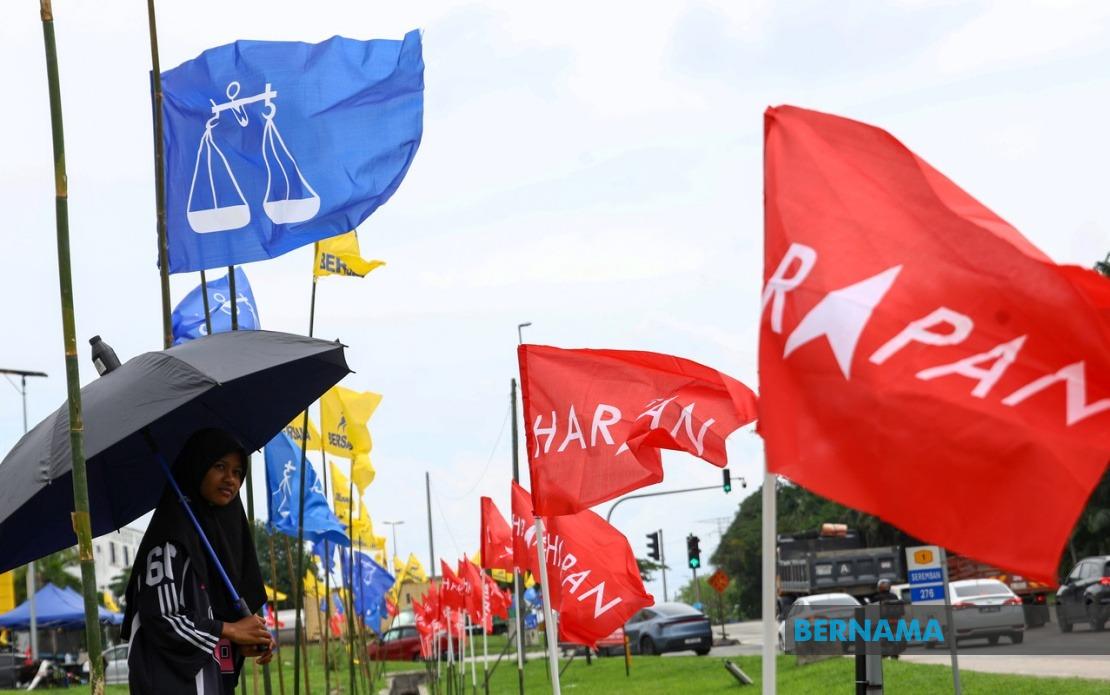
The second week of campaigning for the 16th Johor State Election has revealed starkly divergent strategies between the two main political coalitions contending for the state's 56 assembly seats. As voters prepare to cast ballots on Saturday, July 11, both Pakatan Harapan and Barisan Nasional—each competing across all constituencies—are executing fundamentally different playbooks designed to appeal to the state's electorate.
The strategic divide reflects deeper questions about what contemporary Malaysian voters prioritise. Pakatan Harapan has anchored its campaign around concrete policy responses to immediate household challenges, presenting voters with detailed proposals on wages, housing affordability, employment quality and welfare guarantees. The coalition's manifesto, "Johor For All," represents an attempt to reframe the conversation about development away from headline investment figures and GDP growth towards lived economic outcomes. This approach assumes voters have grown weary of prosperity metrics that fail to translate into tangible improvements in their personal circumstances. For a state where inflation and housing costs have become increasingly pinched middle-class anxieties, the emphasis on wage growth and economic distribution addresses what many families confront daily at supermarket checkout counters and when seeking affordable homes.
Barisan Nasional, by contrast, has mounted a more personality-driven campaign infrastructure. The coalition's decision to prominently feature the return of Datuk Seri Hishammuddin Tun Hussein and Khairy Jamaluddin—both re-entering UMNO's fold through the 'Rumah Bangsa' initiative—signals confidence that senior political figures retain persuasive power among voters. Hishammuddin's prominence carries particular weight in Johor, where his political network and historical influence run deep among traditional BN supporters who may have drifted away during recent political turbulence. His active participation in rallies and campaign events could serve as a confidence signal to UMNO grassroots members whose morale has fluctuated alongside the party's electoral fortunes.
However, political analysts caution against overestimating the impact of even high-profile returnees on today's voting calculations. Dr Mohammad Tawfik Yaakub of Universiti Malaya emphasised that contemporary voters exhibit considerably more sophistication than earlier generations, evaluating campaigns not simply on who delivers speeches but on whether parties present credible candidates backed by substantive policy commitments addressing genuine concerns. The ceramah—the traditional campaign rally—remains a fixture, yet its power to sway voters has diminished markedly as information flows proliferate and public scrutiny of political claims intensifies.
Young voters present a particular challenge for both coalitions, though they may reward BN's star-studded approach more than conventional wisdom suggests. Khairy Jamaluddin's appeal to younger demographics, cultivated through years of consistent positive engagement with that cohort, offers BN a bridge to voters historically resistant to the coalition's messaging. Yet young people today display fundamentally different political behaviours than their parents' generation, rejecting inherited party loyalty in favour of identifying with individual personalities they find credible and relatable. This demographic shift means candidate selection and visibility become increasingly determinative of younger voter behaviour, privileging coalitions capable of fielding figures who command respect beyond partisan circles.
The stark generational difference in voting patterns underscores why both coalitions' strategies carry strategic logic. Barisan Nasional recognises that segments of its traditional support base—particularly older voters who retain stronger party identification—may respond well to the reassuring presence of familiar, established figures. Reinstalling figures who had retreated from frontline politics sends a signal of institutional stability and confidence that resonates with voters seeking continuity. Meanwhile, Pakatan Harapan's policy-forward approach targets voters fatigued by abstract political positioning and demanding concrete evidence that their chosen representatives intend to materially improve their economic circumstances.
The 172 candidates contesting these 56 seats will compete within this broader strategic framework, each campaign attempting to calibrate messaging for their specific constituencies' demographic composition and economic grievances. Johor's diversity—ranging from urban Johor Bahru to manufacturing-dependent areas to agricultural communities—means no single campaign narrative will prove equally persuasive across all constituencies. Some races will pivot largely on policy competence arguments; others may hinge on candidate familiarity or community reputation factors.
Early voting on July 7 and the main polling on July 11 will reveal whether voters respond more convincingly to one coalition's approach. The outcome will likely provide instructive guidance for future Malaysian electoral contests, offering evidence about whether voters prioritise policy substance or personality and institutional continuity when making electoral choices. The Johor election thus transcends state-level significance, serving as a barometer for shifting voter preferences that may determine how national politics evolve across coming cycles.
Both coalitions have committed substantial resources and high-level attention to Johor for good reason: the state's electoral outcome will reverberate across Malaysian politics, potentially signalling whether policy-focused campaigns can overcome incumbency advantages and personality-driven mobilisation strategies, or whether voters remain persuaded by familiar faces commanding established party machinery.

