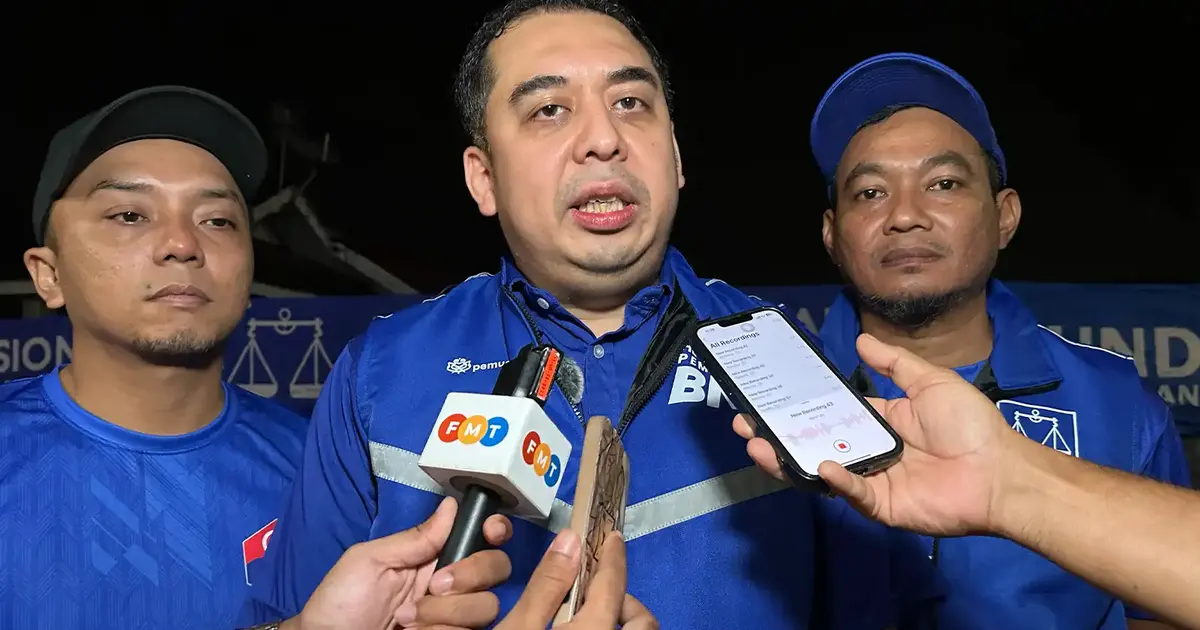
A commanding Barisan Nasional performance in Johor's upcoming state elections would serve as a public mandate supporting reconsideration of former Prime Minister Najib Razak's legal status, according to his son Nazifuddin Razak, even as he stopped short of demanding executive intervention. The younger Razak's remarks reflect ongoing discussions within UMNO and the broader political establishment about the former leader's future, nearly a decade after his conviction in corruption cases that shook Malaysia's political landscape.
Nazifuddin's statement represents a carefully calibrated position that ties electoral outcomes to potential policy shifts regarding his father's circumstances. By framing a BN victory as a popular endorsement, he suggests that voters would be implicitly expressing confidence in Najib's rehabilitation and acceptability within the political fold. This interpretation carries significant weight in Malaysia's majoritarian political culture, where election results are often cited as barometers of public sentiment on contentious issues. The framing effectively transforms a state-level electoral contest into a proxy referendum on attitudes toward Najib's past and future.
However, Nazifuddin's acknowledgment that royal prerogative remains paramount demonstrates awareness of constitutional boundaries and diplomatic sensitivity. In Malaysia's constitutional monarchy, the Yang di-Pertuan Agong holds exclusive authority over matters of clemency and pardons, a power that exists independently of parliamentary support or electoral mandates. This constitutional reality has historically constrained political actors from making direct demands for executive mercy, instead requiring them to frame their positions as expressions of public will or petitions to the throne rather than demands for action. Nazifuddin's careful phrasing respects this constitutional framework while still advancing his family's interests.
The timing of these remarks reflects the intensifying political rehabilitation efforts undertaken by Najib and his supporters since his imprisonment. Following his conviction on corruption charges related to the 1Malaysia Development Berhad scandal, Najib served time in Sungai Buloh Prison before being released in 2023 after serving half his sentence. His lawyers have consistently pursued legal challenges, while his political allies have gradually moved to reintegrate him into public discourse. Recent appearances and statements from Najib himself have tested the boundaries of public tolerance, with mixed reactions from different segments of society and within the ruling coalition itself.
Johor, as Malaysia's southernmost state and a historical BN stronghold, holds particular political significance in assessing the coalition's electoral strength and public support. The state has traditionally served as a barometer for national trends, and strong BN performance there would indeed provide tangible evidence of party confidence and voter backing. Any substantial victory would be interpreted by Najib's supporters as vindication and as validation that the public has moved beyond the scandals associated with his administration. Conversely, a weaker-than-expected result could complicate narratives about his rehabilitation and public acceptance.
The broader implications of linking electoral outcomes to potential clemency create a complex dynamic in Malaysian politics. If successful, this strategy could establish a precedent where electoral performance becomes justification for executive clemency decisions, potentially politicising the pardon process beyond its current scope. This risks further erosion of the separation between political outcomes and judicial or executive mercy decisions, areas traditionally insulated from electoral pressures in democracies with robust rule of law protections.
Within UMNO itself, reactions to Najib's potential rehabilitation remain mixed. While some senior figures, particularly those from Najib's faction, actively champion his cause, others maintain more cautious positions. Younger party members and those concerned with institutional integrity have expressed reservations about appearing to reward a convicted former leader. This internal tension reflects broader concerns within the party about balancing loyalty to a senior figure with commitments to good governance and anti-corruption standards that formed the basis for BN's electoral recovery after 2018.
For Malaysian voters and the wider business community, the question of Najib's status carries implications beyond personal or factional politics. His conviction was widely seen as a landmark moment for Malaysian institutions, demonstrating that high office would not shield individuals from accountability. Any reversal through clemency would signal changing attitudes toward accountability among the political elite. This matters for investor confidence, international perceptions of Malaysia's governance, and the expectations young Malaysians hold regarding institutional integrity.
The involvement of the monarchy in any clemency decision adds another layer of complexity. The Johor throne, occupied by Sultan Ibrahim Iskandar who became Yang di-Pertuan Agong in 2023, carries particular relevance in the dynamics Nazifuddin describes. The king's office has historically maintained careful distance from political pressures, though clemency decisions occasionally occur. Any petition or suggestion that the throne should factor electoral outcomes into clemency deliberations represents an attempt to indirectly influence what should remain an independent constitutional prerogative.
Moving forward, the Johor election will indeed be watched closely as a test of Najib's political rehabilitation prospects and the electorate's appetite for moving beyond the corruption scandals that defined much of the past decade. However, the constitutional reality remains that no election result, however decisive, can determine the sovereign's clemency decision. Ultimately, the throne will decide based on its own assessment of the nation's interests and constitutional propriety, independent of electoral mathematics or factional interests.

