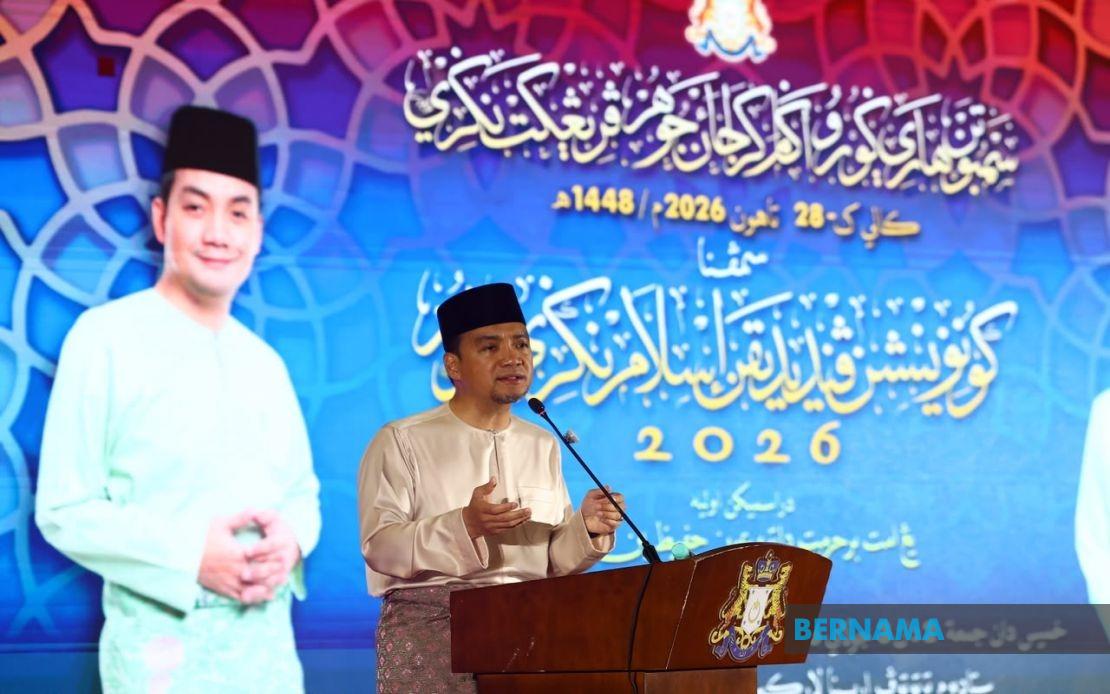
Johor's government is moving beyond conventional secular schooling by extending its transformative SRBJ education framework into the religious education sphere, announcing the creation of the first Sekolah Agama Rintis Bangsa Johor this year. Menteri Besar Datuk Onn Hafiz Ghazi revealed the expansion during ceremonies marking the state's 28th Government Religious Teachers' Day, signalling a significant broadening of what has become one of Southeast Asia's most closely watched state-level education experiments. The decision to integrate Islamic schooling into the pilot scheme reflects growing recognition that Malaysia's dual education system—secular and religious—requires modernisation across both tracks simultaneously.
The SRBJ initiative itself originated from the vision of the Regent of Johor, Tunku Mahkota Ismail, who conceived the programme as a comprehensive response to weaknesses in the state's schooling infrastructure and pedagogical approaches. Since its inception, four pilot schools have already opened their doors: two primary institutions and two secondary schools distributed across Pasir Gudang and Johor Bahru. These establishments, including Sekolah Menengah Kebangsaan Seri Kota Puteri 2, Sekolah Kebangsaan Seri Kota Puteri 4, SMK Tasek Utara, and SK Tasek Utara, now serve as laboratories for testing new educational methods before wider rollout across the state system.
The founding principles underpinning SRBJ centre on five interconnected pillars designed to equip students for a globalised economy and multicultural society. Digital literacy represents the technological foundation, enabling students to leverage contemporary learning tools and develop computational thinking. Multilingual competency ensures graduates can navigate communication across Malay, English, and increasingly Mandarin Chinese contexts—a recognition that linguistic versatility constitutes economic capital in modern Malaysia. Character development and moral education remain central, countering concerns that modernisation might erode values transmission. Teacher empowerment acknowledges that curriculum innovation cannot succeed without investing in professional development and elevating educator status. High-quality facilities complete the vision, providing physical and digital infrastructure that matches international standards.
Extending this framework to religious education through the Sekolah Agama Rintis Bangsa Johor represents a conceptual leap with potentially far-reaching implications. Islamic schools in Malaysia historically operated with less access to digital resources and faced teacher recruitment challenges compared to government secular institutions. By subjecting religious education to the same modernisation logic as SRBJ, Johor aims to demonstrate that Islamic pedagogy and contemporary teaching methods are entirely compatible. The first SARBJ campus in Kota Iskandar will test whether Islamic scholars can effectively integrate multilingual instruction, digital platforms, and modern facilities while maintaining theological rigour and spiritual formation objectives.
State Islamic Religious Affairs Committee chairman Mohd Fared Mohd Khalid confirmed the formal government approval for SARBJ construction, positioning the venture as integral to broadening access to quality Islamic education. This distinction matters because it elevates the initiative beyond theoretical discussion into concrete budgetary commitment and physical infrastructure development. Johor's willingness to allocate resources to religious education modernisation signals that the state views Islamic schooling not as a parallel, separate system requiring different standards, but as part of an integrated educational ecosystem demanding consistent excellence across all institutional types.
The initiative's expansion trajectory now extends into early childhood development, with plans to establish a pilot kindergarten applying SRBJ principles to the foundational learning stage. This downward extension reflects international evidence that educational outcomes are substantially determined by experiences before formal primary schooling begins. By introducing digital literacy concepts, multilingual exposure, and character development at kindergarten level, Johor seeks to embed these competencies from the earliest cognitive phases, creating cumulative advantage throughout students' educational journeys. Few Malaysian states have pursued such comprehensive vertical integration of education reform.
For Malaysian policymakers and educators, the Johor experiment offers empirical data on whether state-level autonomy can drive educational innovation more effectively than centralised national approaches. Malaysia's education system has long grappled with questions of rigidity, insufficient digital integration, and uneven quality across institutions. Johor's willingness to establish pilot schools—accepting short-term inefficiencies for potential long-term learning—contrasts with the nation's typical preference for simultaneous, system-wide implementation of curriculum changes. If SRBJ schools produce demonstrably superior outcomes in student achievement, teacher satisfaction, and employer feedback, pressure could mount on the federal Ministry of Education to adopt similar approaches nationwide.
The timing of this expansion to religious education carries particular significance given ongoing national debates about Islamic education's role in contemporary Malaysia. Conservative voices often frame Islamic schooling as distinct from secular modernisation, while reformers argue that Islamic pedagogy requires updating alongside all other educational domains. Johor's decision to apply the same excellence standards to both systems implicitly positions this as a false dichotomy. The initiative communicates that Quranic studies, Islamic jurisprudence, and character formation rooted in Islamic values can coexist with coding literacy, multilingual fluency, and globally benchmarked teaching practices.
Regional observers will watch closely how SARBJ implementation unfolds because it tests whether Southeast Asia's Muslim-majority nations can simultaneously modernise education and maintain religious identity. Indonesia, Brunei, and Malaysia all face similar policy tensions. If Johor demonstrates that religious schools can adopt world-class pedagogical methods while deepening Islamic knowledge, it provides a model other states and nations might adapt. Conversely, if SARBJ struggles with recruitment, financing, or integration of theological with technical content, it illuminates why dual educational modernisation proves so challenging in practice.
The Regent's educational vision, now materialising across increasingly diverse school types, reflects how Malaysian governance increasingly operates through individual state-level innovation rather than purely national programmes. Johor's capacity to move quickly, pilot new approaches, and expand successful initiatives depends partly on its economic resources and political stability. Replicating such initiatives in less-developed states requires federal support or private investment mechanisms that don't yet exist systematically. Yet if SRBJ and now SARBJ succeed, they could catalyse a broader movement toward localized education innovation within Malaysia's federal structure, fundamentally shifting how the nation develops human capital and prepares citizens for an increasingly complex, technology-driven future.

