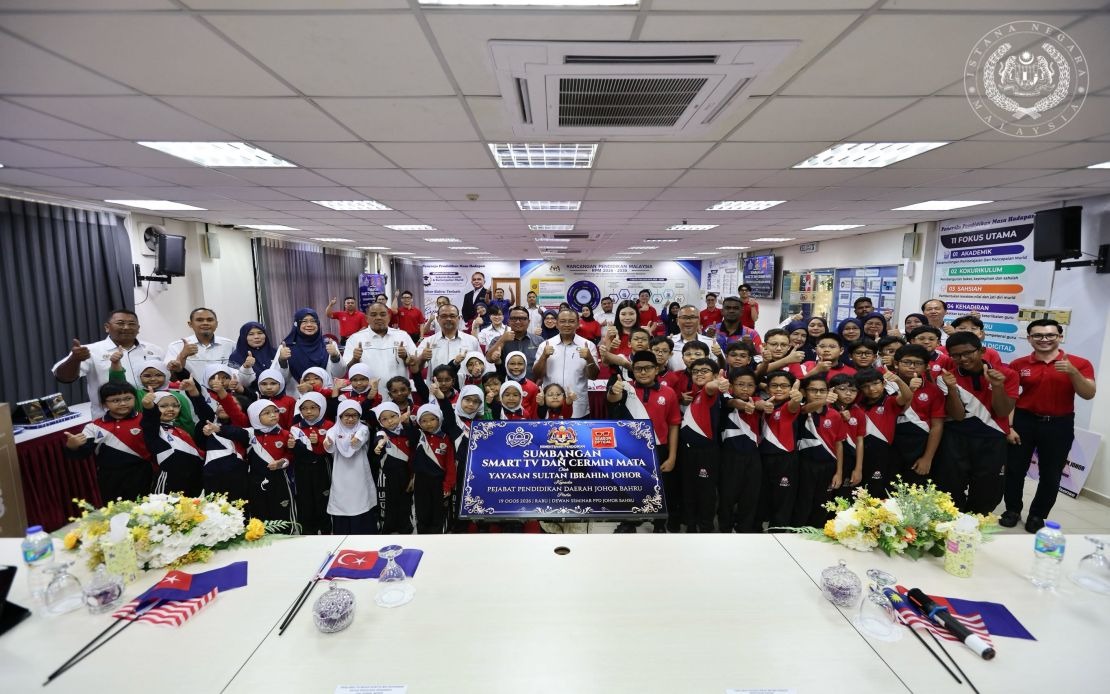
The Yayasan Sultan Ibrahim Johor (YSIJ), the charitable foundation associated with Malaysia's King, has made a substantial contribution to educational infrastructure and student welfare across the Johor Bahru district, delivering 10 large-screen televisions and providing spectacles to more than 2,000 disadvantaged learners. The initiative represents a coordinated effort to tackle two distinct challenges facing schools in the region: the need for modern digital teaching tools and the prevalence of uncorrected vision problems among lower-income students who cannot afford optical care.
The 75-inch smart televisions have been allocated to ten schools within the Johor Bahru District Education Office catchment area, with the explicit purpose of enhancing classroom instruction through digital content delivery. This reflects a broader recognition that access to contemporary technology remains uneven across Malaysian schools, particularly in regions where institutional budgets may be strained. The donation addresses a tangible gap between well-resourced and under-equipped learning environments, enabling educators to incorporate multimedia materials and interactive content into their teaching methodologies.
The spectacle distribution programme has proven more extensive in its reach, with 2,000 pairs of corrective eyewear dispensed to B40 students across twenty schools within the district. This initiative targets a frequently overlooked barrier to academic achievement: uncorrected refractive errors that impair students' ability to engage with classroom materials and participate fully in lessons. For families in the bottom forty percent income bracket, the cost of eye examinations and prescription spectacles often remains prohibitively expensive, forcing children to struggle silently with vision-related learning difficulties.
A defining feature of this year's programme is the deployment of Columba Vision Screener technology, an automated eye-scanning device donated by King Sultan Ibrahim Sultan Iskandar. This equipment represents a technological bridge designed to accelerate the screening process, completing individual vision assessments within ten seconds rather than requiring lengthier conventional examinations. The rapid diagnostic capability substantially increases the programme's capacity to identify vision problems across multiple schools efficiently, reducing the administrative burden on school health coordinators and allowing more students to receive timely referrals for optical intervention.
The spectacles themselves have been sourced through a strategic partnership with Season Optical, a commercial eyewear provider. According to the YSIJ announcement, particular attention has been paid to ensuring that the frames and lenses meet rigorous quality standards and prove appropriate for student use. The emphasis on durability suggests recognition that school-age children require robust eyewear capable of withstanding the wear and tear of daily use, playground activity, and the demands of an active school environment.
The formal handover ceremony took place at the Johor Bahru District Education Office, with YSIJ senior manager Shah Reza Md Kanafe transferring responsibility of the donated items to Johor Education Department officials including Mohd Khatta Muhamad, principal assistant director of the Student Development Sector, and Adnan Samsudin, the chief officer of Johor Bahru's district education office. The presence of Season Optical managing director Sally Loh underscored the private-sector partnership enabling the initiative's scale.
For Malaysia's education ecosystem, particularly in Johor, such initiatives highlight the persistent role of philanthropic intervention in supplementing government provision. While schools receive baseline funding for operations and teaching materials, large-scale technology acquisition and specialised student welfare programmes frequently depend on external support from foundations, corporate partnerships, or royal patronage. The YSIJ's engagement demonstrates how institutional networks can mobilise resources to address specific vulnerabilities within the student population.
The vision-screening and spectacle distribution programme carries particular significance for rural and semi-urban areas within Johor Bahru district, where students may lack ready access to optometry services available in urban centres. By bringing screening technology directly to schools, the programme removes geographical and financial barriers that ordinarily prevent poorer families from accessing eye care. Undetected refractive errors—particularly myopia, hyperopia, and astigmatism—can substantially affect academic performance, classroom participation, and educational outcomes, yet remain invisible to casual observation.
The integration of advanced screening technology with practical spectacle provision represents a holistic approach to addressing educational equity. Rather than simply distributing eyewear without assessment, the Columba Vision Screener enables targeted identification of students who genuinely require correction, reducing waste and ensuring that resources reach those with genuine need. This data-driven methodology contrasts with less sophisticated approaches and suggests growing sophistication in how educational welfare programmes are designed and implemented.
For Malaysian policymakers and education administrators, this initiative offers a case study in multi-stakeholder collaboration. The involvement of the royal foundation, district education authorities, commercial partners, and technology donors demonstrates how coordinated action can scale impact beyond what any single institution could achieve independently. As Malaysia continues to pursue educational excellence and inclusive learning environments, such models—combining technological innovation, welfare support, and cross-sector partnerships—warrant consideration for replication in other states facing similar challenges.
The broader context suggests that addressing educational disparity requires attention to multiple dimensions beyond curriculum and teaching quality. Physical infrastructure, learning tools, and student health services all contribute to creating equitable conditions for academic development. Initiatives like YSIJ's donation thus occupy an important niche in Malaysia's educational landscape, filling gaps that might otherwise persist and potentially constraining outcomes for disadvantaged learners.

