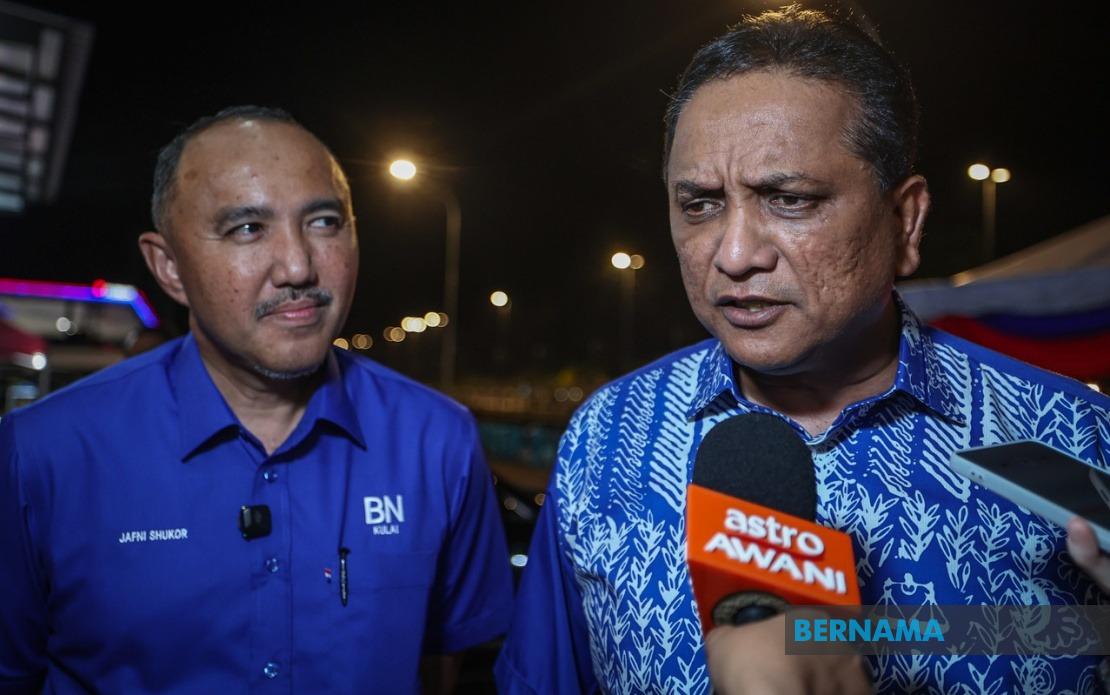
Allegations that Johor's Regent, Tunku Mahkota Ismail, has reduced the state government to a puppet operation have no basis in reality, according to Datuk Seri Reezal Merican Naina Merican, a prominent UMNO Supreme Council member. Speaking in Johor Bahru on June 25, Reezal Merican characterised the accusation as severely exaggerated and insisted that the Regent's public interventions on development matters ought to be understood within the proper constitutional framework rather than misconstrued as overreach.
The controversy emerged following the departure of Datuk Dr Mohd Puad Zarkashi from UMNO. The former Speaker of the Johor State Legislative Assembly cited concerns that Menteri Besar Datuk Onn Hafiz Ghazi had become unacceptably influenced by palace authority, framing the state administration as subordinate to royal directives. Reezal Merican's response positions the Regent's role as a legitimate manifestation of constitutional duty rather than as improper interference in governance.
According to Reezal Merican, the Regent's interventions represent an essential mechanism of institutional oversight. When Tunku Mahkota Ismail articulates positions on Johor's development trajectory, these statements embody his dual obligations: both his prerogative as Regent and his responsibility to advance the welfare of Johor's population. Rather than depicting this as excessive centralisation of authority within palace walls, Reezal Merican frames it as a check-and-balance function that appropriately constrains executive power, including that of the Menteri Besar and senior bureaucratic officials such as the State Secretary.
The timing of these allegations is particularly significant given that Johor is preparing for state elections. The Election Commission designated June 27 as nomination day and scheduled July 11 as polling day, placing the palace-government relationship squarely within the electoral arena. Reezal Merican pointedly questioned Mohd Puad's motivation for raising such concerns at this juncture, suggesting that invoking the royal institution during campaign season amounted to a calculated political manoeuvre designed to influence voters' perceptions.
Within UMNO's internal structure, Reezal Merican claimed, no discussion has emerged suggesting that Johor's party machinery operates as an instrument of palace will. His assertion that he has never encountered such suggestions at the Supreme Council level is designed to reinforce the position that palace-government relations in Johor remain stable and constitutionally sound. This defence becomes increasingly important as UMNO seeks to maintain party cohesion during electoral competition.
The departure of Mohd Puad, a figure with substantial institutional experience in Johor's legislative framework, represents a meaningful fracture within the governing coalition. His willingness to publicly articulate concerns about the balance between executive and royal authority introduces a narrative that could resonate with voters sceptical of concentrated power structures. By casting Mohd Puad's claims as exaggerated political theatre, Reezal Merican attempts to neutralise this narrative's potential electoral impact.
From a constitutional perspective, Malaysian monarchs do retain advisory roles regarding state administration, and these prerogatives vary across the federation's component states. In Johor's case, the Regent's historical prominence in state affairs means that questions about the appropriate scope of royal involvement remain legitimate subjects of public discourse. Reezal Merican's framing, however, suggests that current arrangements reflect proper constitutional balance rather than aberrant palace dominance.
The allegation that palace authority has effectively subordinated the Menteri Besar strikes at the heart of state-level governance legitimacy. If voters believe that elected executives have lost meaningful autonomy, this perception could undermine confidence in the electoral process itself. Reezal Merican's intervention appears designed to reassure the electorate that elected officials retain substantive authority even as they operate within a constitutional environment that includes royal oversight mechanisms.
For Malaysia's broader political landscape, the Johor situation illustrates ongoing tensions between administrative efficiency and institutional balance. As royal households across the federation navigate modernisation pressures and demands for transparent governance, questions about the appropriate scope of monarchical influence on elected governments will likely persist. The manner in which UMNO and state leadership respond to such challenges may establish precedents affecting monarchical-democratic relations throughout Malaysia.
The deployment of palace relationships as electoral ammunition reflects strategic competition within Johor's political ecosystem. Reezal Merican's pushback indicates that UMNO views such allegations as threats to party unity during a critical electoral period. Whether voters accept his reassurances about constitutional propriety or find Mohd Puad's concerns about palace influence more persuasive could significantly shape the election outcome and the subsequent trajectory of state governance.
As Johor approaches its electoral moment, the palace-government relationship has become an explicit campaign issue despite establishment figures' efforts to contain the narrative. The positioning of royal authority as a stabilising force rather than as a constraint on democratic governance reflects deeper questions about how Malaysia's constitutional monarchy should interact with elected institutions at the state level.

