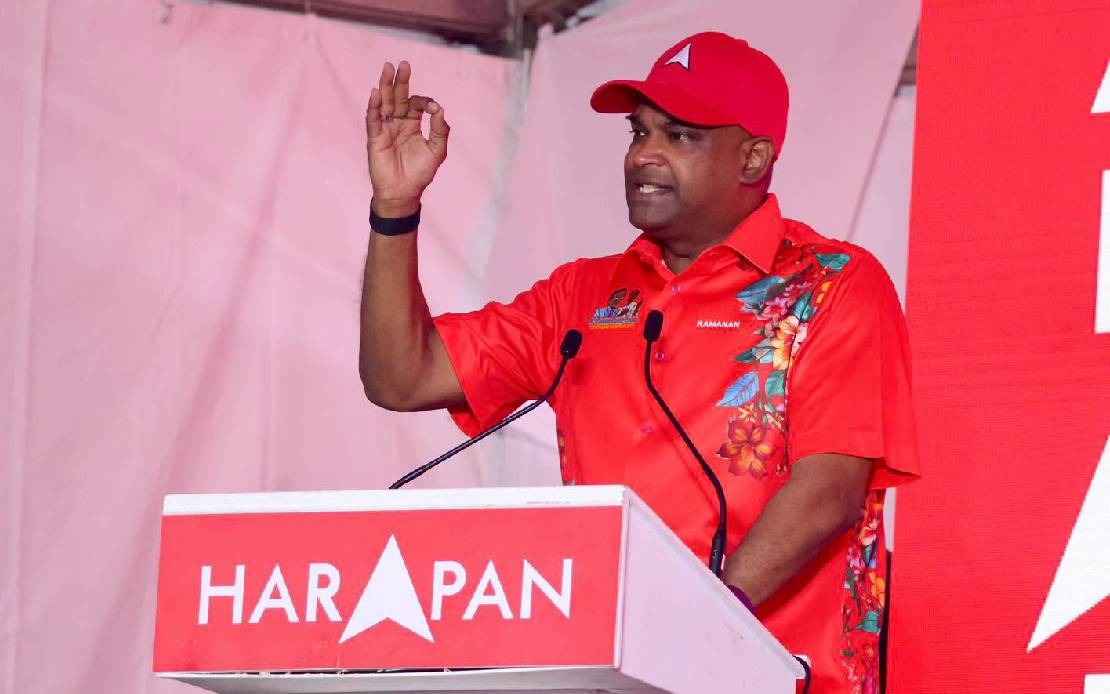
Federal commitment to Johor's development remains unwavering, according to PKR Vice-President Datuk Seri R Ramanan, who emphasised the government's multi-pronged approach to raising living standards across the state. Speaking at the Johor Ke Depan, Undi Harapan roadshow in Simpang Renggam, Ramanan outlined how the administration continues to channel substantial capital into the region through a combination of direct investment, infrastructure expansion, and targeted welfare initiatives designed to reach households at all income levels.
The remarks come as the state gears up for its 16th general election, scheduled for July 11, with early voting set for July 7. A total of 172 candidates are contesting across the state, making this a pivotal moment for both the federal government and the state administration to demonstrate their alignment and ability to execute development agendas. Ramanan's intervention signals a deliberate effort to frame the state election as an opportunity to strengthen governance continuity between Putrajaya and the Johor state government.
Ramanan stressed that the constellation of assistance programmes now in place or under implementation reflects a conscious strategy to distribute national development gains equitably across Johor. His framing suggests that without administrative coherence at state and federal levels, the delivery mechanisms for these programmes could become fragmented or inefficient. This argument forms a central pillar of the Pakatan Harapan campaign pitch to voters, essentially presenting the ballot as a mechanism for removing institutional friction in development delivery.
The roadshow itself served as a platform for coalition unity, with prominent figures including Amanah Secretary-General Faiz Fadzil, PKR Vice-President Datuk Seri Amirudin Shari, and three Pakatan Harapan candidates for the Machap, Benut, and Layang-Layang seats. The gathering underscored how the coalition is attempting to project itself as a cohesive force capable of managing both state and national interests simultaneously, a message particularly resonant in Johor, which has historically served as an economic bellwether for the broader Malaysian economy.
Johor's status as a federal priority reflects its outsized economic importance. The state houses major port facilities, petrochemical installations, and manufacturing clusters that contribute substantially to national GDP and export revenue. Infrastructure investments in such corridors have multiplier effects that extend beyond state boundaries, justifying the federal government's strategic focus. However, Ramanan's remarks also hint at an underlying political calculation: Johor remains a crucial swing state with voting patterns that can shift markedly based on economic conditions and perceived governance competence.
The assistance programmes referenced by Ramanan likely encompass a range of interventions from income support and housing subsidies to skills training initiatives and small business financing schemes. In the context of post-pandemic economic recovery and current inflationary pressures, such programmes take on heightened significance for middle and lower-income households. The government's emphasis on their implementation suggests confidence that these measures are resonating with voters concerned about cost-of-living pressures.
Ramanan's call for voters to grant Pakatan Harapan the state mandate directly links electoral outcomes to administrative efficiency. This argument assumes that voters will prioritise governance alignment over other considerations such as local representation or the performance records of individual candidates. While this may appeal to economically sophisticated urban voters focused on macro-level development outcomes, it may resonate less strongly in rural constituencies where direct, personalised services and local advocacy have historically determined voting behaviour.
The timing of the roadshow, roughly a week before voting, suggests an intensive final push to consolidate support among swing voters. The selection of Simpang Renggam as a venue indicates campaign strategists view the Benut and surrounding areas as electorally competitive. These semi-industrial and agricultural regions have seen demographic shifts that may have altered traditional voting patterns, making them potential battlegrounds.
From a broader Southeast Asian perspective, Johor's election carries implications beyond Malaysia's borders. As a state directly abutting Singapore and hosting significant cross-border trade, labour mobility, and investment, governance stability and development trajectory matter to regional economic networks. A government perceived as capable of delivering infrastructure and maintaining investor confidence in Johor potentially influences wider perceptions of Malaysia's institutional competence and attractiveness as an investment destination across the region.
The emphasis on coordinated federal-state governance also reflects lessons from previous electoral cycles where divided government—with opposition parties controlling state or federal levels—has occasionally led to bottlenecks in infrastructure approval and implementation. By pressing for alignment, the coalition is attempting to frame the choice in technocratic terms: good governance through unified administration versus the risks of bureaucratic friction.
Looking ahead, the outcome in Johor will likely signal which electoral narrative—development delivery and administrative efficiency, or local grievances and anti-incumbency sentiment—carries more weight with Malaysian voters. Should Pakatan Harapan secure a strong mandate, it would validate the coalition's assertion that voters prioritise federal-state alignment and infrastructure progress. Conversely, a weaker showing would suggest that voters' primary concerns lie elsewhere, potentially forcing a reassessment of campaign messaging strategies for future contests.
The state election thus serves as a crucial referendum not merely on state-level governance, but on the federal government's broader electoral coalition and its ability to sustain development momentum in a critical economic region.

