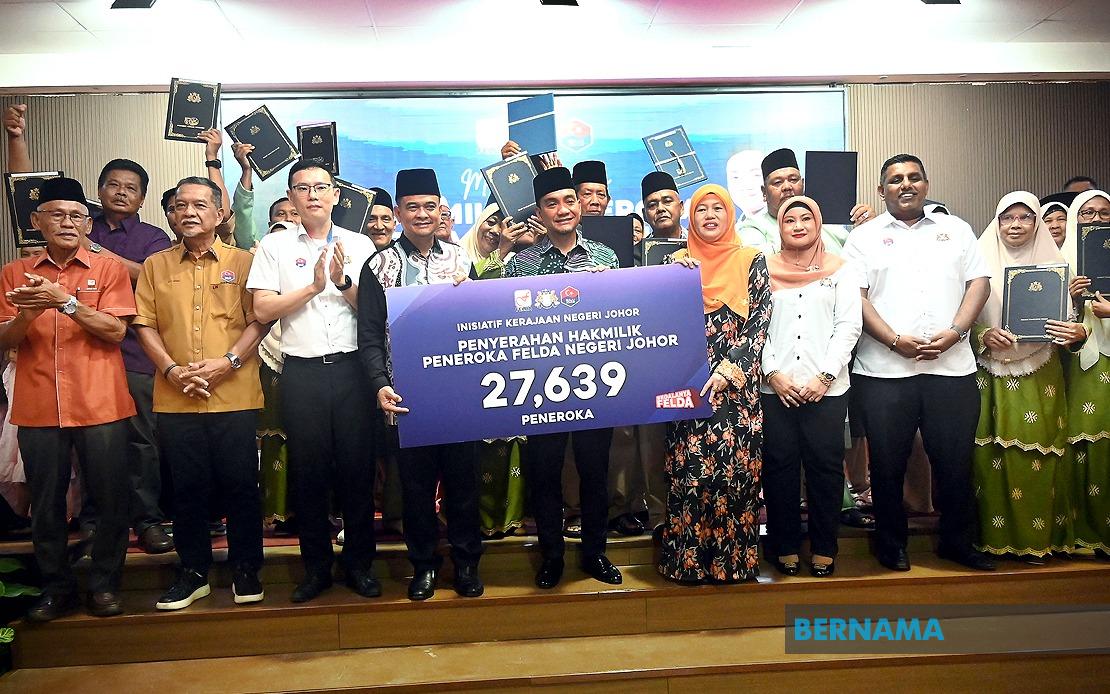
The Johor government has virtually cleared a backlog that has plagued Federal Land Development Authority settlers for years, resolving 27,639 out of 27,642 pending land title applications—a completion rate of 99.99 per cent. The achievement was marked at a ceremony in Kluang on June 23 where Menteri Besar Datuk Onn Hafiz Ghazi presented formal titles to 210 settlers from three districts, bringing closure to a vexing administrative matter that had long clouded land ownership across FELDA schemes in the state.
The resolution of land title disputes carries particular weight in rural Johor, where FELDA settlements have historically served as anchors for agricultural development and community stability. For decades, settlers in these schemes operated with incomplete or ambiguous ownership documentation, a situation that constrained their ability to secure financing, transfer property, or make long-term investment decisions affecting their plantations and homes. The bureaucratic delay reflected broader challenges in Malaysian land administration, where competing claims, incomplete records, and inter-agency coordination issues have routinely delayed title issuance across multiple states.
Menteri Besar Onn Hafiz framed the resolution as evidence of the state government's prioritisation of FELDA communities, characterising the initiative as integral to a wider rural development strategy. His remarks acknowledged that land ownership uncertainty had been a persistent source of concern within these settlements, creating both practical difficulties and underlying anxiety among residents who had invested decades building their enterprises on what they considered their land. The presentation ceremony itself was a public affirmation that the state recognises FELDA settlers as deserving constituencies warranting sustained governmental attention.
The breakdown of resolved applications across three key districts—Kluang, Kota Tinggi, and Mersing—suggests the initiative was geographically comprehensive rather than narrowly focused. These areas collectively represent significant FELDA presence in Johor, with Kluang and Mersing in particular hosting substantial settler populations engaged in oil palm cultivation and other agricultural activities. The geographic spread indicates that title processing occurred across multiple district land offices, requiring coordination between state land authorities and federal FELDA administration—no trivial feat given Malaysia's complex overlapping jurisdictions in land matters.
The presence of Johor's Agriculture, Agro-based Industry and Rural Development Committee chairman Datuk Zahari Sarip at the ceremony underscored that this initiative intersects with the state's agricultural policy framework. Land titles function as essential collateral in rural finance, enabling settlers to access credit for equipment purchases, crop diversification, or infrastructure improvements. By clearing the title backlog, the state potentially unlocks economic activity within these settlements, allowing residents to leverage their land equity for productive investments that strengthen their competitive position in increasingly challenging commodity markets.
Yet the near-complete resolution—with just three applications remaining unprocessed—raises questions about the nature of these three outstanding cases. Whether they involve disputed claims, missing documentation, or inherent complexities suggests that even systematic clearing operations occasionally encounter intractable issues that resist straightforward administrative remedies. The 99.99 per cent figure represents extraordinary success by Malaysian bureaucratic standards, yet the remaining 0.01 per cent may warrant investigation into whether certain settlers face insurmountable obstacles warranting policy intervention or legislative adjustment.
For Malaysian readers across other states facing similar land title challenges—particularly in Peninsular Malaysia's older agricultural schemes—the Johor experience offers a cautionary lesson in how institutional inertia can create decades-long delays affecting real people's economic security. It simultaneously demonstrates that political will can drive resolution if successive administrations maintain consistent commitment and dedicate adequate resources. FELDA schemes in other states, notably Pahang and Perak, harbour populations with comparable grievances, suggesting that this Johor precedent may soon become a template for intervention elsewhere.
The timing of this resolution carries subtle political implications. FELDA settlers represent a traditionally important constituency in Malaysian rural politics, historically aligned with governmental parties and responsive to visible governance achievements. Clearing a long-standing grievance months ahead of potential electoral cycles demonstrates responsive administration while acknowledging past failures—a delicate balance in rural governance where credibility depends partly on rectifying previous governmental shortcomings.
The initiative also reflects evolving Malaysian approaches to rural development, moving beyond infrastructure provision toward systemic resolution of property rights issues that fundamentally constrain rural economic advancement. Secure land titles facilitate not only individual economic mobility but also aggregate productivity growth across agricultural sectors. By removing title uncertainty, the Johor government eliminates a class of transaction costs that have historically suppressed rural competitiveness.
The broader context matters too. FELDA, despite its historical importance as an anti-poverty instrument and rural development flagship, has faced mounting scrutiny regarding financial management and developmental outcomes. Land title resolution projects contribute to restoring institutional credibility by addressing tangible settler grievances that accumulated during periods of administrative neglect. For FELDA settlers themselves, formalised land titles represent not merely bureaucratic documentation but symbolic recognition that their contributions to national agricultural production merit governmental respect and institutional security.