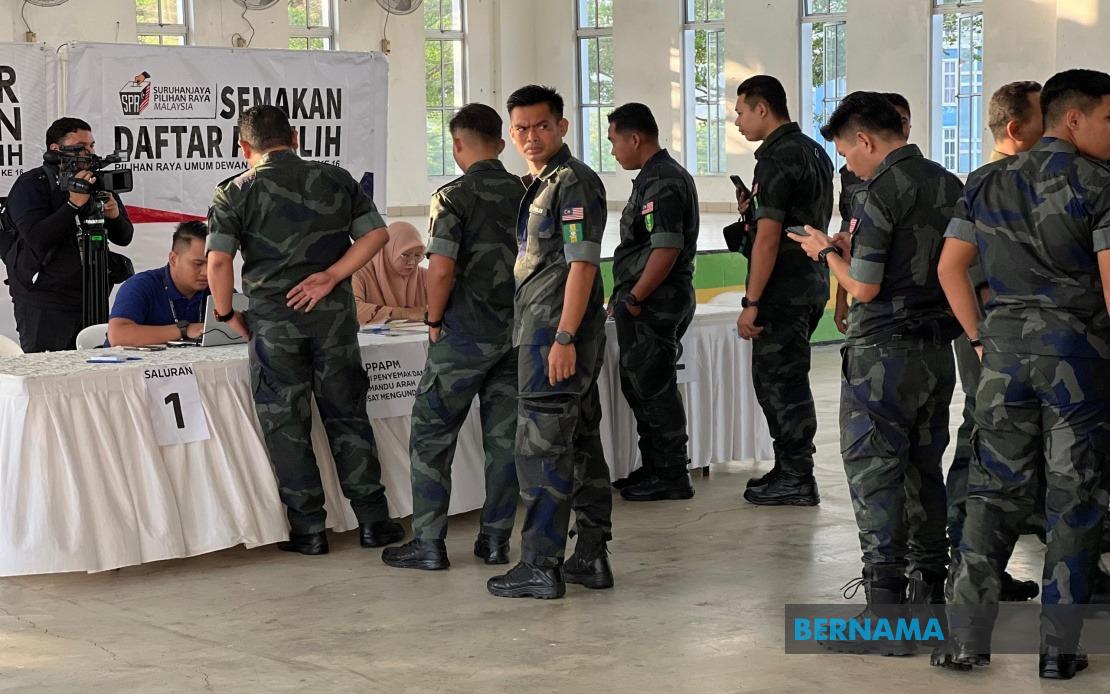
The 16th Johor state election began its early voting phase this morning as the Election Commission opened 64 designated centres across the state to facilitate security personnel ahead of the main election day on Saturday. The process, which commenced at 8 am, was designed to enable members of the Malaysian Armed Forces, Royal Malaysia Police and General Operations Force, along with their spouses, to exercise their voting rights while maintaining operational readiness. This early voting mechanism represents a standard practice in Malaysian elections, recognising that security force personnel often face deployment constraints during normal polling periods.
According to Election Commission data, the early voting exercise accommodated a total of 24,751 eligible voters from these security sectors. The distribution reflected the respective sizes of each uniformed service, with the Malaysian Armed Forces contingent and their spouses comprising 12,041 of the total voters spread across 11 dedicated polling centres. The remaining 12,710 voters, drawn from the Royal Malaysia Police and General Operations Force alongside their family members, accessed voting facilities at 53 additional centres, demonstrating a more dispersed geographical arrangement across the state's districts.
The staggered closing schedule reflected Election Commission protocols designed to manage voting flows efficiently throughout the day. Rather than all centres closing simultaneously, polling stations shut down in phases beginning at noon and continuing until 6 pm, allowing flexibility for voters with varying schedules and reducing congestion at any single closing time. This methodical approach to early voting represents careful administrative planning, particularly important given the large number of voters participating across multiple locations simultaneously.
Weather conditions across Johor remained favourable for voting operations, according to field observations from Bernama journalists stationed in various districts. Reports from areas including Batu Pahat, Muar, Pontian and Tangkak indicated sunny conditions throughout the voting period, which typically supports better voter turnout and operational efficiency at polling centres. Weather factors, while sometimes overlooked in election coverage, can meaningfully influence voter participation rates and the comfort of both voters and election officials managing the process.
The early voting framework exists specifically to accommodate the unique circumstances of Malaysia's security personnel, who cannot always be guaranteed leave during regular polling days. The Malaysian Armed Forces, Royal Malaysia Police and General Operations Force maintain round-the-clock operational commitments that may prevent members from participating during Saturday's main election. By enabling these essential service members to vote before the general election, the Election Commission ensures that their democratic participation is not compromised by professional obligations to the nation.
Saturday's general polling day promises significantly greater participation, with approximately 2.7 million ordinary voters preparing to cast ballots across 56 state seats in Johor. This represents the state's broader electorate exercising their choice in determining representation for the next legislative term. The scale of Saturday's election dwarfs the early voting numbers, indicating that the security personnel voting today represent a distinct but numerically smaller segment of Johor's total eligible voters.
The logistics of managing 64 early voting centres simultaneously underscores the Election Commission's operational capacity and planning sophistication. Each centre required proper staffing, security arrangements, voting materials and administrative oversight to ensure compliance with electoral standards and security protocols. The coordination required across multiple locations, involving different security branches and their respective institutional structures, demanded substantial preparation and inter-agency cooperation.
For Malaysian elections generally, the existence of separate early voting mechanisms for security personnel reflects a practical recognition that democratic participation and national security concerns must be balanced thoughtfully. Rather than exempting these voters entirely, Malaysia's approach integrates them into the electoral process through alternative timing arrangements. This philosophy underpins both the early voting framework and broader Malaysian electoral administration.
The Johor election carries particular significance within Malaysia's political landscape, given the state's historical importance and the competition for control of its state assembly. The early voting exercise for security personnel, while procedurally routine, forms the opening chapter of what promises to be a closely watched electoral contest. Saturday's results will reveal voter preferences across 56 constituencies and potentially reshape Johor's political direction for the next term of government.
As the early voting process concluded across the state's 64 centres, election officials began preparations for the main polling day, ensuring that materials, staffing and security arrangements would be in place for the anticipated turnout of millions of voters. The successful completion of early voting serves as both a practical necessity for security personnel and an operational validation of the Election Commission's processes and procedures, setting the stage for Saturday's much larger democratic exercise across the state.

