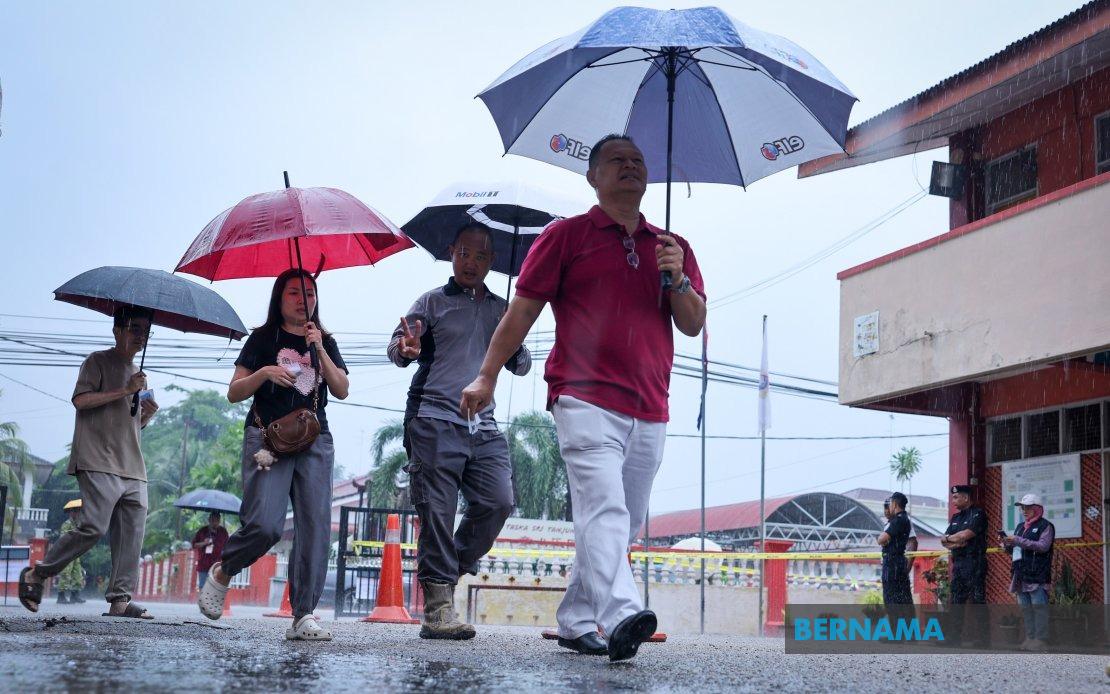
Voting in Johor's 16th state election unfolded smoothly on July 11 despite patchy weather, with most of the state enjoying clear skies while the southern Muar district battled persistent downpours from early morning. The contrasting conditions across Johor's geography did not significantly impede voter participation, with election officials reporting steady streams of citizens exercising their democratic rights across the state's 1,076 polling stations.
Election Commission personnel, police and media representatives were stationed at polling venues well before the 8am opening, establishing the logistical infrastructure required for a coordinated nationwide election exercise. Field observations from major urban and rural centres revealed organised queuing and smooth administrative processes, suggesting the EC's planning and deployment of resources across Johor's diverse terrain had been effective. The early morning presence of election machinery at locations such as Sekolah Kebangsaan Seri Pantai in Mersing and Dewan Raya Taman Ungku Tun Aminah in Johor Bahru indicated comprehensive preparation across both developed and peripheral voting areas.
Mersing's Sekolah Kebangsaan Seri Pantai exemplified the positive conditions characterising much of the state, with crystalline morning light accompanying early arrivals including elderly voters and persons with disabilities who typically utilise priority voting windows. The consistent pleasant weather reported across multiple urban venues including SMK Senggarang in Batu Pahat and SJKC Kulai in Kulai created conditions conducive to sustained voter participation throughout the day. These favourable circumstances stood in marked contrast to the meteorological challenges facing Muar's voting population, where heavy precipitation persisted from predawn hours through the morning polling period.
The rainfall in Muar, whilst substantial, demonstrated the resilience of voter behaviour in Malaysian elections. Polling centres in the district, including SJKC Limbong and Sekolah Kebangsaan Ismail 1, recorded determined turnout despite the inclement weather, reflecting the priority many citizens assign to electoral participation regardless of environmental obstacles. The difference in weather patterns across Johor's distinct geographic zones—from the coastal eastern districts to the interior agricultural regions—underscored the scale of logistical coordination required for statewide simultaneous polling.
Approximately 2.7 million eligible voters participated in the exercise to select representatives for 56 contested state assembly seats across Johor. The sheer number of voters, combined with the need to manage 1,076 separate polling locations with security, administrative oversight, and vote-counting protocols, represented a significant operational undertaking. The Election Commission's decision to stagger polling station closing times according to local administrative schedules reflected pragmatic accommodation of Johor's diverse settlement patterns, from densely populated urban constituencies to dispersed rural communities requiring extended access periods.
One hundred and seventy-two candidates competed for the 56 state seats, representing multiple political coalitions and independent hopefuls vying for voter favour. This candidate density—approximately three contenders per contested seat—reflected the competitive intensity of electoral politics in Johor, Malaysia's second-largest state and economically significant territory within the federation. The diverse slate of candidates encompassed established political parties, emerging movements, and independent aspirants, providing voters with ideological and personality-based choices spanning the political spectrum.
Preceding this election, the state legislative assembly had been dissolved on June 1, triggering the electoral cycle and formal campaign season. At the time of dissolution, Barisan Nasional held commanding dominance with 40 of the then-sitting seats, establishing it as the presumptive frontrunner for the election. Pakatan Harapan's 12 seats represented the principal opposition grouping, while Perikatan Nasional's three representatives and MUDA's single assemblyperson constituted smaller parliamentary presences. This pre-election distribution provided context for understanding the anticipated post-election composition and potential coalition-building scenarios that would shape Johor's governance structure for the subsequent electoral term.
The separation between voting and counting procedures—with immediate tallying commencing once polling stations closed—ensured results would emerge the same evening, maintaining public attention and media focus on the election outcome. This compressed timeframe between voting closure and result declaration compressed the period of uncertainty and speculation, enabling rapid political response and coalition negotiations should they become necessary. The EC's determination of staggered closing times acknowledged practical requirements whilst maintaining the principle of simultaneous statewide elections, a foundational element of Malaysian electoral practice.
For Malaysian political observers and regional analysts monitoring Johor's electoral dynamics, the state election carried significance beyond its immediate territorial scope. As one of Malaysia's most populous states and an economic powerhouse contributing substantially to national GDP, Johor's governance arrangements influence federal-state relations, policy implementation capacity, and the overall trajectory of Malaysian politics. The interplay between BN's historical dominance, PH's challenge to that dominance, and the emergence of PN and other actors reflected broader realignments within the Malaysian political ecosystem that the Johor results would either reinforce or disrupt.

