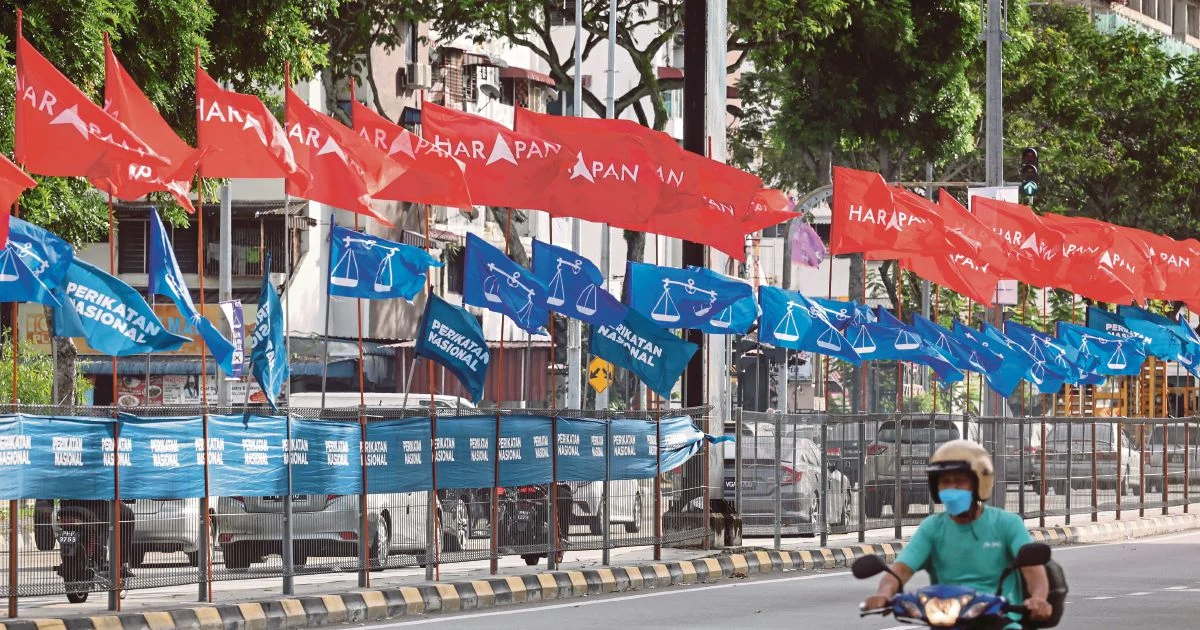
The upcoming Johor state election is poised to become a battleground where Malaysia's three major political blocs will vie for dominance, with multiple contests expected to emerge across 33 of the state's 56 parliamentary seats. This multi-cornered competition reflects the increasingly fragmented nature of Malaysia's political landscape, where no single coalition can rely on a clear path to power in the country's second-largest state by population.
The emergence of concurrent three-way fights in nearly 60 per cent of Johor constituencies signals a fundamental shift in the state's electoral dynamics. Historically, Johor has been dominated by Barisan Nasional, which maintained an iron grip on the state government for decades before the 2018 political tsunami briefly disrupted that pattern. The current configuration suggests that voters in these marginal and competitive seats will exercise unprecedented influence in determining the outcome, with victory margins potentially narrowing to just hundreds or thousands of ballots in tightly contested constituencies.
Barisan Nasional's presence in these three-way contests reflects its continued efforts to reclaim former strongholds following its federal electoral losses in recent years. The coalition, anchored by the United Malays National Organisation, remains the establishment force in Johor and retains significant organisational machinery and grassroots networks. However, the presence of two competing coalitions in the same seats indicates that BN's historical advantage has been substantially eroded, requiring the coalition to mount more aggressive and targeted campaigns to persuade voters of its relevance in contemporary Malaysian politics.
Pakatan Harapan's participation in these competitive races underscores its ambition to consolidate gains made in urban and semi-urban areas while expanding into traditional BN heartland. The opposition coalition, which briefly governed Malaysia between 2018 and 2020, has built momentum through successive electoral campaigns and maintains appeal among younger voters and those seeking political change. In Johor specifically, PH's performance in the 2023 general election demonstrated pockets of support even in regions considered BN bastions, providing a foundation for the state election campaign.
Perikatan Nasional's involvement in these contests represents perhaps the most significant variable in the three-way dynamic. The relatively newer political alignment, which includes the Malaysian Islamic Party and Bersatu, has cultivated a substantial following particularly among rural and Malay-Muslim voters. PN's federal government involvement and regional governance in several Malaysian states have given it institutional credibility that extends Johor's political competition beyond the traditional BN-versus-opposition binary that characterised previous elections.
The distribution of three-way contests across 33 seats carries important implications for seat allocation and ultimate government formation. Races with three competitive candidates typically result in lower victory margins, meaning that even incremental swings in voter sentiment or localised campaign effectiveness can determine individual outcomes. This fragmentation creates scenarios where the overall state-level vote share may not translate proportionally into assembly seats, a dynamic that has become increasingly apparent in Malaysian elections during the past five years.
Geographic patterns in these contests will likely reflect significant regional variation across Johor's 56 constituencies. Urban areas such as those surrounding Johor Baru city and Skudai may witness more developed three-way competitions as urban voters demonstrate greater fluidity in their political preferences. Conversely, rural constituencies and those in the interior regions may feature more traditional BN-versus-opposition dynamics, with third-party intervention less pronounced. This geographic segmentation means that election outcomes could diverge significantly across different parts of the state.
The timing of Johor's state election within Malaysia's broader political calendar also merits consideration. Coming after the 2023 general election, the Johor campaign will serve as a crucial barometer of voter sentiment regarding coalition performance at both federal and state levels. Voters unhappy with the current federal administration, whether PH-led or involving other configurations, may express dissatisfaction through state-level voting patterns. Conversely, some voters may reward stability or punish perceived instability depending on how political conditions evolve during the campaign period.
Candidate selection will prove critical in these three-way contests, as local personalities and individual track records often dominate voter calculus in marginal seats. All three coalitions face the challenge of fielding candidates who possess both organisational party credentials and genuine community connection. In constituencies where three serious candidates compete, even relatively unpopular candidates cannot be abandoned without risking seat loss, placing premium on campaign discipline and voter mobilisation efficiency.
The financial and organisational dimensions of campaigning across 33 three-way contests will strain resources for all participating coalitions. Campaigns cannot simply concentrate efforts in safe seats; instead, all three blocs must maintain presence across the battleground constituencies to avoid ceding ground by default. This dispersed campaign strategy contrasts with previous elections where resources could be concentrated in a smaller number of genuinely competitive seats, potentially affecting campaign quality and voter outreach depth.
Looking beyond electoral mechanics, the prevalence of three-way contests reflects deeper changes in Malaysian voter behaviour and coalition construction. Traditional party loyalty has weakened, particularly among younger cohorts, while issue-based and personality-driven voting has increased. Johor voters, while retaining some deference to historical BN dominance, have demonstrated growing willingness to consider alternative political options when dissatisfied with incumbent performance. This attitudinal shift explains why previous BN strongholds now host competitive three-way races where alternative candidates previously would have been marginalised.

