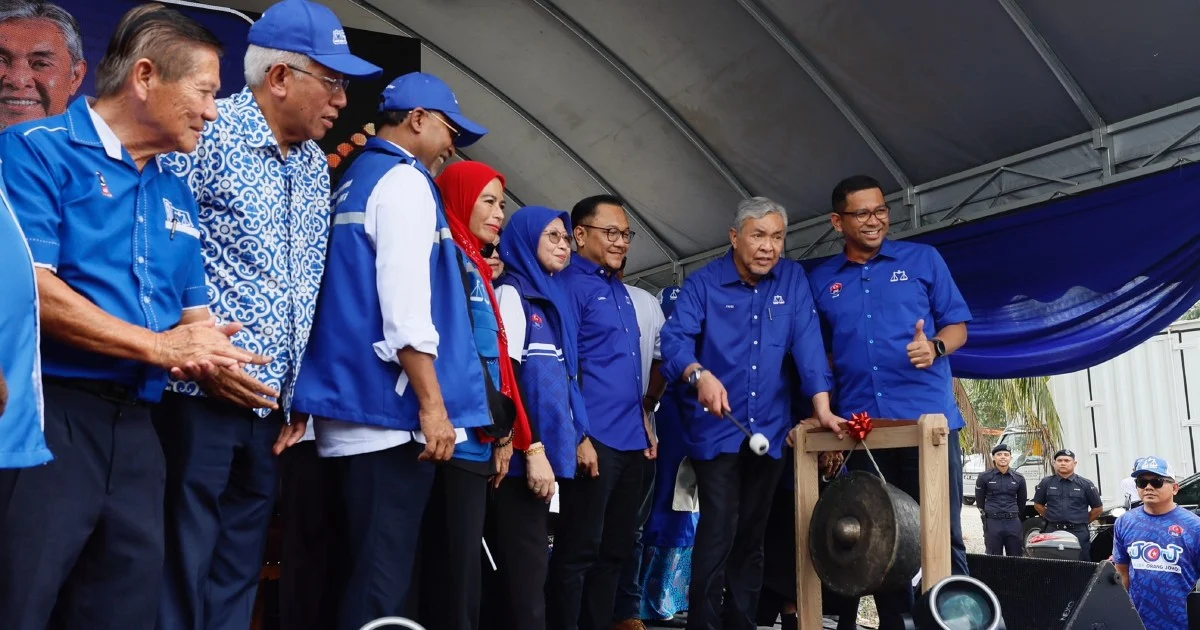
Datuk Seri Dr Ahmad Zahid Hamidi has issued a pointed call to Pas, demanding the Islamist party translate its public commitments into tangible grassroots action to back Barisan Nasional candidates competing in the Johor state election. Speaking in Batu Pahat, the UMNO deputy president underscored a widening gap between rhetoric and delivery in the coalition's arrangement, signalling frustration with what he perceives as insufficient mobilization by Pas members on the ground.
The challenge reflects underlying tensions within BN's broader coalition strategy, where the inclusion of Pas—a party with deep roots in Peninsular Malaysia's conservative Muslim voter base—represents both opportunity and complexity. Pas's decision to align with BN marked a significant political realignment, yet its execution at the grassroots level has proven uneven, creating friction between coalition partners seeking to maximize electoral gains in Johor, traditionally a BN stronghold.
Zahid's intervention carries particular weight given UMNO's traditional dominance in Johor politics and its expectation of commanding performance from allied parties. The state remains strategically crucial for UMNO's broader federal ambitions, and any perceived shortfall in Pas's commitment could undermine the coalition's consolidated vote-sharing objectives. His remarks suggest UMNO leadership believes Pas cadres must move beyond public declarations to actively convince their supporters—a predominantly rural and small-town Muslim electorate—to vote for BN candidates across the board.
The dynamics at play in Johor elections reflect a broader realignment within Malaysian politics following the collapse of the Pakatan Harapan government and subsequent shifting alliances. Coalition politics in Malaysia increasingly depends on inter-party trust and efficient vote mobilization, particularly when smaller parties join larger blocs. Pas's historical strength among conservative voters in certain constituencies gives it considerable influence over electoral outcomes, making its cooperation essential for BN's election strategy.
Zahid's public rebuke, delivered in a key electoral zone, signals to Pas leadership that platitudes will not suffice and that measured performance will be evaluated transparently. This kind of pressure from dominant coalition partners is common in Malaysian politics, where informal hierarchies dictate resource allocation and strategic positioning. UMNO, as the largest BN component, naturally expects alignment from junior partners and tends to express dissatisfaction when ground operations appear insufficient.
The Johor state election carries implications extending beyond state-level governance. Electoral performance here influences factional dynamics within UMNO itself, affects confidence in BN's broader coalition project, and potentially impacts national-level political calculations. Success in Johor would validate UMNO's rehabilitation strategy following several years of political turbulence and judicial proceedings against senior figures including Zahid himself. Conversely, underperformance could invite criticism from party rivals and coalition skeptics.
Pas's internal capacity to mobilize supporters hinges partly on its organizational depth and partly on whether rank-and-file members view the BN alliance as genuine or transactional. The party's dual identity—as both an opposition force in federal politics and a coalition partner in certain states—creates complexity in messaging. Pas leaders must convince their supporters that cooperation with BN serves Islamic interests and constitutional concerns, not merely electoral expedience.
Johor's electoral landscape features distinct geographic and demographic zones. Urban areas and established suburban constituencies present different mobilization challenges than rural districts, where traditional community networks and religious institutions often shape voting patterns. Pas's comparative advantage lies particularly in rural constituencies with significant Muslim populations, making its ground performance disproportionately consequential for overall BN outcomes across these areas.
Zahid's statement also carries implications for how BN manages coalition partnerships going forward. If Pas fails to deliver the vote mobilization BN expects, UMNO may reassess the partnership's value and consider alternative arrangements. Conversely, if Pas demonstrates effective grassroots organization, it strengthens its claim to influence within coalition decision-making and resource distribution for future elections.
The tension between UMNO and Pas within BN illustrates the perpetual challenge of managing ideologically diverse coalition partners toward unified electoral goals. While both parties oppose Pakatan Harapan and seek to preserve conservative, Bumiputera-focused governance, their organizational cultures and strategic outlooks differ substantially. UMNO's secular-nationalist framework contrasts with Pas's religious-focused approach, and these differences occasionally surface in public disagreements about priorities and implementation.
Looking ahead, Johor's electoral outcomes will offer concrete evidence of whether coalition partnerships can function effectively at scale or whether Malaysian politics remains prone to fragmentation when diverse groups attempt coordinated action. Zahid's challenge to Pas will be measured against actual voter turnout, constituency-by-constituency results, and broader BN performance, providing stakeholders with clear data about coalition functionality and each party's contribution to collective success.

