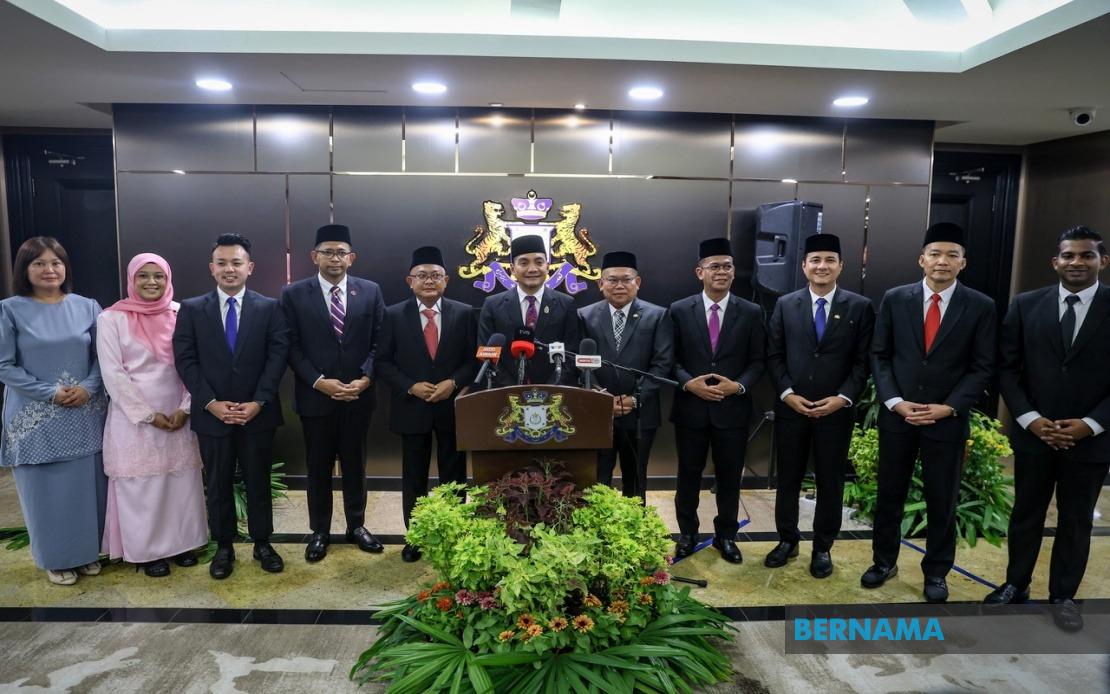
Johor's government has moved to expand its administrative capacity by appointing 10 deputy chairmen to its State Executive Council committees, a decision announced by Menteri Besar Datuk Onn Hafiz Ghazi in Iskandar Puteri on July 22. The structural enhancement reflects the state's recognition that its increasingly ambitious development programme requires a broader base of experienced leadership to manage complexity across multiple portfolios and district-level operations.
The restructuring addresses a practical governance challenge facing many state administrations: as policy ambitions grow and implementation becomes more intricate, the existing committee structure can become a bottleneck. By introducing deputy committee chairs, Johor is creating a parallel tier of accountability and operational oversight that should theoretically allow for faster problem resolution and more intensive monitoring of individual projects without overwhelming the principal committee chairs. This represents a calculated expansion of the executive layer rather than a wholesale reorganisation.
Onn Hafiz framed the appointments within Johor's broader strategic narrative, linking them explicitly to the state's vision of achieving developed status by 2030 under the 'Maju Johor 2030' framework and the accompanying Johor Economic Transformation Plan. These are not cosmetic changes, the Menteri Besar suggested, but necessary infrastructure investments for steering the state through an increasingly demanding implementation phase. As major infrastructure projects, industrial diversification initiatives, and social transformation programmes gather momentum simultaneously, the coordination challenge intensifies, necessitating additional administrative bandwidth.
The appointments have received formal consent from the Regent of Johor, Tunku Mahkota Ismail, a procedural requirement that underscores the significance of the structural change. In Malaysian state governance, such ceremonial approval reflects the constitutional role of the ruler and adds legitimacy to administrative decisions. This consent requirement also signals that the appointments are not merely bureaucratic shuffling but represent considered decisions involving the palace's awareness and endorsement.
Operationally, the deputy committee chairmen are expected to function as enablers and expeditors rather than policy formulators. Their primary responsibilities centre on deepening engagement with field-level implementation, coordinating between government departments and agencies, and creating channels for grassroots feedback. Onn Hafiz stressed that deputy chairs must work in close partnership with their committee counterparts, emphasising that the expansion creates collaborative relationships rather than parallel hierarchies that might generate turf conflicts or duplicative effort.
For Malaysian states seeking to improve governance outcomes without undertaking major constitutional or structural overhauls, the Johor model offers a pragmatic template. The approach assumes that bottlenecks in service delivery often stem not from policy deficiency but from insufficient management capacity to oversee diverse implementation portfolios. By distributing oversight responsibilities across a wider leadership network, the state theoretically improves responsiveness to public concerns while maintaining clear reporting lines and accountability chains.
The emphasis on reaching grassroots communities represents an implicit acknowledgment that previous implementation mechanisms may have struggled to translate state-level policy into neighbourhood-level results. Each deputy committee chair becomes, in effect, a bridge between bureaucratic planning and community outcomes, tasked with ensuring that major government initiatives actually manifest as tangible service improvements or development benefits at the district level where citizens experience governance directly. This reflects lessons learned from the challenges of translating ambitious state programmes into consistent ground-level delivery.
Johor's decision also carries implications for broader Malaysian governance trends. As federal and state governments pursue increasingly complex economic transformation agendas, similar capacity expansions may prove necessary across other states. The success or failure of Johor's experiment in distributing leadership responsibilities could influence how other administrations structure their own executive teams, particularly those pursuing time-bound development targets comparable to the 2030 vision.
The appointments carry inherent expectations of significant workload and responsibility. Onn Hafiz described the positions as matters of substantial trust, language that carries both motivational weight and implicit warning about performance standards. The deputy chairs will face scrutiny regarding whether their appointment actually accelerates problem resolution and improves service delivery, or whether they become superfluous additions to an already layered bureaucracy. Success ultimately depends on whether the structure creates genuine operational leverage or simply multiplies approval processes.
The timing of the announcement, during the mid-phase of Johor's JETP implementation, suggests that the state government has identified practical constraints in its current administrative architecture that are slowing execution. Rather than waiting until 2030 approaches with outstanding deliverables, the proactive restructuring attempts to address implementation challenges while sufficient time remains for the new arrangements to demonstrate their value and make necessary adjustments.
Looking forward, the effectiveness of this governance innovation will depend substantially on the calibre of individuals appointed, their ability to navigate state bureaucracies pragmatically, and their commitment to facilitating rather than obstructing. In governance structures, titles matter less than the actual working relationships and political dynamics that determine whether additional layers accelerate progress or create friction. Johor's success in achieving its 2030 targets may ultimately hinge less on having ten deputy committee chairs than on whether those individuals receive the autonomy, resources, and political backing necessary to function as genuine force multipliers across the state's development machinery.

