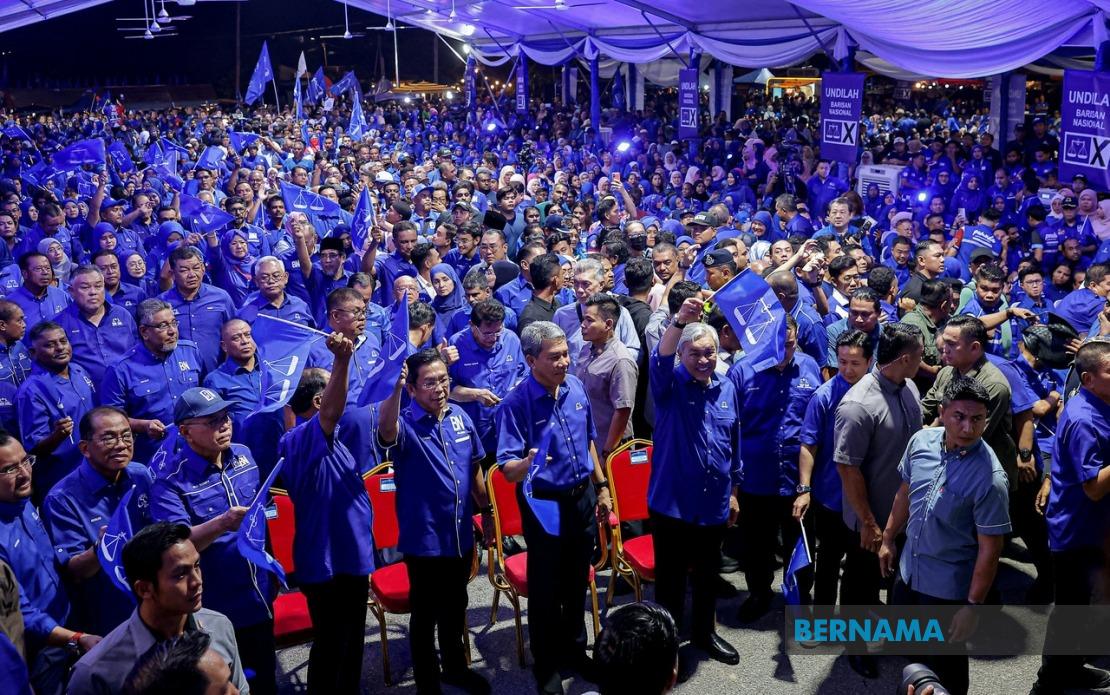
Barisan Nasional should harness the momentum from its sweeping Johor state election triumph to capture victory in Negeri Sembilan's upcoming polls, coalition chairman Datuk Seri Dr Ahmad Zahid Hamidi declared at the campaign machinery launch in Seremban on Tuesday. The UMNO president emphasized that the coalition's decisive performance in Johor, where it captured 48 of 56 state assembly seats and secured nearly 60 per cent of the popular vote, provided both inspiration and a strategic template for replicating success in the smaller state.
Ahmad Zahid's call to action came during BN's formal launch of its election machinery and candidate announcements for the 16th Negeri Sembilan state election at Tuanku Abdul Rahman Stadium in Paroi. The event underscored the coalition's determination to reverse its 2023 performance in Negeri Sembilan, when it secured only 14 of the state assembly seats, signalling that the upcoming August polls represent a critical opportunity for organizational renewal and electoral recovery across the peninsula's central region.
The coalition chairman attributed Johor's historic breakthrough to unprecedented internal cohesion, describing how BN members operated as an integrated force rather than competing factions. This unity, he argued, transcended individual political interests and created a shared sense of purpose that voters recognized and rewarded. Ahmad Zahid specifically highlighted the importance of complementary teamwork, where coalition partners leveraged each other's organizational strengths rather than duplicating efforts or creating redundant power structures. This model, he insisted, should become the governing principle for Negeri Sembilan's campaign, requiring members to subordinate candidacy preferences to the collective objective of securing state-level victory.
A significant portion of Ahmad Zahid's address focused on temperance within the party machinery regarding internal selection processes. He cautioned candidates and aspirants against allowing disappointment over nomination decisions to undermine their commitment to the broader electoral campaign. This guidance carries particular weight in Malaysian politics, where internal BN tensions over candidate selection have occasionally weakened campaign momentum in previous elections. By reframing individual candidacy as subordinate to institutional victory, Ahmad Zahid attempted to establish psychological and organizational boundaries that would insulate the campaign from the corrosive effects of internal competition.
The timing of Ahmad Zahid's remarks reflected strategic calculations within the BN hierarchy regarding the trajectory of Malaysian electoral politics. The Johor victory, achieved in March 2023, had demonstrated that despite a decade of governance questions and internal fragmentation, BN retained substantial organizational capacity and voter confidence when presenting a united front. For Negeri Sembilan specifically, the 2023 result had been disappointing, suggesting that the state's political dynamics differed from the Johor context or that local grievances had not been adequately addressed during the previous campaign cycle.
The Election Commission's timeline for the Negeri Sembilan election established compressed preparation horizons. With nomination day scheduled for the following Saturday and polling set for August 1, the coalition possessed approximately two weeks to finalize candidate selection, launch integrated campaign messaging, and mobilize ground-level operatives. This accelerated schedule reinforced Ahmad Zahid's emphasis on immediate action, particularly his directive for party members to commence door-to-door voter engagement without delay. The compression of the campaign calendar meant that early momentum and organizational efficiency would disproportionately influence outcomes.
Ahmad Zahid's framing of electoral victory as emblematic of effective governance reflected broader narratives within BN's contemporary political positioning. By emphasizing that the Johor result demonstrated voter confidence in "political stability, driving economic growth, and governing responsibly," he constructed victory as validation of managerial competence rather than ideological positioning. This approach proved strategically valuable for a coalition rebuilding its legitimacy after years of governance questions and internal leadership transitions. It allowed BN to present itself as a custodian of stability and economic stewardship rather than engaging primarily on identity or values-based dimensions that might prove divisive within its multiethnic composition.
The presence of BN deputy chairman Datuk Seri Mohamad Hasan and other coalition leaders at the Seremban event symbolized organizational commitment to the campaign and suggested consensus regarding strategic direction. Mohamad Hasan's position as deputy chairman and his prior roles in Negeri Sembilan politics indicated that the state retained significance within broader BN calculations. The participation of multiple coalition components, beyond UMNO, underscored the formal architecture of BN's campaign structure and the intention to mobilize component parties' separate organizational networks for maximum voter reach.
For Malaysian political observers and Southeast Asian analysts monitoring coalition dynamics, Ahmad Zahid's address illuminated persistent organizational challenges within BN despite electoral recovery. The need to explicitly remind members to prioritize institutional interests over personal advancement suggested that internal competition for candidacy positions remained a source of potential friction. This reflected deeper structural questions about party discipline and the distribution of political rewards within BN's federal system. The coalition's ability to suppress candidacy conflicts and maintain unified campaign messaging would significantly determine whether Johor's success could be replicated in a different state context with distinct local political economies.
The Negeri Sembilan election assumed additional importance because the state's electoral outcomes could signal whether BN's 2023 Johor triumph represented a genuine realignment of Malaysian voter preferences or merely a localized phenomenon reflecting state-specific grievances. If BN could substantially improve on its 14-seat performance from 2023, it would strengthen narratives within the coalition about renewed voter confidence and effective campaign organization. Conversely, a disappointing result would raise questions about the replicability of campaign strategies across different state contexts and the durability of the political momentum that the Johor victory had generated.

