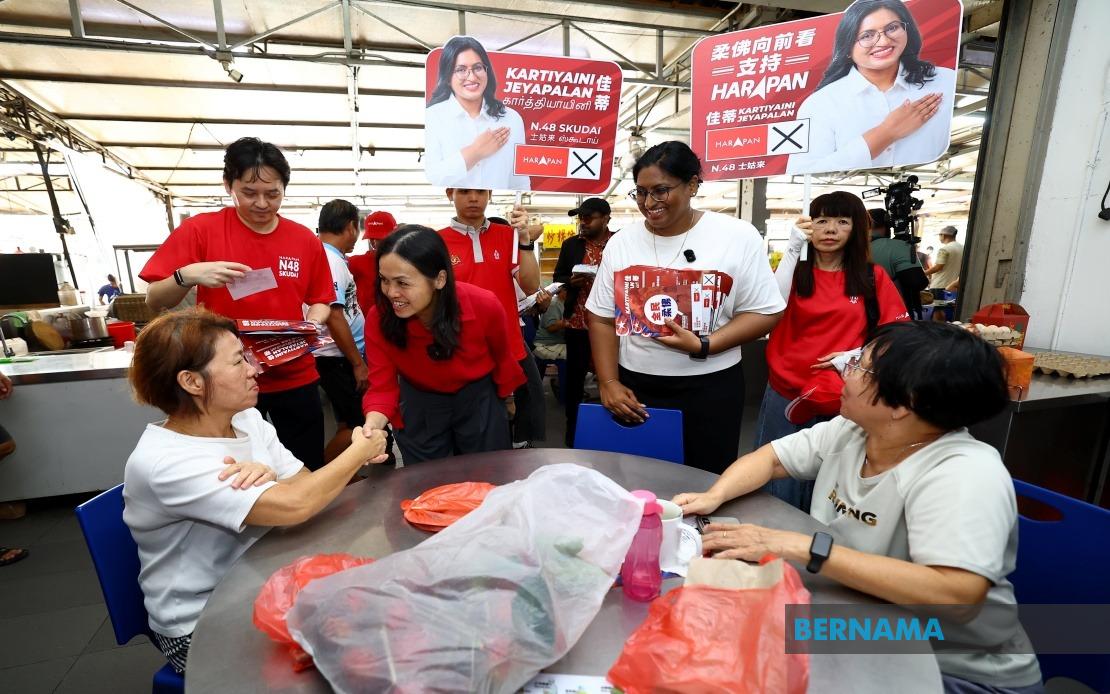
With less than a week remaining before Johor's state election, political leaders are making a final push to mobilize voters and combat election-related misinformation spreading across digital platforms. Johor DAP chairman Teo Nie Ching, who doubles as Deputy Communications Minister, has launched a two-pronged campaign addressing both voter participation and information integrity as the state prepares to elect 56 representatives to the state assembly.
Teo's appeal centres on the principle that voting is a precious democratic privilege that voters should not take for granted. Speaking after meeting residents in the Skudai constituency on July 9, she drew attention to the remarkable sacrifices made by Malaysians living abroad to participate in the electoral process. These stories, she argued, should shame those with the luxury of proximity to polling stations into action. Her anecdotes paint a picture of a diaspora deeply invested in their country's political future despite geographical distance.
The Deputy Communications Minister shared the example of an Australian voter in Queensland who went to extraordinary lengths when conventional postal delivery appeared unreliable, camping at airport terminals hoping to find a fellow Malaysian willing to courier his ballot by hand across continents. Equally striking was the case of a Chinese-based postgraduate student who paid over RM1,000 to rebook a flight at short notice, absorbing the extra cost to ensure personal participation in voting. These actions underscore a commitment that contrasts sharply with the relative ease available to voters in Malaysia itself, particularly those working in nearby Singapore and Kuala Lumpur who face minimal logistical barriers.
For context, the Johor state election represents a significant political moment for a state that has been subject to considerable demographic and economic change. With 2.7 million registered voters eligible to cast ballots, turnout could meaningfully influence which coalition shapes the state's development agenda for the coming term. Teo's emphasis on voter participation reflects broader concerns within the Pakatan Harapan coalition about mobilising their base in a state where political realignment has created uncertainty.
Parallel to her voter mobilisation efforts, Teo issued a direct warning about the proliferation of false information during the campaign's final stretch. She identified fake social media accounts and fabricated news as deliberate tools designed to deceive voters at a moment when political emotions run highest and critical thinking may be lowest. Her emphasis on digital literacy and a culture of verification before sharing represents an acknowledgment that Malaysian voters, like their global counterparts, face unprecedented challenges in distinguishing reliable information from sophisticated manipulation.
The Deputy Communications Minister advocated for what she termed a "verify before you share" approach, positioning media literacy as a civic responsibility rather than a technical skill. Her framing recognises that in an environment where information travels at digital speed, false narratives can attain dangerous velocity and reach before fact-checkers can intervene. The appeal also implicitly acknowledges the role ordinary citizens play as either amplifiers or gatekeepers of misinformation within their networks.
Kartiyaini Jeyapalan, the Pakatan Harapan candidate for the Skudai seat, complemented these efforts by describing the coalition's intensive campaign targeting cross-border workers. She revealed that PH leadership had positioned themselves at the Sultan Iskandar Building Customs, Immigration and Quarantine Complex from 5 am, engaging with workers before their daily commute into Singapore. The coalition had also deployed teams onto buses ferrying workers across the causeway, personalising appeals to return for voting.
Kartiyaini's approach represents a strategic focus on a specific voter demographic with particular mobility patterns. Cross-border workers constitute a substantial portion of Johor's electorate, and their participation rates can meaningfully shift electoral outcomes in closely contested seats. By meeting workers at border checkpoints rather than waiting for them to approach campaign offices, Pakatan Harapan demonstrates an understanding that convenience and accessibility shape electoral behaviour.
Beyond immediate voter mobilisation, Kartiyaini stressed that the coalition's messaging extends to educating voters on the substantive importance of state-level governance. Many Malaysians treat state elections as secondary to federal polls, a perception that can suppress participation. She argued that state governments control critical portfolios affecting daily life—from economic development and infrastructure to education and healthcare policy within state jurisdiction. This framing attempts to elevate the Johor state election from a sideshow to a contest with tangible consequences for constituents' material welfare.
The timing of these leadership interventions reveals strategic anxiety within Pakatan Harapan about final turnout and information environment. Johor has historically been a complex political terrain, and recent electoral volatility—including the emergence of new political alignments and shifting voter preferences—creates uncertainty about which coalition will ultimately control the state government. Higher turnout generally favours coalitions with stronger grassroots organisation and younger, more educated voters, demographics traditionally associated with Pakatan Harapan's base.
The election itself comes at a moment of broader political flux across Malaysia. State elections often serve as barometers for federal-level sentiment, and Johor's result will reverberate through Malaysian politics. Both the incumbent government and opposition will read the outcome as an indicator of their respective electoral prospects, making this Saturday's polling meaningful far beyond Johor's borders.
For Malaysian voters within and beyond the state, the competing messages from Teo and Kartiyaini—to vote and to think critically about information—encapsulate a modern democratic challenge. Citizens must navigate practical obstacles to participation while simultaneously developing the discernment to evaluate political claims in an information landscape increasingly polluted by deliberate falsehoods. The Johor election thus becomes a test not merely of which coalition prevails, but of whether informed democratic participation remains achievable in contemporary Malaysia.

