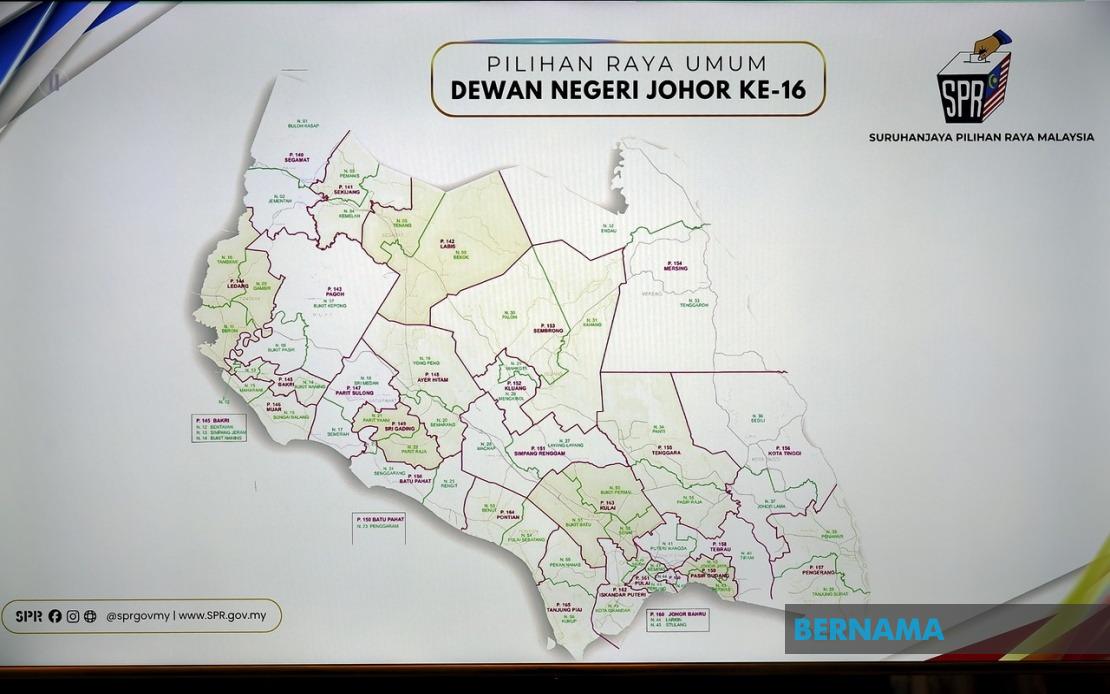
Tomorrow marks the formal launch of Johor's 16th state election as nomination day brings candidates and political machinery into full motion across the southern state. The exercise will determine which contenders officially enter the race for all 56 state assembly seats, with registration windows running from 9 am to 10 am at designated venues statewide. Once the Election Commission completes its screening protocols, the official roster of candidates will be made public, setting the formal stage for what promises to be a competitive campaign leading up to polling day on July 11.
The electoral landscape in Johor encompasses a substantial voter base. According to the Election Commission, approximately 2.73 million citizens are registered to vote, comprising over 2.7 million ordinary voters supplemented by military and police personnel with eligible spouses. Early voting opportunities have been scheduled for July 7, allowing certain segments of the electorate to cast ballots prior to the main polling day. This extended voting arrangement reflects efforts to ensure accessibility across different demographic groups within Malaysia's second-largest state by population.
The major political coalitions have moved decisively to field complete candidate lists across all 56 seats, signalling their commitment to contesting every constituency. Pakatan Harapan's composition features Parti Keadilan Rakyat with 20 nominees, Amanah contributing 19, and the Democratic Action Party fielding 17 candidates. This three-way distribution within the coalition reflects internal power dynamics and historical performance patterns across different regions of Johor, with each party claiming strongholds in specific areas based on previous electoral cycles.
Barisan Nasional has matched Pakatan Harapan's comprehensive approach by presenting candidates throughout the state. The coalition's traditional powerhouse UMNO fields 36 candidates, while the Malaysian Chinese Association contributes 16 and the Malaysian Indian Congress four. This allocation underscores UMNO's dominant position within the BN structure and reflects the demographic composition of Johor's constituencies, where Malay-majority areas significantly outnumber mixed or predominantly Chinese electorates.
Perikatan Nasional's presence across Johor demonstrates the coalition's intention to challenge both establishment groupings. PAS has fielded 11 candidates, Bersatu 16, and the Malaysian Indian People's Party five. This distribution reveals Perikatan's strategic focus on specific constituencies, particularly in areas where its Islamic messaging or anti-establishment positioning may resonate with voters disillusioned with traditional parties.
Beyond the major coalitions, several smaller political entities are making electoral bids. MUDA, the youth-oriented party that gained traction in recent years, is contesting four seats, primarily in urban constituencies where its reform-minded platform may appeal to younger voters. The Socialist Party of Malaysia enters the fray with a single candidate, while Parti Bersama Malaysia is making its electoral debut by fielding 15 candidates across the state. These smaller players may struggle to overcome incumbent advantages and resource disparities, yet their participation enriches the democratic process and offers voters alternative choices beyond the dominant three-coalition framework.
The Election Commission has prioritised procedural clarity as nomination day approaches, advising prospective candidates to verify their nomination documentation well in advance to prevent eleventh-hour complications. Candidates must ensure deposit payments are completed early and retain receipts as required documentation when submitting official nomination papers. These administrative prerequisites, while seemingly routine, have historically proven critical junctures where well-intentioned candidates have encountered disqualification through procedural oversights rather than substantive ineligibility.
Anticorruption oversight has been intensified specifically for this election cycle. The Malaysian Anti-Corruption Commission has issued explicit directives to all candidates and party structures warning against unlawful conduct under both the MACC Act 2009 and the Election Offences Act 1954, as amended in 2012. To operationalise this enforcement mandate, the MACC has established five 24-hour operations centres strategically positioned across Tampoi, Batu Pahat, Kluang, Segamat, and Mersing. These facilities provide public channels for reporting suspected corruption or power abuse, creating an institutional mechanism designed to deter election-related malfeasance throughout the campaign and voting periods.
The immediate electoral context emerged following the Johor State Legislative Assembly's dissolution on June 1, formally triggering the election schedule. This development followed months of political repositioning within Johor as various factions shifted allegiances and tested electoral viability ahead of the formal campaign period. The dissolution marked the definitive endpoint for parliamentary maneuvering and initiated the structured electoral calendar that culminates in the July 11 vote.
Historical context from the preceding 2022 state election reveals the competitive terrain now being contested. In that election, Barisan Nasional secured 40 seats, establishing clear electoral dominance in Johor. Pakatan Harapan won 12 seats, Perikatan Nasional claimed three, and MUDA captured one. These results positioned BN with substantial but not overwhelming control of the state assembly, enabling Pakatan and Perikatan legislators to exert meaningful opposition roles. Whether those 2022 patterns persist or shift represents the fundamental question underlying tomorrow's nomination exercise and the subsequent campaign.
For Malaysian observers and the Southeast Asian political ecosystem more broadly, the Johor election serves as an early indicator of voter sentiment in a major state where elections influence national coalition calculations. BN's performance here will signal whether the coalition has recovered ground following its 2018 electoral shock, while Pakatan's showing will indicate whether the reform coalition has consolidated gains or faces regression. Perikatan's results may demonstrate whether PAS-Bersatu positioning has durable voter appeal outside stronghold areas, particularly as religious and cultural issues intersect with economic and governance concerns.

