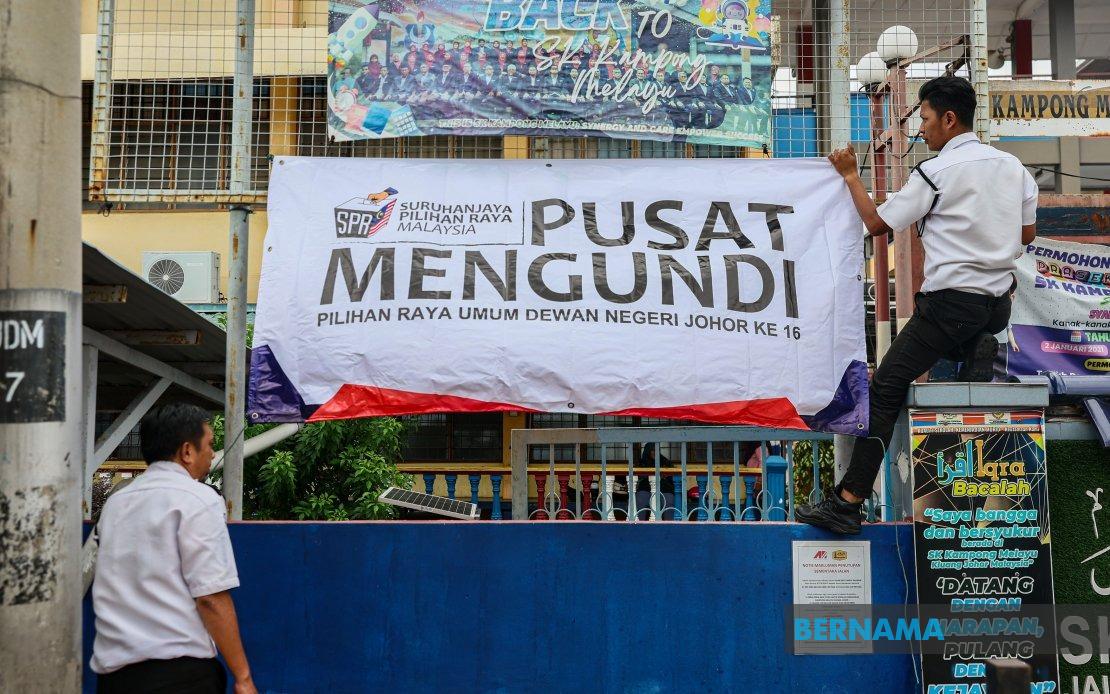
More than 2.7 million eligible voters in Johor are participating in the state's 16th legislative election today, marking a significant political moment for Malaysia's second-largest state by population. The ballot determines which representatives will occupy all 56 seats in the State Legislative Assembly, with polls opening simultaneously across the state at 8 am and closing in stages throughout the afternoon and evening. The Election Commission has mobilized substantial resources to manage the exercise, deploying over 43,000 election workers and operating 1,076 polling centres with 4,889 individual voting streams to accommodate the large electorate.
The voting process reflects meticulous logistical planning designed to ensure accessibility and efficiency across Johor's diverse geography. Polling stations will close at varying times between 11 am and 6 pm depending on their location, with island polling stations closing significantly earlier—Pulau Besar at 11 am, Pulau Aur and Pulau Pemanggil at noon—to accommodate the complexities of island voting. The staggered closure schedule allows counting to begin progressively rather than creating a bottleneck at day's end. Officials have mandated that 24,677 postal ballots must be returned by the 6 pm deadline, ensuring their inclusion in the final tally. The Election Commission is projecting full results by 10 pm, pending the counting process proceeding without major delays.
Election observers are monitoring the expected turnout closely, as it carries implications for understanding voter engagement across the state. The Commission has set an ambitious target of approximately 70 per cent participation, a notable threshold given that the previous 2022 Johor state election saw a 54.92 per cent turnout. Any improvement on that figure would suggest increased voter interest and confidence in the electoral process, though weather conditions may present challenges. The Malaysian Meteorological Department has forecasted morning rain in several districts including Johor Bahru, Batu Pahat, Kulai, Muar, Pontian and Tangkak, with thunderstorms predicted in Kluang, Kota Tinggi, Segamat and Mersing during afternoon and evening hours. Such weather could either suppress participation or prove inconsequential depending on how voters prioritize their civic duties.
The composition of candidates contesting reflects the current fragmented state of Malaysian politics, with 172 individuals competing across multiple political formations. Pakatan Harapan and Barisan Nasional each fielded the maximum 56 candidates possible under electoral rules, demonstrating their status as the two primary coalitions. Perikatan Nasional, the emerging coalition that has gained traction in recent years, nominated 33 candidates, while Parti Bersama Malaysia advanced 15 hopefuls. Smaller parties and independent candidates round out the field, with MUDA entering four candidates, Parti Orang Asli Malaysia one, Parti Sosialis Malaysia one, and six independent candidates standing without party affiliation. This diverse field means voters face complex choices that extend beyond simple two-coalition competition.
The pre-election configuration of the dissolved assembly reveals the dynamics that prompted today's exercise. Before dissolution on 1 June, Barisan Nasional controlled 40 of the 56 seats, providing significant parliamentary dominance despite losing federal power in recent national elections. Pakatan Harapan held 12 seats, suggesting minority status in Johor despite their Putrajaya presence. Perikatan Nasional, despite national prominence, claimed only three state seats in the previous assembly, while MUDA held a solitary seat. The gap between BN's state strength and PH's federal position underscores how Johor remains a Barisan stronghold, complicating the national political picture where Pakatan leads the federal coalition.
Practical arrangements for voting reflect authorities' commitment to facilitating participation while maintaining electoral integrity. Employers received explicit reminders that staff should receive reasonable time away from work to vote, acknowledging that working-age participation is crucial to achieving healthy turnout levels. Early voting on 10 July accommodated police personnel, armed forces members and their spouses, ensuring security sector representation. These 20,607 early voters have already cast ballots, reducing pressure on today's polling infrastructure.
The election's significance extends beyond Johor itself, carrying implications for Malaysian politics at the regional and national level. A strong result for any coalition in Johor could reshape perceptions of momentum heading into any future national elections. For Barisan Nasional, defending their 40-seat majority represents consolidating state-level dominance even as they rebuild federal credentials. For Pakatan Harapan, gains in Johor would demonstrate capacity to challenge Barisan on traditionally hostile ground, strengthening their narrative as an emerging force nationwide. For Perikatan Nasional, converting state seats into meaningful numbers could validate their claims to becoming the nation's alternative political force. The result will likely influence calculations within all three coalitions regarding their strategic positioning for subsequent state elections.
Malaysian and regional observers have focused on whether today's election demonstrates broader trends in electoral behaviour or represents a local phenomenon specific to Johor's political landscape. The 2022 Johor election saw turnout decline to below 55 per cent, raising questions about voter fatigue or declining electoral engagement. The Election Commission's 70 per cent target represents aggressive optimism, and achievement of this goal would counter narratives of declining participation that have characterized some recent Malaysian electoral exercises. Alternatively, if turnout remains flat or declines further, it could signal persistent voter disengagement requiring deep reflection from all political parties about their connections to constituents.

