Johor's political leadership has undergone a significant transformation with the reshuffling of the State Executive Council, a development that marks both continuity and generational evolution within the state administration. Menteri Besar Datuk Onn Hafiz Ghazi has sought to frame the changes as a deliberate strategic move designed to maintain administrative momentum while injecting fresh perspectives into the governance of Malaysia's southern anchor state.
The reshuffle, which saw 10 state assemblymen take their oath of office before the Regent of Johor, Tunku Mahkota Ismail, at Istana Bukit Serene, represents a carefully calibrated approach to leadership transition. The retention of six incumbent portfolio holders suggests a desire to preserve institutional knowledge and policy continuity, while the appointment of four new members indicates the Menteri Besar's commitment to broadening the talent pool within the state government. This balance between experience and renewal reflects broader patterns observable in Southeast Asian state administrations, where the pressure to demonstrate both stability and progressive change has become increasingly acute.
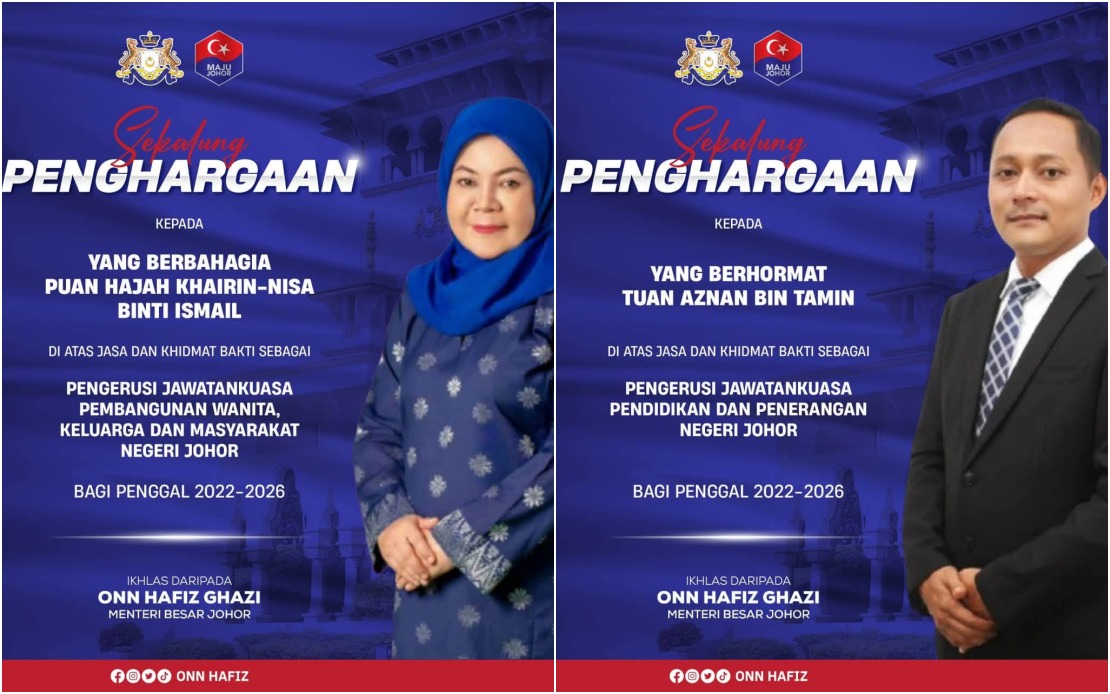
In acknowledging the departures, Onn Hafiz extended formal recognition to four former Exco members from the 2022-2026 term—Datuk Zahari Sarip, K. Raven Kumar, Aznan Tamin, and Khairin-Nisa Ismail. His public articulation of gratitude serves multiple functions within the context of Malaysian state politics, where managing relationships among the political elite remains critical to governing coalitions. By emphasizing that the reshuffle did not diminish the legacies of these outgoing members, the Menteri Besar sought to prevent any perception of rejection or underperformance that might create fissures within the party or broader ruling coalition.
The philosophical underpinning of the Menteri Besar's remarks warrants closer examination. His assertion that "the responsibility entrusted for Johor does not end with a particular position" suggests a deliberate attempt to reframe political service beyond individual office-holding. This framing proves significant for Malaysian politics, where the prestige and status associated with ministerial or exco positions often carries substantial weight in determining political loyalty and faction dynamics. By depersonalizing the reshuffle, Onn Hafiz aimed to present it as an institutional necessity rather than a personal or political judgment.
Johor's economic and administrative challenges provide important context for understanding the timing and composition of this reshuffle. As one of Malaysia's most economically significant states, hosting major industrial zones, petroleum and petrochemical operations, and serving as a critical entry point to Singapore, Johor faces mounting pressure to maintain competitive advantage while addressing infrastructural needs and ensuring inclusive development. The appointment of new cabinet members ostensibly reflects an assessment that fresh administrative approaches are necessary to navigate these complex challenges.
The gender dimension of the reshuffle also merits consideration. With Khairin-Nisa Ismail's departure marking the loss of a female Exco member, questions inevitably arise regarding the representation of women within Johor's highest governance structures. Although the statement does not specify the gender composition of the four newly appointed members, the loss of female representation in cabinet-level positions aligns with broader patterns in Malaysian state governance where women remain underrepresented in executive decision-making positions despite their substantial contributions to electoral politics and party organization.
For Malaysian observers concerned with state-level governance, the reshuffle raises important questions about policy continuity. The retention of six portfolio holders suggests that major ongoing initiatives—whether related to economic development, social services, infrastructure, or other critical domains—will maintain institutional continuity. However, the introduction of four new faces introduces uncertainty regarding potential policy inflections or shifts in administrative priorities. How these new members navigate their portfolios, whether they bring distinct ideological perspectives, and how they integrate within the existing executive structure will significantly influence Johor's governance trajectory over the coming years.
The ceremonial elements of the reshuffle, including the formal oath-taking before the Regent, carry symbolic weight that extends beyond administrative procedure. In Malaysian constitutional monarchy systems, the role of the Regent in witnessing and formalizing executive appointments reaffirms the institutional legitimacy of the appointments while connecting state governance to the constitutional framework. For Johor specifically, this ritual reinforces the state's distinctive institutional arrangements and the continuing relevance of traditional authority structures within modern governance contexts.
From a Southeast Asian perspective, Johor's administrative renewal reflects patterns visible across the broader region. State governments throughout Malaysia and neighboring countries increasingly confront pressures to demonstrate administrative effectiveness while managing competing faction interests within ruling coalitions. The need to balance stability with perceived dynamism has become a persistent challenge for regional political leaders, with cabinet reshuffles serving simultaneously as responses to genuine administrative needs and as tools for managing internal political relationships.
The Menteri Besar's emphasis on teamwork and collective achievement, particularly his reference to the leadership team's capacity to navigate challenges while maintaining focus on development and welfare, suggests an understanding that successful state governance depends on institutional cohesion. The ability to execute major projects, attract investment, and deliver public services requires not merely individual competence but organizational alignment. His public acknowledgment of previous achievements and contributions appears designed to foster sufficient goodwill among departing and continuing officials to maintain this crucial institutional coherence.
Looking forward, the practical implications of this reshuffle will unfold gradually as the new and returning Exco members assume their responsibilities. The state's trajectory on key issues—economic competitiveness, infrastructure development, social equity, and environmental sustainability—will ultimately provide the measure of whether this administrative renewal achieves its stated objectives. For stakeholders throughout Johor and observers throughout Malaysia, the coming months and years will reveal whether the infusion of new energy and perspectives enhances the state's capacity to address mounting challenges and capitalize on emerging opportunities in an increasingly competitive regional environment.

