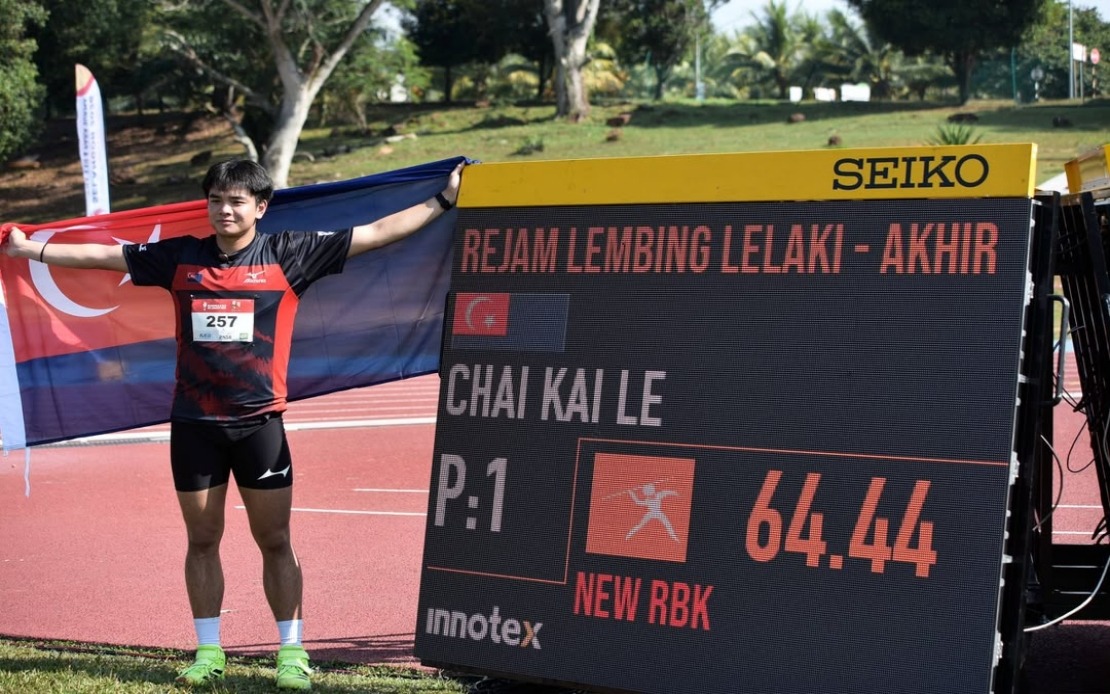
The 2026 Malaysia Games in Selangor witnessed a landmark athletic achievement as 18-year-old Chai Kai Le from Johor claimed the men's javelin gold medal, erasing a record that had stood unchallenged for more than a quarter century. Competing at the Universiti Putra Malaysia Sports Centre in Serdang, Kai Le unleashed a throw of 64.44 metres on his second attempt, decisively surpassing the previous Games record of 62.33 metres established by Sarawak's Kho Mei Kuan during the 2000 edition held in Penang. The performance underscores the steady progression of Malaysian javelin talent and hints at broader competitive improvements across Southeast Asian athletics.
The podium composition reflected Johor's strength in the discipline, with two of the three medal positions claimed by athletes from the state. Penang's Tan Chun Wei captured the silver medal courtesy of a 60.43-metre effort, whilst Kai Le's Johor teammate Mohd Noor Iman Norman completed the medal sweep with a bronze-medal throw of 59.04 metres. This concentration of success in a single state suggests targeted development programmes and institutional support are beginning to yield measurable results in field events, an area where Malaysian athletics has traditionally faced challenges against stronger regional competitors.
Addressing the media following his triumph, Kai Le revealed that the record-breaking performance aligned with his carefully laid competitive objectives. The teenager explained that his preparation strategy had stretched across two years specifically targeting this SUKMA iteration, allowing him to approach the competition with realistic yet ambitious targets. His evident satisfaction reflected not merely the achievement of winning gold but the validation of his systematic approach to athletic development—a reminder that success at this level requires sustained commitment rather than sporadic effort.
The young javelin thrower's comments about his second throw proved particularly instructive, offering insight into the physical demands and technical precision required at elite amateur levels. Kai Le acknowledged suffering technical complications during his second attempt that triggered lower back discomfort and subsequent fatigue. Rather than pursuing increasingly aggressive throws that might have extended the record further, he adopted a pragmatic approach, prioritising injury prevention and management over record maximisation. This maturity in decision-making—knowing when to consolidate rather than overextend—often distinguishes developing athletes who build sustainable careers from those who achieve brief peaks followed by decline.
Context emerges from Kai Le's credentials in the broader domestic and regional hierarchy. The medallist holds the national under-20 record at 65.65 metres, a mark that exceeds his SUKMA-winning throw by over a metre. This gap between his personal best and competition best suggests untapped potential, indicating that further improvements remain plausible as he matures physically and refines technical execution. For Malaysian athletics observers, such benchmarks offer encouragement that the pipeline contains athletes capable of challenging established Southeast Asian powerhouses in field events.
On the track side of the competition, Penang's Mohammad Aiman Haikal Sahrudin demonstrated similar dominance in the men's 10,000-metre race walk, a discipline that demands exceptional aerobic capacity and biomechanical precision. Sahrudin's winning time of 47 minutes 28.84 seconds proved sufficient to hold off Kelantan's Ahmad Farish Irfan Ahmad Fahmi, who crossed in 47 minutes 37.17 seconds for the silver medal. The Federal Territories' Khor Jing Hong, representing Malaysia's youngest competitive cohort at just 18 years of age, earned bronze with a time of 47 minutes 49.27 seconds, underlining the depth of emerging talent across multiple states.
Sahrudin's achievement carried additional significance in the context of his SUKMA trajectory. The 18-year-old from Kampung Tanah Liat in Penang improved substantially upon his silver-medal performance at the previous Games held in Sarawak, demonstrating consistent development and the capacity to perform under increased pressure. Such progression across successive Games editions indicates meaningful maturation rather than one-off competitive success, a distinction crucial for those evaluating long-term prospects.
Looking forward, Sahrudin articulated aspirations extending well beyond SUKMA recognition. He outlined intentions to gain selection for Malaysia's national squad and subsequently qualify for the 2027 SEA Games—an objective that requires substantially elevated performance standards. Notably, Sahrudin acknowledged that the SEA Games programme does not include the 10,000-metre race walk, necessitating a transition to the 20,000-metre variant to serve his regional ambitions. This competition also formed part of the Selangor Games schedule, providing an immediate opportunity to test his capabilities across the extended distance.
The race walk discipline occupies a curious position within Malaysian athletics. Less glamorous than sprinting or jumping events, race walking demands specialized training and exceptional discipline in technique execution, as rule violations result in disqualification. The emergence of competitive race walkers like Sahrudin and Khor suggests growing infrastructure and coaching expertise in a historically underdeveloped area. For a federation seeking to accumulate medals across diverse disciplines at regional competitions, such expansion into less populated events provides strategic advantage.
Both Kai Le and Sahrudin represent a generation of Malaysian athletes maturing within established competitive frameworks. The 2026 SUKMA provides a crucial developmental stepping stone for athletes eyeing subsequent SEA Games participation and beyond. These Games function as dress rehearsals for regional competition, allowing athletes to refine preparation strategies, assess performance consistency, and identify technical refinements before stepping into more demanding environments. The calibre of performances emerging from Selangor 2026 suggests Malaysian athletics is methodically building capability across multiple disciplines simultaneously.
The broader implications extend beyond individual achievement. Record-breaking performances at SUKMA typically stimulate increased participation and investment in particular sports within winning states. Johor's javelin success may well inspire heightened interest and resource allocation toward field events in the state, perpetuating the competitive advantages already evident. Similarly, Penang's race walking results may prompt neighbouring states to develop their own walking programmes, creating competitive pressure that ultimately elevates national standards.
As Malaysian athletes continue pursuit of excellence at increasingly competitive levels, the performances witnessed at Selangor 2026 will likely feature prominently in recruitment and programme development discussions. State sports councils will examine successful models employed by Johor and Penang, seeking to replicate structured preparation approaches across their own competitive systems. The Games thus function as both celebration of achievement and benchmark-setting exercise that shapes athletic development policy across the nation for years ahead.

