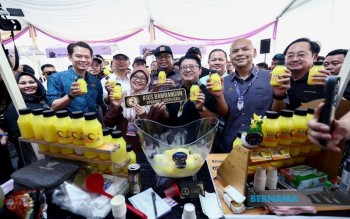
Sabah's burgeoning business sector is poised to gain significant momentum through the JOM MALAYSIA platform, a national initiative designed to propel local products onto the international stage. Chief Minister Datuk Seri Hajiji Noor emphasised the movement's strategic importance during the opening of the JOM MALAYSIA Festival 2026 at the Sandakan Sports Complex, positioning it as far more than a conventional commercial showcase. Rather, the programme represents a coordinated ecosystem bringing together entrepreneurs, government agencies, financial institutions, and consumers in pursuit of shared economic objectives that transcend simple product merchandising.
The alignment between JOM MALAYSIA and Sabah Maju Jaya (SMJ) 2.0—the state's overarching development blueprint—illustrates how the movement supports broader economic priorities. Both initiatives prioritise sustainable, inclusive, and competitive expansion grounded in grassroots entrepreneurial empowerment and improved market access for local operators. This convergence creates what Hajiji described as a comprehensive development chain: entrepreneurs receive support and capacity-building, products undergo quality enhancement and value addition, and market opportunities expand domestically and internationally. The "local to global" aspiration serves as the guiding philosophy, acknowledging that successful economies must nurture homegrown talent while enabling them to compete beyond borders.
The recognition of Sabah as a host location for the festival carries symbolic weight for East Malaysia's economic positioning. The federal government's decision to include the state signals confidence in Sabah's capacity to drive regional economic development and reflects appreciation for its entrepreneurial potential. This vote of confidence comes at a pivotal moment, as Sabah's SMEs have demonstrated tangible export competitiveness in recent years. Data presented during the event shows that 124 Sabah-based SME entrepreneurs participated in 18 international trade expos throughout 2025, generating RM95.9 million in potential sales—a remarkable 37.12 per cent increase from the RM60.4 million recorded in the previous year. This trajectory suggests that with appropriate support mechanisms and visibility platforms, Sabah's business community possesses genuine capability to secure substantial international orders.
The state government has institutionalised its commitment to enterprise development through targeted, well-resourced programmes. The SME-UP Assistance Programme, operating under the SMJ 2.0 framework and administered by the Department of Industrial Development and Research, carries an allocation of RM15 million earmarked to develop 600 micro, small, and medium-sized enterprises. This targeted investment reflects a deliberate strategy to move beyond ad hoc support and create systemic capacity-building that reaches multiple layers of the entrepreneurial spectrum. Simultaneously, the Sabah Ready-to-Eat Programme addresses a specific market opportunity in food commercialisation, providing development grants, retort machine assistance, and halal certification support. These complementary initiatives remove practical barriers that often prevent promising local products from accessing both domestic and export markets, addressing quality standards, regulatory compliance, and production equipment constraints that frequently impede growth.
The readiness-to-export theme extends beyond manufactured goods into the crucial services sector, particularly tourism. Sabah's visitor economy generated RM8.74 billion in tourism revenue from 3.79 million arrivals last year, figures that underline the sector's economic significance for the state. This foundation becomes particularly strategic as Malaysia approaches Visit Malaysia Year 2026 and Sabah prepares to host Visit Sabah Year 2027. Tourist arrivals create natural promotional opportunities for local products and services, as visitors frequently seek authentic regional goods and experiences to take home or share with networks. The intersection of tourism marketing and product promotion offers multiplicative benefits: enhanced visitor flows drive sales of local merchandise while simultaneously building international brand awareness and creating pathways for repeat orders from consumers who encountered products during their travel.
Chief Minister Hajiji's proposal to expand JOM MALAYSIA activities to additional strategic destinations across Sabah in conjunction with Visit Sabah Year 2027 demonstrates forward-thinking coordination between economic and tourism development agendas. Rather than treating these as separate initiatives, the approach recognises their complementarity. Tourism-anchored JOM MALAYSIA events would position local entrepreneurs to capture spending from international visitors while building distribution networks and securing contracts that extend well beyond the tourist season. Strategic location selection—presumably focusing on high-traffic tourism zones and regional commercial hubs—would maximise both visitor exposure and local economic diffusion across the state.
For Malaysian entrepreneurs and policymakers monitoring regional economic development, Sabah's JOM MALAYSIA implementation offers instructive lessons about institutionalising support for export-oriented growth. The model emphasises ecosystem-building rather than isolated interventions, recognises the interconnectedness of entrepreneur empowerment, product quality, and market access, and leverages existing economic strengths like tourism to create multiplicative opportunities. This approach contrasts with programmes that focus narrowly on promotional activities without addressing underlying constraints in production capacity, quality assurance, or business management expertise.
The performance metrics already visible in Sabah's trade expo participation suggest the platform is meeting real entrepreneurial demand. A 37 per cent annual increase in potential sales value indicates not merely increased participation but meaningfully improved deal flow and commercial engagement. This upward trend likely reflects growing familiarity among international buyers with Sabah's product offerings, improved presentation standards, and enhanced business readiness among participating entrepreneurs. Sustained growth will require maintaining momentum through consistent promotional support, continued product development initiatives, and reliable access to financing and logistics infrastructure.
Looking ahead, the success of JOM MALAYSIA in Sabah may establish a template for similar initiatives across other Malaysian states, particularly in East Malaysia where geographic isolation from major markets and limited domestic scale necessitate deliberate export-orientation strategies. The movement's emphasis on building comprehensive entrepreneurial ecosystems rather than merely hosting sales events reflects contemporary understanding of what sustains export competitiveness in the long term. As Sabah positions itself as a growth engine for East Malaysia and the broader Malaysian economy, platforms like JOM MALAYSIA assume heightened importance in translating entrepreneurial energy into sustainable commercial advantage.

