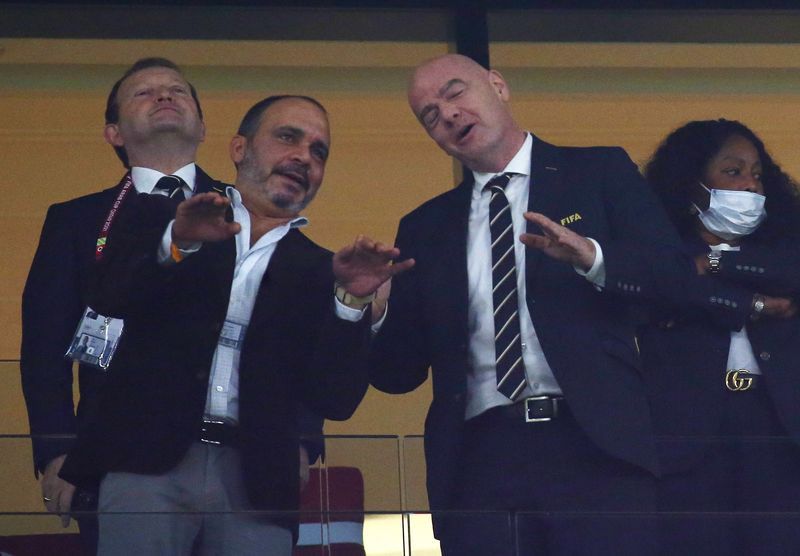
The head of Jordan's football federation has levelled serious allegations at FIFA President Gianni Infantino, claiming the world soccer governing body attempted to leverage assistance to the Jordanian association in exchange for his public backing. Ali bin Hussein made the accusation public on Tuesday, describing FIFA's approach as tantamount to blackmail and rejecting any notion that his organisation would comply with such demands.
According to Bin Hussein's account, FIFA officials made verbal overtures during the World Cup period suggesting that endorsing Infantino "would go a long way to helping our FA out." These communications allegedly came after the Jordanian federation had repeatedly sought FIFA's assistance on various matters without receiving satisfactory responses. The timing and conditional nature of the offer—linking support to a political endorsement—form the crux of Bin Hussein's complaint, which he articulated through a statement posted on social media.
Jordan's football leadership has emphasised its commitment to ethical standards and governance, with Bin Hussein explicitly stating that the association would not compromise its principles regardless of potential benefits offered in return. The public rebuke represents an unusually direct confrontation between a national federation and the FIFA president, signalling deepening fractures within international football's institutional hierarchy.
Infantino's authority within world soccer has been substantially weakened following his recent retreat on a controversial proposal to partially privatise FIFA's commercial operations. The initiative, which would have involved selling a minority stake to raise billions of dollars for global sports development initiatives, encountered sustained resistance from confederations and national associations across multiple regions. A September 19 deadline imposed by Infantino failed to generate the consensus he required, forcing him to abandon the scheme.
The fracturing of support around Infantino extends beyond the World Cup commercialisation dispute. High-ranking FIFA officials, including Secretary General Mattias Grafstrom and Chief of Global Football Development Arsene Wenger, have publicly distanced themselves from the FIFA president's direction. Bin Hussein characterised these developments as symptomatic of broader leadership problems at the governing body, suggesting that Infantino's grip on the organisation has weakened considerably.
Beyond the endorsement controversy, Bin Hussein articulated a catalogue of grievances reflecting the structural disadvantages faced by smaller football nations within FIFA's framework. Jordan, operating with constrained financial resources, has struggled to manage escalating operational costs while receiving inadequate support from the governing body. Supporters of the Jordanian squad faced prohibitively expensive ticket prices for World Cup matches, yet many were subsequently denied entry visas despite having purchased access.
The taxation issue raised by Bin Hussein highlights another dimension of inequality within FIFA's international tournament structure. Jordan's participation in the United States-hosted World Cup triggered U.S. federal tax obligations that were processed through FIFA and ultimately levied against the Jordanian association. Other participating nations based in Canada and Mexico, despite hosting matches and training operations on North American soil, did not face comparable taxation burdens. This disparity effectively penalised Jordan for geographical positioning, diverting funds that should have supported players and coaching staff.
The outstanding payments for the 2025 Arab Cup represent a separate financial grievance. The Jordanian national team reached the tournament final in Qatar—a significant achievement for a confederation of modest resources—yet FIFA has withheld reward money since December without adequate explanation. This delay persists despite FIFA's publicly documented financial reserves, which amount to billions of dollars. The contradiction between FIFA's stated wealth and its delayed payments to participating nations underscores broader concerns about resource allocation and institutional priorities.
Jordan's World Cup campaign itself, while historic as the nation's first-ever qualification for the tournament, ended disappointingly in the group stage. The investment required to prepare for and participate in the competition—combined with unexpected taxation and delayed payments—created cumulative financial strain on the Jordanian federation. Bin Hussein's public statements suggest that these practical challenges have crystallised into fundamental questions about how FIFA operates and whether smaller member associations receive equitable treatment.
The allegations from Jordan intersect with Infantino's broader vulnerability within FIFA's internal structures. With key executives already distancing themselves from his leadership and his flagship commercial initiative shelved, the endorsement demand accusations provide additional ammunition for those questioning his fitness to lead world football. For Southeast Asian readers and football administrators, the situation illustrates how institutional power imbalances within global sports governance can disadvantage smaller nations.
The dispute also exposes tensions between FIFA's aspirational rhetoric about development and inclusion and the actual mechanics of how the organisation functions. While FIFA promotes itself as committed to growing football globally and assisting member federations, Jordan's experience suggests that practical support often comes with implicit or explicit political conditions. This pattern of conditionality, if substantiated, would represent a significant governance failure at the international level.
As Infantino faces mounting pressure from multiple directions—including this latest public challenge—the episode demonstrates that even FIFA's authoritarian structures cannot insulate the president from accountability. National associations, particularly those representing larger populations and economic interests, retain collective power to constrain leadership decisions. Whether this moment catalyses broader institutional reform or simply represents another confrontation to be managed remains uncertain, but the accumulation of grievances suggests that Infantino's tenure continues to be defined by controversy and declining confidence among constituent members.

