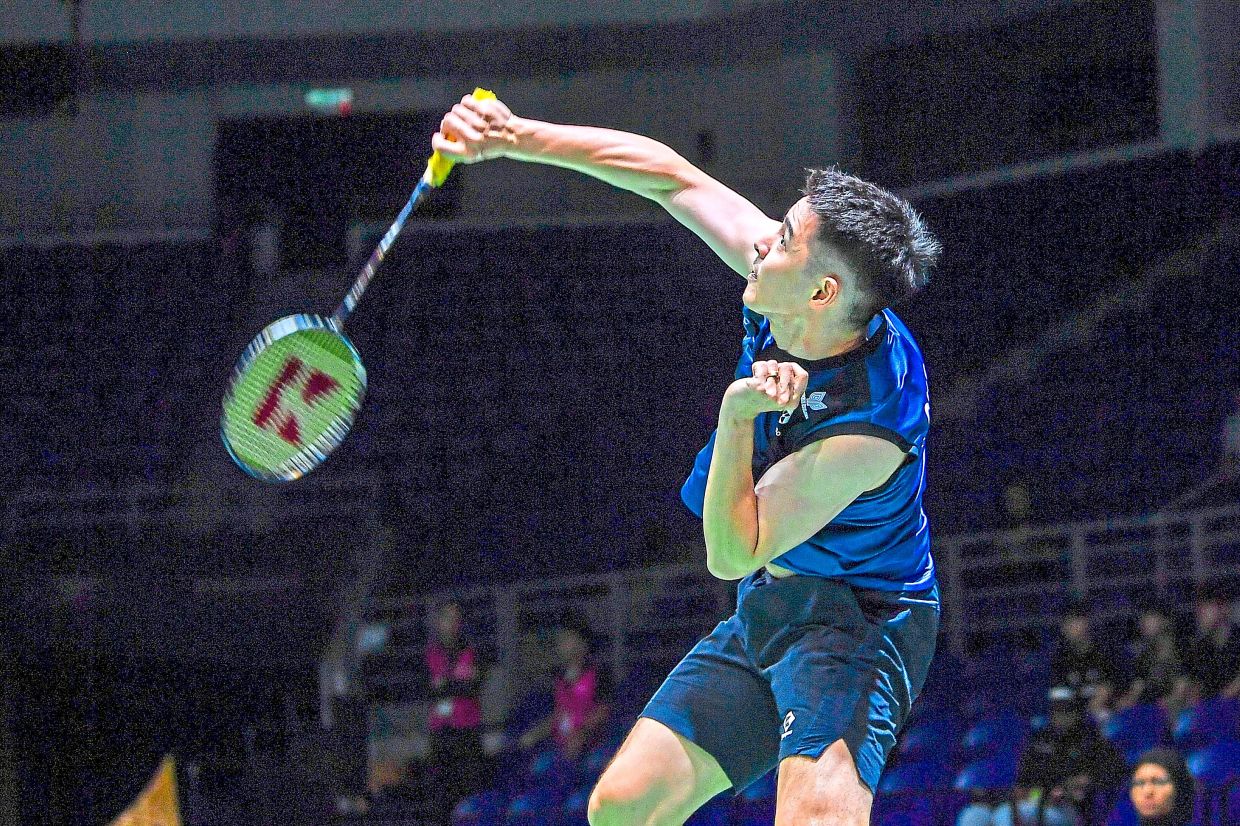
Cheam June Wei's remarkable journey through the Korean Masters continued Friday when the Malaysian shuttler dispatched Taiwan's seventh-seeded Su Li-yang in a competitive quarter-final clash at the Asan Yi Sun-sin Gymnasium. The independent player secured his place in the semi-finals with a hard-fought victory, claiming the match 23-21, 10-21, 21-18 in a display that showcased both tactical acumen and mental resilience under pressure.
June Wei's performance represented another significant scalp in what has become an unexpectedly strong tournament run. The Malaysian admitted surprise at his own progression, noting that reaching the semi-finals exceeded his initial expectations heading into the competition. Yet rather than allowing nerves to creep in as the stakes increased, he maintained his focus on the fundamental elements of play, concentrating on winning points sequentially rather than contemplating the broader implications of each match.
The quality of opposition June Wei has overcome underscores the significance of his achievement. In the opening round, he stunned world-ranked player Jason Teh, a seeded competitor whose credentials were substantially higher than those of an independent Malaysian shuttler. This breakthrough victory proved not to be a one-off flash of form, as he then navigated past Dong Tianyao of China, ranked 49th globally, to reach the quarter-finals where Li-yang awaited.
The semi-final berth comes at a crucial juncture in Malaysian badminton's competitive calendar. While the country's elite shuttlers have traditionally dominated regional and international tournaments, performances by lesser-ranked players like June Wei often go unnoticed despite their importance to the sport's depth and development. His success demonstrates that outside the established hierarchy of Malaysian badminton stars, talent capable of defeating seeded international opponents exists within the domestic system.
In the men's doubles competition, Malaysia recorded unambiguous success when the pairing of Man Wei Chong and Soh Wooi Yik dismantled India's Krishna Prasad Garaga and Pruthvi Krishnamurthy Roy with a dominant display. The scoreline of 21-7, 21-18 indicated overwhelming superiority, with the Malaysian team controlling rallies and dictating terms throughout both sets. This commanding performance secured their advancement to the semi-finals and positioned them as genuine contenders for medals.
Another all-Malaysian doubles contest saw Tee Kai Wun and Yap Roy King emerge victorious against Aaron Chia and Aaron Tai. The 21-12, 21-15 scoreline suggested a match characterized by consistent execution rather than drama, with the winners maintaining control from the outset. Such internal rivalries, while costly in terms of eliminated talent from further rounds, often produce the standard-setting performances that keep Malaysian badminton competitive at the highest levels.
The mixed doubles category, however, presented a starkly different narrative. Three Malaysian pairs entered the quarter-final round but none successfully navigated past their opposition. Jimmy Wong and Cheng Su Yin fell to South Korea's second-seeded Kim Jae-hyeon and Jang Ha-jeong after a tight encounter that went against them 17-21, 18-21. The narrow margins suggested opportunities missed rather than fundamental outclassing, a distinction that may prove instructive for technical analysis.
Loo Bing Kun and Noraqilah Maisarah Ramdan suffered a more decisive exit when encountering China's third-seeded pairing of Gao Jiaxuan and Wu Mengying. Losing 14-21, 15-21 indicated the Chinese combination's clear ascendancy in both technical execution and competitive control. Similarly, Chen Tang Jie and Clarissa San came up short against Japan's Haruki Kawabe and Kokona Ishikawa, defeated 20-22, 17-21 in a match that hinged on fine margins.
The elimination of all three Malaysian mixed doubles pairs raises questions about the category's competitive standing within Malaysian badminton. Where men's and women's doubles achieved semi-final representation through strong performances, the mixed format appears to represent a relative weakness. This pattern has implications for squad selection and training priorities, particularly given the category's prominence in contemporary international badminton.
For June Wei specifically, the semi-final appearance offers an opportunity to test his credentials against opponents whose seeding and world rankings will typically exceed those he has already defeated. His approach of point-by-point focus rather than match-level contemplation suggests a mental framework conducive to competing effectively at elevated levels. Whether he can convert this run into a first significant title remains the outstanding question as the tournament progresses toward its conclusion.
The Korean Masters serves as an important barometer of competitive standards within badminton's Asian ecosystem. Malaysian representation across multiple categories allows for comparative assessment of domestic strength relative to established powers like China, India, Japan, and South Korea. June Wei's individual trajectory, combined with mixed results from the doubles combinations, paints a picture of a badminton nation with pockets of elite capability alongside areas requiring developmental focus and strategic attention.

