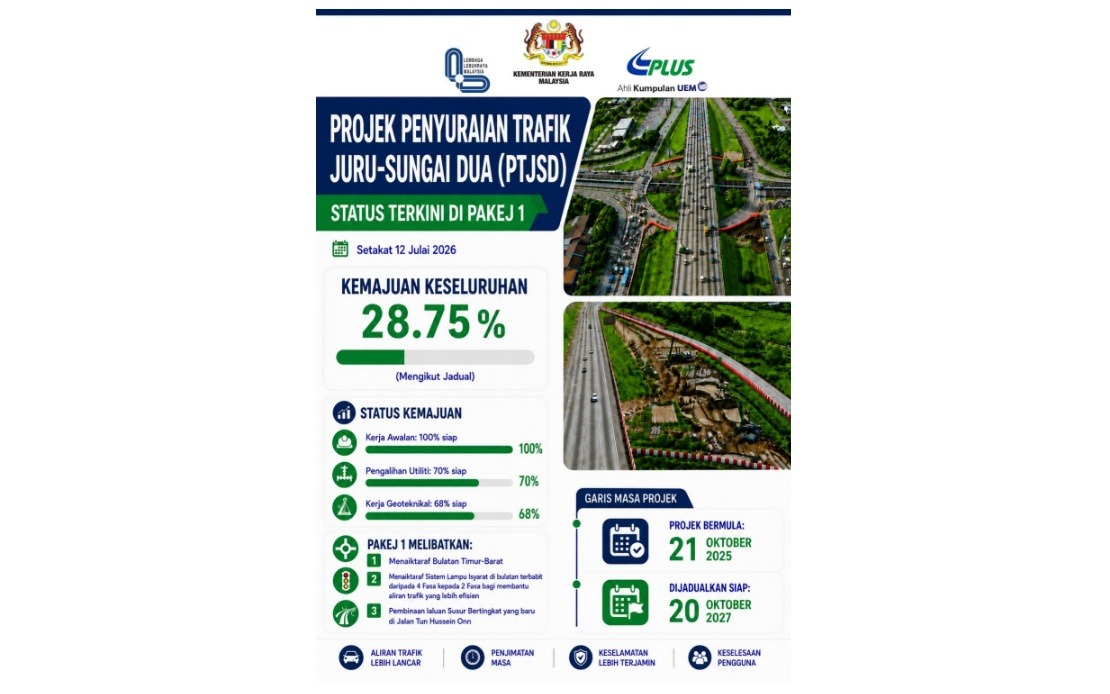
The Juru-Sungai Dua Traffic Dispersal Project (PTJSD) is tracking positively through its construction phases, with PLUS Malaysia Berhad reporting that Package 1 has achieved 28.75 per cent overall progress as of mid-July. The milestone indicates the infrastructure initiative remains aligned with its planned delivery schedule, marking steady advancement in one of northern Peninsular Malaysia's most significant transport undertakings.
Within the first package, several foundational components have reached advanced stages. Preliminary works have been entirely finished, setting the groundwork for subsequent construction phases. Utility relocation—the process of relocating water pipes, electricity cables, telecommunications lines and other essential services—stands at 70 per cent completion, while geotechnical investigations and soil preparation work have progressed to 68 per cent. These preliminary activities, though less visible to the public, form the essential infrastructure backbone upon which the main construction will rest.
Package 1 encompasses three major infrastructure components designed to alleviate congestion at a critical juncture in the Penang transport network. Work includes a comprehensive upgrade of the East-West Roundabout, modernisation of the traffic signal system to optimise vehicle flow through the intersection, and the construction of a new elevated slip road along Jalan Tun Hussein Onn. Together, these elements represent an integrated approach to managing traffic movement through one of the region's busiest corridors.
The broader PTJSD initiative stretches 17.3 kilometres across three administrative zones in Seberang Perai—the South, Central and North districts—serving approximately 200,000 daily commuters. When operational in October 2027, the expanded infrastructure is projected to fundamentally reshape traffic patterns along the Juru-Sungai Dua axis, which functions as the principal gateway connecting Penang State with Kedah, Perlis and northern Perak. For Malaysian commuters and logistics operators, this route represents a lifeline for commercial and daily movement between the northern region and more populated southern areas.
The RM3 billion investment reflects the scale of congestion challenges afflicting the corridor. Current conditions force motorists to endure journey times exceeding one hour during morning and evening peak periods, creating severe economic inefficiencies for businesses reliant on timely delivery and frustration for workers commuting between states. The new direct Juru-Sungai Dua route, a centrepiece of the project, is projected to absorb 30 per cent of existing traffic, compressing travel duration to just 20 minutes during congested periods. Such a reduction would represent a transformative improvement in connectivity and time efficiency.
Delivering benefits beyond mere speed, the PTJSD framework emphasises traffic calming and safety enhancements. The upgraded roundabout and intelligent signalling systems will reduce conflict points where accidents typically occur, whilst the elevated slip road removes potential friction between different vehicle streams. For local residents in the three Seberang Perai districts, the project promises quieter streets as through-traffic diverts to the new route, potentially improving air quality and reducing noise pollution in residential areas currently bearing the brunt of congestion-related wear.
The implementation structure demonstrates inter-agency coordination within Malaysia's transport governance. PLUS Malaysia Berhad, the concessionaire managing federal highways, collaborates with the Ministry of Works and the Malaysian Highways Authority to design and execute the project. This arrangement allows technical expertise to concentrate within PLUS's operations division whilst regulatory oversight and policy direction flow through government channels. For infrastructure observers, the coordinated approach signals serious institutional commitment to resolving the Juru-Sungai Dua bottleneck.
The October 2027 completion target carries significance beyond the immediate corridor. Penang functions as Malaysia's premier manufacturing and services hub in the northern region, with industrial zones and commercial centres generating traffic volumes far exceeding local demand. Improved connections to adjacent states would facilitate labour force movement, supplier logistics and market access, potentially strengthening economic competitiveness across the northern corridor. Similarly, the project supports Malaysia's longer-term vision of creating seamless transport networks linking major economic zones.
Currently at 28.75 per cent, Package 1's progression suggests sustained momentum through coming quarters. The 70 per cent completion rate for utility relocation indicates that major service disruptions should be minimised during active construction, whilst the 68 per cent geotechnical progress reflects thorough subsurface assessment critical for foundations and pavement design. These intermediate milestones, though technical in nature, validate that project planners are maintaining disciplined execution rather than rushing through preliminary phases.
For Malaysian stakeholders, the PTJSD exemplifies a necessary recalibration of transport investment priorities toward congestion relief rather than purely new capacity creation. The project's focus on optimising existing corridors through intelligent design reflects recognition that most major routes have reached saturation points where signal timing improvements and geometric enhancement yield better returns than wholesale new construction. This efficiency-oriented approach may influence future transport planning across other chronically congested Malaysian corridors facing similar pressures.

