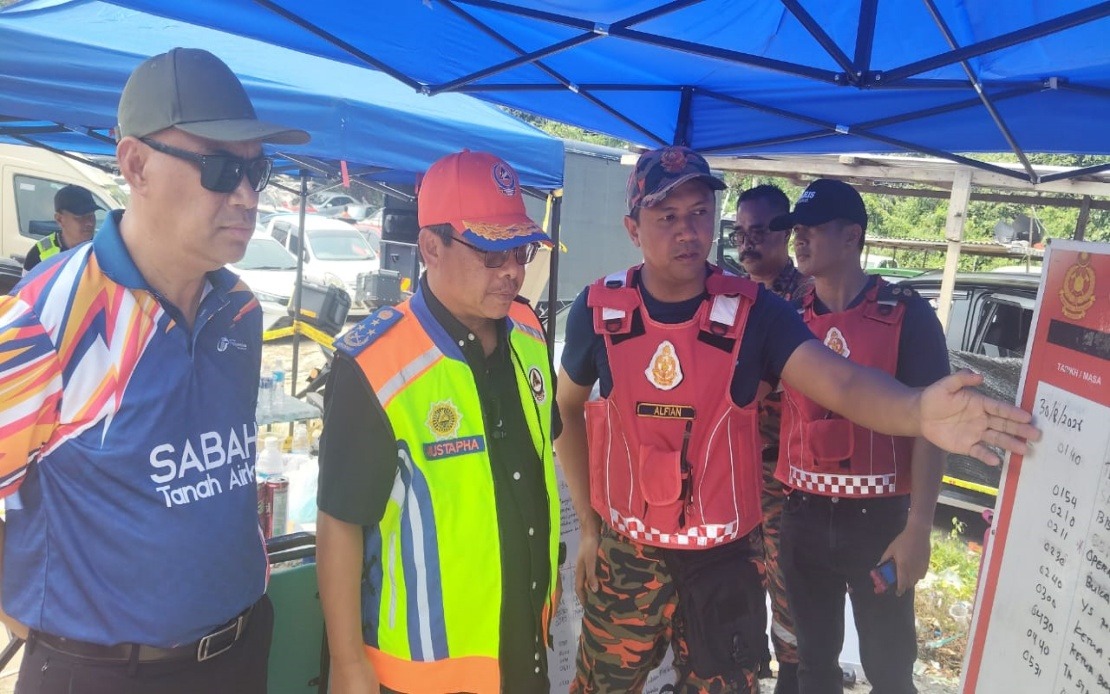
A major fire that swept through Kampung Lok Buta in Kota Kinabalu early Friday morning has left three young children dead and rendered over 200 families homeless, triggering an emergency response from federal and state authorities. The blaze, which erupted at 1.40 am, consumed more than 200 residential structures in what has become one of the region's most serious domestic disasters in recent months. To manage the humanitarian crisis, authorities have established two temporary relief centres at Dewan Kampung Likas and Dewan Damai to provide shelter and coordinate assistance for more than 200 displaced victims.
Minister in the Prime Minister's Department (Sabah and Sarawak) Datuk Mustapha Sakmud announced that the relief facilities would serve as registration points and distribution hubs for aid materials, while also enabling the comprehensive documentation of all those affected. The immediate activation of these centres reflects the scale of the emergency and the need to systematise assistance efforts during the chaotic aftermath of such a catastrophe. Mustapha's department, which oversees federal-state coordination in East Malaysia, has taken a leading role in ensuring that the response transcends administrative boundaries and operates with maximum efficiency.
Kota Kinabalu City Hall (DBKK) formally declared the affected area a disaster zone following Mustapha's inspection of the site. This administrative designation unlocks additional resources and expedites the deployment of emergency services, as well as simplifying the bureaucratic pathways through which relief and reconstruction assistance can flow. The declaration carries significant implications for insurance claims, rebuilding permits, and access to disaster recovery funds, providing a crucial framework for affected residents to rebuild their lives.
The three victims have been identified as Nana Abdullah, aged 4; her brother Mohd Asrul Abdullah, aged 6; and their cousin Nurfarahdilah Mohd Tajihah, aged 8. Their deaths underscore the particular vulnerability of young children in fire emergencies, where rapid evacuation and limited mobility become matters of life and death. The loss of three members of an extended family within a single night has devastated the community and drawn regional attention to fire safety concerns in densely populated residential areas.
Mustapha stressed the importance of identifying and assisting students whose education may be disrupted by the disaster. He committed to briefing the Ministry of Education about affected pupils across primary schools, secondary institutions, and Technical and Vocational Education and Training (TVET) programmes. This pedagogical dimension of disaster response reflects growing recognition that educational continuity is essential for child welfare and long-term community recovery, particularly in economically vulnerable populations where school disruption can compound existing disadvantages.
The Kota Kinabalu City Hall mayor and District Disaster Management Committee chairman Datuk Seri Dr Sabin Samitah accompanied Mustapha during the site visit, signalling integrated coordination between municipal and federal authorities. Mustapha called for urgent meetings between DBKK and relevant agencies to develop a comprehensive assistance strategy addressing both immediate needs and longer-term reconstruction priorities. Such inter-agency dialogue is essential in the Malaysian context, where responsibility for disaster response is distributed across multiple government levels and departments.
Mustapha indicated that the Malaysia Agreement 1963 (MA63) Implementation Action Council would convene to address the crisis, with both Prime Minister Datuk Seri Anwar Ibrahim and Sabah Chief Minister Datuk Seri Hajiji Noor expected to attend. This high-level engagement reflects the political significance of the disaster and the need for coordinated federal-state action. The council meeting would provide an opportunity for DBKK leadership to brief national leaders directly on the situation and requirements for affected residents, ensuring that Sabah's concerns receive prominence in federal decision-making.
Mustapha announced that initial financial assistance would be provided to the families of the three deceased children, acknowledging the acute hardship imposed by sudden loss combined with material displacement. Beyond the immediate tragedy of bereavement, families now face the practical challenges of securing shelter, replacing destroyed possessions, and managing grief whilst navigating the bureaucratic dimensions of disaster response. Early financial support, though necessarily limited, can ease some of these burdens during the most critical period following the tragedy.
The Kampung Lok Buta fire has exposed vulnerabilities in fire prevention and emergency response within Kota Kinabalu's informal residential zones, where housing density, building materials, and fire access routes may not meet contemporary safety standards. The destruction of over 200 homes in a single incident suggests the possibility of rapid fire spread through inadequately separated structures, a pattern common in established kampung settlements where development has occurred incrementally over decades without comprehensive fire safety planning. The incident will likely prompt scrutiny of building codes, fire brigade resource allocation, and community education in fire prevention across similar neighbourhoods throughout Sabah and Sarawak.
For Malaysian readers, the Kampung Lok Buta fire represents both an immediate human tragedy and a broader policy challenge regarding urban fire safety, particularly in settlements serving low-to-middle income populations. The establishment of relief centres and high-level political engagement demonstrates the institutional capacity to mobilise resources quickly when disasters occur. However, the loss of three young lives and displacement of over 200 families also highlights the importance of preventive investment in fire safety infrastructure, building code enforcement, and community fire awareness programmes that can reduce the frequency and severity of such incidents in future.

