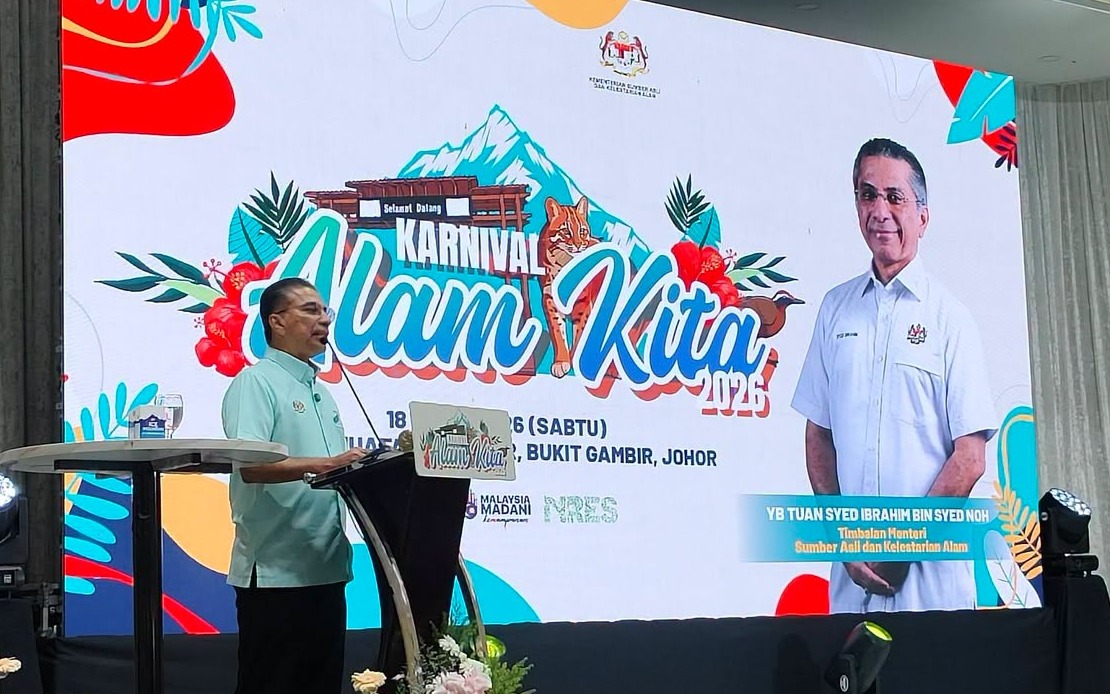
The Ministry of Natural Resources and Environment is bringing its flagship environmental awareness campaign, Karnival Alam Kita 2026, to Johor as part of a broader push to embed sustainable living practices into the daily routines of Malaysian communities. The initiative reflects a strategic shift in how the government communicates environmental responsibility—moving away from abstract policy discussions toward tangible, practical demonstrations that help ordinary Malaysians understand their role in the nation's green transition.
Deputy Minister Syed Ibrahim Syed Noh underscored the philosophy underpinning this year's carnival, emphasising that the ministry has deliberately restructured its outreach to place information, technology, and sustainable solutions within reach of citizens. Rather than presenting sustainability as a distant, technical concern, the carnival framework allows residents to observe firsthand how environmental practices integrate into domestic routines, workplace habits, and community interactions. This approach addresses a persistent challenge in environmental messaging: the gap between public awareness of global issues and their willingness or ability to act locally.
Central to the ministry's messaging is the contention that environmental stewardship cannot remain the exclusive domain of government agencies or environmental specialists. Instead, Syed Ibrahim framed sustainability as a shared responsibility beginning at the household level, extending through schools and workplaces, and permeating community structures. This devolution of responsibility reflects international best practice in environmental governance, where transformative change typically requires coordination across multiple societal layers rather than top-down mandates alone.
The deputy minister acknowledged a communications challenge that resonates across the Asia-Pacific region: most citizens understand sustainability through high-level terminology—rare earth elements, e-waste, climate change, forestry—yet struggle to connect these concepts to their immediate lives. Malaysian families grappling with daily consumption decisions, electronic device disposal, and household waste management often do not recognise these activities as components of the larger sustainability agenda. By reframing environmental action in vernacular, accessible language, the carnival seeks to dissolve the perceived distance between individual behaviour and systemic environmental outcomes.
Amongst the carnival's flagship initiatives is the Young Environmental Ambassador Programme, a structured training framework targeting secondary school students. The programme aims to cultivate a cadre of youth leaders equipped with environmental knowledge and motivated to influence peer behaviour and family practices. Given Malaysia's youthful demographic profile, this investment in young ambassadors carries significant multiplier potential—student-led sustainability initiatives in schools have demonstrated measurable impacts on household recycling rates, water conservation, and waste reduction across Southeast Asian case studies.
Simultaneously, the NRES Lestari Squad, in partnership with waste management entity Bateriku (M) Sdn Bhd, executed KUDAH, a targeted waste collection operation. The initiative successfully recovered 37 kilograms of discarded materials, including 17.3 kilograms of plastic bottles destined for conventional landfill. The quantification of environmental impact—translating collected plastic into an estimated 43.2 kilograms of carbon dioxide equivalent averted, equivalent to emissions avoided through approximately 100 kilometres of vehicle non-use—makes abstract sustainability gains tangible and measurable for participants.
The carnival's programme architecture incorporates multiple engagement pathways, ranging from electronic waste recycling campaigns to used cooking oil recovery schemes, biodiversity exhibitions, and marketplace activations featuring certified green products. This diversified menu reflects the recognition that different community segments respond to different messages and engagement mechanisms. Some participants may be motivated by waste reduction outcomes, others by health and food security implications of sustainable practices, still others by economic opportunities within the green economy.
From a Malaysian and Southeast Asian perspective, the carnival's focus on translating sustainability into household practice addresses a critical implementation gap. While regional governments have committed to net-zero carbon targets and sustainable development frameworks, actual progress depends on millions of individual decisions around consumption, waste, and resource use. The Karnival Alam Kita 2026's emphasis on practical demonstration and accessible communication represents a pragmatic recognition that policy frameworks alone prove insufficient without corresponding shifts in public behaviour and household practices.
The Johor deployment carries particular significance given the state's industrial footprint, consumer population density, and role as a major economic engine within Malaysia. Successful embedding of sustainability practices in Johor's communities creates proof-of-concept opportunities for scaling similar initiatives across other states, whilst also positioning Malaysia as a regional leader in community-centred environmental governance. For multinational corporations and international investors operating within Malaysia, demonstrated commitment to public environmental engagement may influence investment decisions and enhance the country's positioning within global sustainability rankings.
The ministry's approach also reflects evolving international understanding of environmental governance, wherein authentic behavioural change requires going beyond information provision to create enabling conditions—accessible technology, community support structures, and visible peer adoption—that facilitate sustainable choices. By hosting interactive activities and partnering with non-governmental organisations, the carnival acknowledges that government authority alone carries limited persuasive power in lifestyle transformation.
Looking forward, the success of Karnival Alam Kita 2026 will likely depend not merely on immediate participation metrics but on sustained behavioural outcomes in participating communities. Longitudinal tracking of waste reduction, recycling participation, and adoption of sustainable practices among carnival participants would provide evidence of whether the carnival format generates lasting environmental action or represents episodic awareness-raising. Such data would inform the ministry's strategy for subsequent carnival iterations and broader environmental education programming.
The carnival's nationwide expansion following Johor's launch will test whether the accessibility-focused messaging and practical demonstration model can sustain engagement across Malaysia's diverse demographic, economic, and geographic contexts. Urban professionals, rural agricultural workers, and semi-urban families may each require tailored communication frameworks and locally contextualised sustainability solutions. The ministry's capacity to adapt the carnival's core framework to reflect regional environmental priorities whilst maintaining consistent messaging about shared responsibility will ultimately determine its effectiveness in advancing Malaysia's environmental sustainability agenda.

