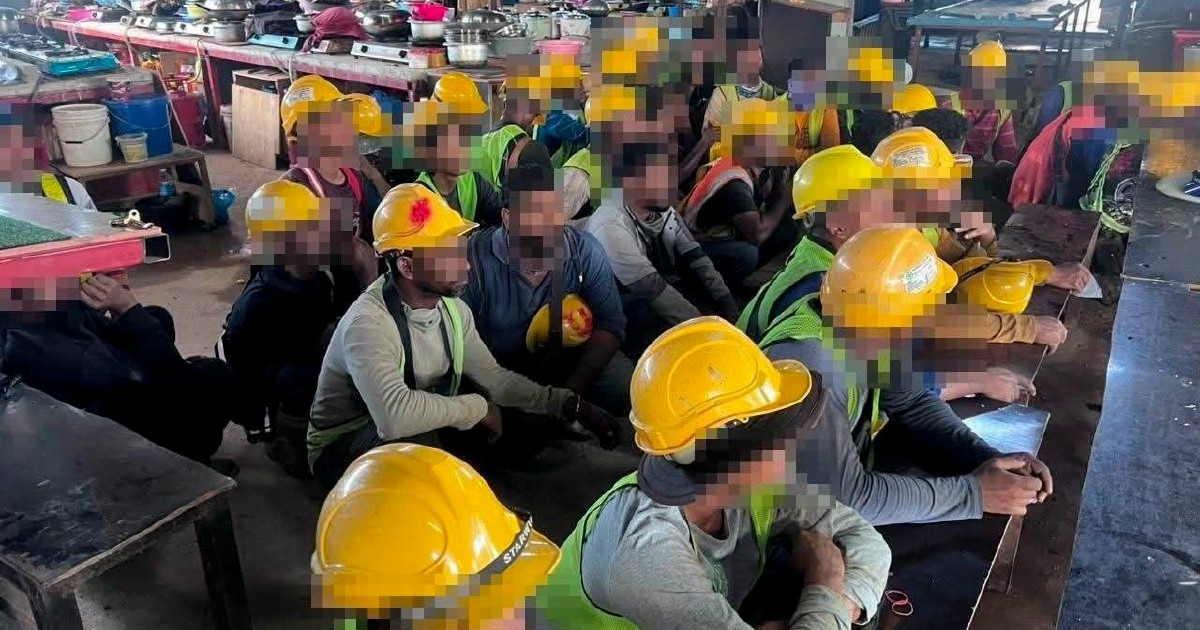
Enforcement officials in Kedah have intensified their migration control operations, with the latest development seeing 81 undocumented workers apprehended at a single construction site in Kuala Kedah. The arrests, made during the targeted Op Sapu initiative, represent a significant sweep that has drawn attention to the persistent challenge of irregular employment in Malaysia's northern state, particularly within the high-demand construction sector where labour shortages have historically created vulnerability to hiring undocumented workers.
The Kedah Immigration Department conducted the operation, marking another phase in what appears to be an escalating series of enforcement actions across the state. Op Sapu, which translates loosely as "sweep operation," has become a regular mechanism for immigration authorities to identify and detain foreign nationals without valid documentation. Construction sites have emerged as focal points for these raids, given their seasonal nature, high workforce turnover, and often remote locations that make them attractive to employers seeking to circumvent standard hiring protocols.
Construction remains one of Malaysia's most vulnerable sectors for irregular employment, driven by fierce price competition among contractors and the labour-intensive nature of building projects throughout the country. In Kedah, where infrastructure development continues to drive economic growth, the demand for workers has outpaced the availability of documented foreign labour, creating incentives for employers to overlook immigration status in favour of immediate workforce availability. The sector's reliance on manual labour, coupled with minimal penalty enforcement at the business level in many cases, perpetuates cycles where undocumented workers find employment despite regulatory prohibitions.
The capture of 81 individuals in a single operation underscores the scale at which undocumented employment can operate even at individual work sites. This volume suggests either significant coordination among employers willing to hire irregular workers, or a particular construction project of considerable scope requiring substantial workforce deployment. Either scenario reflects broader structural issues within Malaysian labour management that extend beyond simple immigration violations into questions about supply chain accountability and contractor responsibility throughout the building industry.
For undocumented migrants themselves, these enforcement actions carry serious consequences. Beyond immediate detention and legal processing, individuals face deportation proceedings that can disrupt family arrangements, eliminate income sources, and result in re-entry prohibitions that complicate their future mobility. Many undocumented workers arrive in Malaysia through organised networks promising employment, only to find themselves in vulnerable situations with minimal legal recourse should they face wage theft, workplace injury, or exploitation. The Op Sapu approach, while necessary for maintaining rule of law, addresses symptoms rather than underlying demand for irregular labour.
The timing and frequency of such operations often reflects political and administrative cycles rather than consistent enforcement strategy. Immigration enforcement resources are distributed across competing priorities, and construction site raids generate visible outputs—large arrest numbers and media coverage—that demonstrate departmental effectiveness to oversight bodies and the public. This creates incentive structures that may not align perfectly with the most effective deterrence mechanisms against employers who knowingly hire undocumented workers, a gap that remains a persistent challenge in Malaysian immigration administration.
Kedah's geographical position as a border state adjacent to Thailand adds layers of complexity to migration management. Cross-border movement, established smuggling networks, and the relative ease of irregular entry along parts of the shared boundary mean that Kedah experiences higher volumes of undocumented population than many other states. This structural reality places particular pressure on state-level immigration enforcement, even as federal policies and international agreements shape the broader context within which such enforcement occurs.
The construction industry's dependence on migrant labour—both documented and undocumented—creates a fundamental tension in Malaysia's economic model. Official policies emphasize skills shortages and legitimate labour importation, yet enforcement simultaneously targets irregular workers whose availability supports price points and project timelines upon which the industry depends. Without comprehensive reform addressing the demand side of this equation, enforcement operations like Op Sapu may achieve temporary disruption but rarely produce lasting structural change in hiring practices.
Regional implications extend beyond Kedah's borders, as construction workers from Thailand, Myanmar, Bangladesh and other neighbouring countries form part of Malaysia's broader migrant workforce. The crackdown reinforces the risks of irregular migration for workers and smugglers alike, potentially affecting patterns of undocumented entry and movement throughout Southeast Asia. Other states monitoring these enforcement trends may adjust their own operational priorities accordingly, creating ripple effects across Malaysia's construction sector.
Moving forward, the sustainability of such enforcement depends on coordination between immigration authorities, labour inspectorates, and industry bodies to address systematic hiring of undocumented workers. The 81 detainees from Kuala Kedah will progress through deportation procedures, but without corresponding enforcement pressure on employers themselves, the underlying incentive structures driving demand for irregular workers will persist. Comprehensive approaches combining inspections, penalties, and workforce regularisation programmes have shown greater long-term effectiveness in neighbouring jurisdictions, offering potential templates for Malaysian policy reform.

