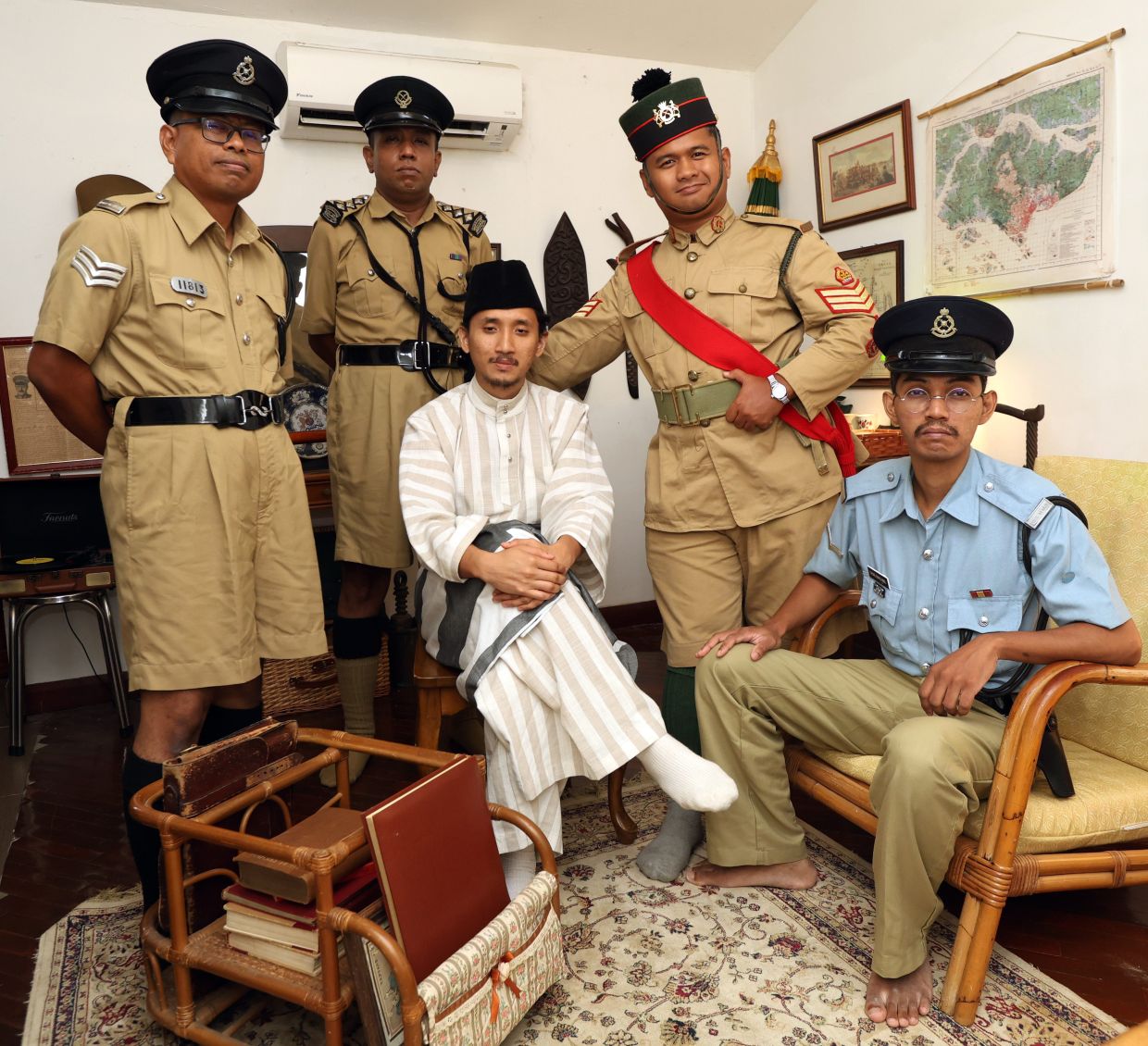
Weekend gatherings in PRUS meeting spaces have transformed into something far more purposeful than casual hobby sessions. Members of Persatuan Reka Ulang Sejarah arrive dressed meticulously in historical military uniforms, creating an atmosphere where Malaysia's past is not merely discussed but physically embodied and demonstrated. What began as informal gatherings among vintage uniform collectors has evolved into a registered society with an explicit mission: making Malaysian history accessible and tangible, particularly for young people who might otherwise encounter it only through the abstractions of textbooks and classroom lectures.
The organization's origins trace back to the early 2010s, when military enthusiasts and uniform collectors convened at events hosted by the Port Dickson Army Museum near the decommissioned Royal Malaysian Air Force Base in Sungai Besi, Kuala Lumpur. These early gatherings operated under the informal banner "We Are Re-enactors" before the group formalized itself as Persatuan Reka Ulang Sejarah in 2023, a move that fundamentally expanded their capacity to engage with educational institutions and cultural venues. This transition from casual collectors to an officially recognized society reflects a broader recognition that historical preservation requires structure and legitimacy, particularly when the goal involves accessing schools and museums.
Abdul Hakim Abdul Rani, the group's chairman, describes a specific catalyst for formalizing the collective effort. He had observed considerable public confusion regarding historical military uniforms, especially from eras when photographs remained exclusively in black and white and when different military branches appeared visually indistinguishable to the untrained eye. This knowledge gap motivated him and fellow members to channel their expertise outward, transforming private collection and discussion into public education. "We wanted to share the knowledge we have and spread awareness on this subject," he explains. Official registration enabled the group to approach schools and museums with structured programming rather than ad-hoc appearances, lending credibility to their educational mandate.
What distinguishes PRUS from simple costume enthusiasts lies in their meticulous commitment to historical accuracy extending far beyond the uniforms themselves. Different military eras carried distinct protocols governing posture, body language, marching techniques, and even modes of speech—details that casual observers might overlook but which fundamentally shape how history communicates itself to audiences. Abdul Hakim, who works professionally as a tour guide and previously served in the Territorial Army, emphasizes that accuracy serves an educational rather than entertainment function. The group explicitly rejects the notion that re-enactment exists primarily for enjoyment; instead, they position their work within a framework of pedagogical responsibility toward preserving and transmitting historical understanding.
This commitment materialized tangibly during a two-day jamboree conducted in July, where PRUS members underwent structured training in period-appropriate marching, map reading, navigation techniques, and basic combat manoeuvres derived from original pre-Independence military manuals. Abdul Hakim led these sessions drawing directly from his own military background, ensuring that training reflected authentic protocols rather than imaginative reconstruction. Significantly, all weapons used during combat demonstrations were replaced with sticks, a pragmatic compliance measure that maintained educational integrity while respecting modern regulations and safety requirements. The jamboree's purpose was not to glorify combat but to illuminate how soldiers of that historical period actually conceptualized and executed their duties.
The group's engagement with Malaysia's film and television industry represents another dimension of their historical preservation work. PRUS members regularly consult on productions requiring period accuracy, advising directors and costume departments while occasionally appearing as extras to ensure visual fidelity to the era being depicted. Mohd Fadzreeq Mokti, the group's vice chairman, articulates this role as extending far beyond acting in the conventional sense. When PRUS members appear in uniform on screen or at public events, they are consciously performing historical authenticity itself—demonstrating not merely how people looked during particular periods but how they moved, spoke, and conducted themselves socially. This distinction proves crucial for audiences absorbing historical information through visual media, where inaccuracy can calcify into false historical memory.
The group's activity intensifies noticeably during August and September, when National Month and Malaysia Day programming dominates public discourse and institutional calendars. These periods provide PRUS with amplified opportunities to display their collections at exhibitions and educational events, reaching youth audiences who might otherwise never encounter historical materials beyond classroom instruction. Abdul Hakim has observed with concern that certain students demonstrate unfamiliarity with significant historical figures and pivotal national events—gaps he attributes partly to the limitations of conventional teaching methodologies. He views this knowledge deficit as a pressing concern warranting intervention, positioning schools as critical venues for introducing historical engagement during formative educational years when curiosity and receptiveness remain highest.
Mohd Fadzreeq, who teaches in a school setting himself, has witnessed firsthand the impact of embodied historical presentation. When he appears at his own school in historical uniform—an arrangement approved by school leadership—students respond with visibly heightened engagement and enthusiasm. Pupils repeatedly inquire when he will return wearing those uniforms, indicating that the visual and tangible presence of historical materials activates learning mechanisms that conventional classroom resources fail to trigger. He identifies a fundamental pedagogical principle underlying PRUS's work: young children learn most effectively through hands-on, multisensory engagement rather than abstract information transmission. The absence of accessible museums and historical sites in many communities exacerbates this limitation, making PRUS's interventions particularly valuable for students with limited exposure to material history.
The concept of PRUS members functioning as "walking museums" encapsulates their educational philosophy succinctly. These individuals do not merely display uniforms for aesthetic appreciation; they embody historical periods, actively answering questions and contextualizing artifacts for curious observers. This interactive approach transforms passive observation into dialogue, allowing audiences to formulate questions prompted by what they encounter and to receive answers grounded in rigorous study. Members invest considerable time studying historical manuals, military archives, and period-specific documentation to ensure their responses reflect genuine historical knowledge rather than speculation or popular misconception. This preparatory work remains largely invisible to public audiences but constitutes the foundation enabling PRUS to function as credible historical interpreters rather than costumers.
The significance of PRUS's work extends beyond individual student engagement to broader questions about how Southeast Asian societies maintain connection with their pre-Independence and early-Independence histories. Malaysia's rapid modernization and urbanization have created temporal distance from these formative periods, risking collective amnesia regarding the military and civilian experiences that shaped national development. Through immersive re-enactment and museum engagement, PRUS combats this historical erosion by making the past viscerally present and accessible. Their work demonstrates that historical preservation need not remain confined to academic institutions or elite collectors; instead, it can flourish through passionate communities dedicated to translating specialized knowledge into public understanding.
For Malaysia's educational ecosystem, PRUS represents a model of community-driven historical engagement that supplements institutional frameworks without requiring substantial government resources. Schools facing curriculum pressures and limited access to museum programming can invite PRUS members to conduct interactive sessions, transforming history lessons into memorable experiences. The group's expansion and formalization suggest growing recognition that historical literacy represents a public good worthy of sustained effort. As Malaysia continues navigating contemporary challenges, maintaining informed understanding of national history—particularly regarding military development, pre-Independence movements, and early nation-building—provides essential context for civic consciousness and national cohesion. PRUS's members, whether they recognize it explicitly or not, function as custodians of this crucial historical memory, translating antiquated uniforms and period documents into living history that resonates with younger generations.

