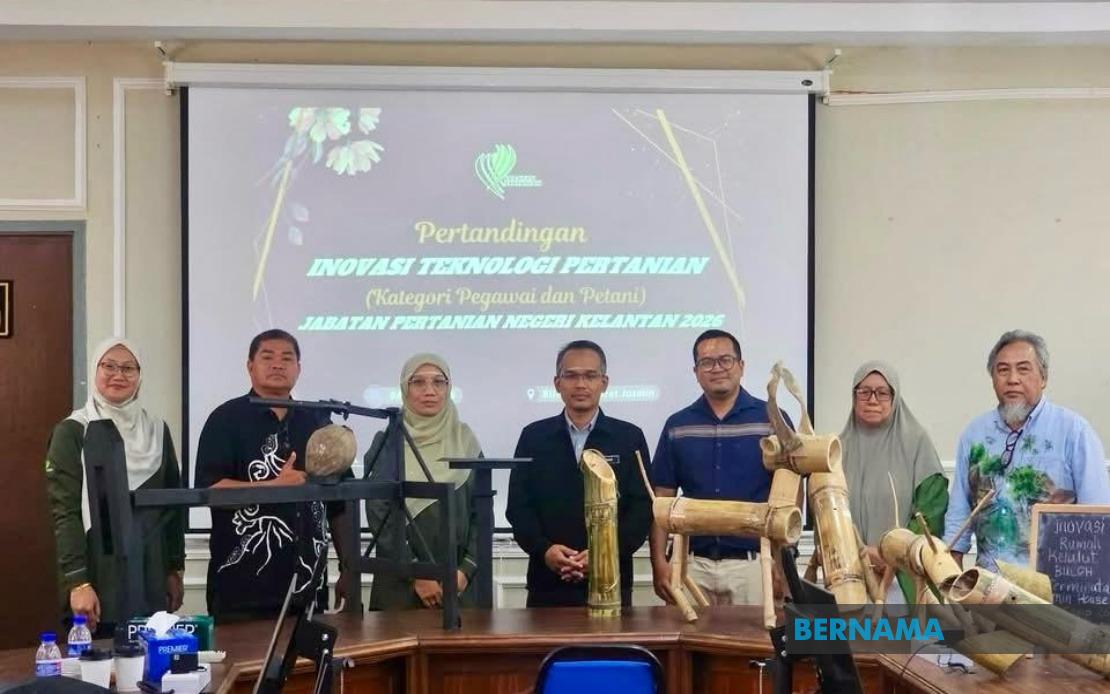
Che Adnan Che Kadir, a 56-year-old plantation entrepreneur from Kelantan, has developed a portable coconut dehusking device that earned a four-star rating at the state level and is now being considered for adaptation to process durians, one of Malaysia's most commercially valuable agricultural products. The recognition comes from the Kelantan Department of Agriculture's 2026 Agricultural Technology Innovation Competition, where judges identified the invention's potential to address challenges across multiple fruit categories. The achievement represents a significant milestone for agricultural innovation in the state and underscores growing interest in mechanising labour-intensive farming processes across Southeast Asia's agricultural sector.
The judging panel, comprising representatives from the Kelantan Department of Agriculture, the Malaysian Agricultural Research and Development Institute (MARDI), and various polytechnics, suggested expanding the device's application beyond coconuts after witnessing its engineering design and operational efficiency. Durian processing emerged as the priority for development, given the crop's economic importance to Malaysia and the inherent difficulties in opening the spiky fruit safely. Areca nuts were also mentioned as potential candidates for the technology's adaptation, reflecting broader industry interest in reducing manual labour and improving worker safety across tropical agriculture.
Che Adnan explained that the judges' suggestion to explore durian applications came as an unexpected endorsement of his original concept. His initial motivation was pragmatic—solving the everyday challenges of coconut dehusking on his six-hectare farm in Kampung Chetok, Pasir Mas. However, the competitive evaluation process revealed that the mechanical principles underlying his design held promise for scaling up to industrial applications and serving a much larger agricultural market. This recognition has motivated him to pursue further development and commercialisation, viewing his farm-level innovation as the foundation for a potential industry-wide solution.
The technical performance of the device demonstrates why agricultural judges and MARDI officials saw commercial potential. The portable 3.5-kilogramme machine reduces coconut dehusking time from the traditional two to three minutes per fruit down to approximately one minute, with experienced operators achieving results in forty to forty-five seconds. This dramatic efficiency gain directly translates to labour cost savings and increased throughput for commercial coconut processors, smallholder farmers, and agricultural businesses operating across Malaysia and the wider region. The portability aspect is equally significant, allowing the device to be deployed across different farm locations without requiring permanent infrastructure installation.
For durians specifically, the case for mechanisation is compelling. Durian processing currently demands considerable skill and carries genuine occupational hazards—the thick, thorny husk requires careful manipulation to avoid hand injuries, and inconsistent technique can damage the flesh beneath. Malaysia's durian industry, worth billions in both domestic consumption and export markets, relies heavily on manual labour for processing. A successful adaptation of Che Adnan's technology could standardise the opening process, reduce injury risk, and potentially increase processing capacity during peak harvest seasons when labour shortages often constrain supply chains.
Che Adnan's award victory two days before speaking to BERNAMA qualifies him as a candidate to represent Kelantan at the national competition during National Innovation Week in Putrajaya, scheduled for late September. Progression to the national level would elevate the innovation's profile significantly and provide access to broader funding opportunities and industry partnerships. The national platform also offers visibility to potential investors, agricultural equipment distributors, and government agencies seeking to support Malaysian agricultural technology development.
To strengthen his competitive position at the national stage, Che Adnan must implement recommendations from the state-level judges. These improvements focus on refining the mechanical design, optimising the device's durability under continuous commercial use, and adapting it for durian processing. He is actively seeking an innovation grant to fund these refinements, which would enable prototype testing, design iteration, and assessment of production scalability. The financial support would also facilitate collaboration with engineering specialists and agricultural research institutions to validate the technology's effectiveness across different durian varieties and processing scenarios.
The potential RM10,000 national innovation grant, while modest in absolute terms, provides crucial seed funding for product development. Beyond the financial component, grant recipients gain access to technical mentorship, market analysis support, and networking opportunities within Malaysia's agricultural innovation ecosystem. These non-monetary benefits often prove as valuable as direct funding, particularly for individual inventors transitioning from single-farm applications to broader commercialisation. Government support through such grants reflects Malaysia's strategic interest in agricultural modernisation and reducing the sector's reliance on migrant labour, themes increasingly relevant across Southeast Asia.
The economic implications of successful durian mechanisation extend beyond individual farmers. Malaysia's durian export industry faces growing international competition from Thailand, Vietnam, and Indonesia, where labour costs remain lower. Technological advantages in processing efficiency, quality consistency, and worker safety could provide Malaysian producers with competitive differentiation in premium markets. Durian is typically handled as a premium product commanding high prices in Singapore, China, and other affluent Asian markets where consumers are willing to pay for quality and consistency—attributes that standardised mechanical processing could deliver.
Che Adnan's journey illustrates a broader pattern in agricultural innovation across developing economies: farmers identifying practical problems on their own farms and engineering solutions that could scale regionally. His willingness to subject his innovation to independent evaluation, accept expert feedback, and pursue formal commercialisation pathways distinguishes his approach from many small-scale innovations that remain confined to individual operations. The Kelantan Department of Agriculture's competition structure actively encourages this progression, creating visible pathways for farm-level inventors to access resources and expertise necessary for market development.
The potential for technology transfer and licensing arrangements also warrants attention. Once refined and validated, the durian processing device could be licensed to agricultural equipment manufacturers, smallholder farming cooperatives, or agribusiness companies, creating additional revenue streams for Che Adnan while accelerating market penetration. Such arrangements are increasingly common in Southeast Asia, where institutions and private companies actively seek locally-developed technologies suited to regional agricultural conditions. This model also preserves intellectual property rights for original inventors while distributing commercialisation risks across multiple parties.
Looking forward, Che Adnan's innovation demonstrates why agricultural technology remains a priority development area for Malaysia. The country's agricultural sector faces persistent challenges: an ageing farmer population, declining rural youth participation, labour shortages exacerbated by migration to urban centres, and the need to maintain competitiveness in global commodity markets. Innovations that address worker safety, boost productivity, and improve product quality simultaneously attack multiple structural challenges. Success at the national innovation competition would position Che Adnan's device as a potential model for addressing similar mechanisation opportunities across Malaysia's diverse agricultural landscape, from palm oil processing to spice production and beyond.

