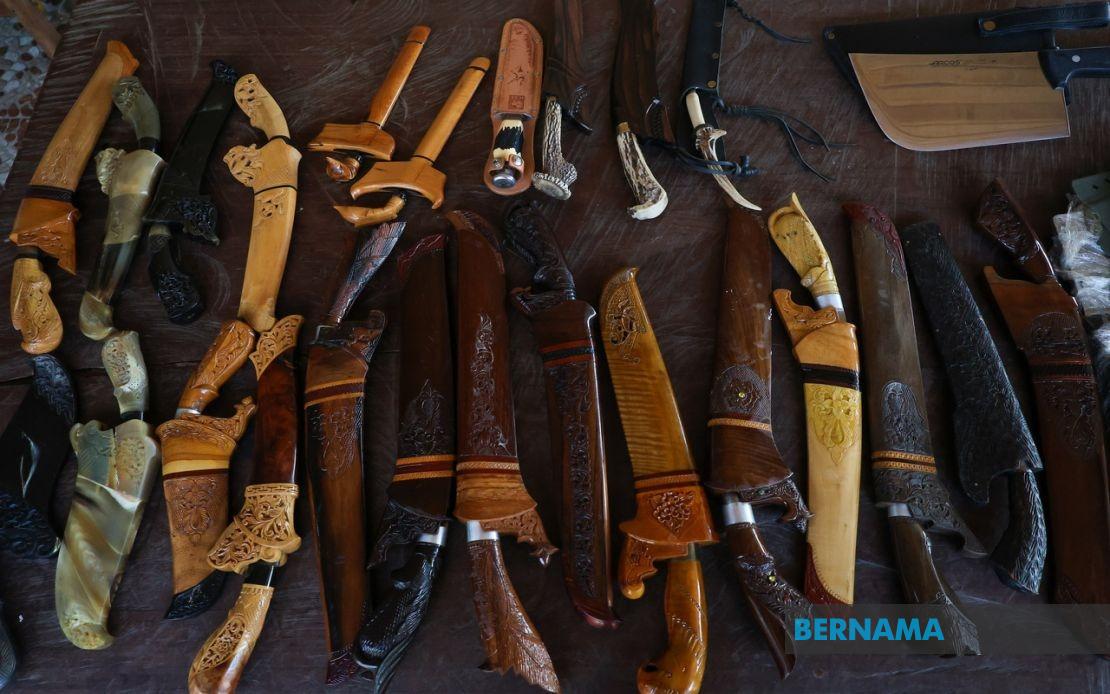
The distinctive bird-headed golok symbolises a fading chapter in Malaysia's cultural history. As Kelantan's master blacksmiths pass away without passing their skills to younger generations, traditional weapon-making faces existential threat. One collector's dedicated preservation effort now stands as a quiet testament to the region's once-thriving craftsmanship, underscoring the urgency of safeguarding a heritage at risk of disappearing entirely within a generation.
Ahmad, 71, has emerged as an unlikely custodian of this vanishing legacy. Over two decades, he has assembled an impressive collection of more than 100 traditional and modern weapons valued at approximately RM20,000, representing pieces acquired from across Europe, Asia and North America. His holdings span machetes, knives, swords and keris, each representing distinct eras and regional techniques. Among his most treasured acquisitions are a Sarawak knife featuring a deer-antler hilt and a keris fashioned from black kemuning wood with a golden kemuning wood hilt, artefacts that carry the signatures of craftsmen no longer alive.
What drives Ahmad's passion is a profound recognition of what is lost when knowledge-holders pass away. He explains that whenever a master blacksmith dies without transmitting his expertise, essential craft knowledge and cultural memory vanish irretrievably. This understanding shapes his conviction that his collection serves a broader preservation purpose beyond personal enjoyment. Each blade in his cabinet represents not merely an object, but an irreplaceable repository of technical skill, aesthetic sensibility and historical consciousness that once animated Kelantan's workshops.
The significance of traditional Kelantan weapons extends beyond their martial function or commercial value. The bird motif adorning hilts, for instance, echoes ancient artistic traditions connected to the Petalawali figure historically depicted on sultanate vessels. These design elements transform functional tools into cultural artefacts, where every carving reflects the maker's unique artistic identity and technical mastery. In this sense, Ahmad observes, each handcrafted piece becomes a distinct work of heritage carrying its own narrative about regional identity and artistic lineage.
The bird-shaped hilt accomplishes dual purposes that illuminate traditional design philosophy. Ergonomically, it provides superior grip comfort during use. Simultaneously, it embodies historical and artistic significance, connecting contemporary blades to centuries-old visual language. This integration of form and meaning characterises the sophistication of traditional Kelantan blacksmithing, where practical functionality and cultural expression merged seamlessly.
Ahmad's collection strategy prioritises preservation over profit. Despite receiving collector interest, he has never considered selling pieces, particularly those crafted by now-deceased blacksmiths whose workmanship cannot be replicated. This refusal to commercialise reflects a curatorial mindset focused on preventing permanent loss rather than maximising financial returns. His approach suggests that some cultural assets possess value that transcends monetary calculation, serving instead as collective heritage requiring stewardship across generations.
Maintaining these artefacts demands rigorous discipline and technical knowledge. Ahmad stores his collection in a dedicated climate-controlled cabinet and conducts inspections every three months, applying protective oil to prevent blade deterioration and rust formation. This meticulous maintenance regime demonstrates that heritage preservation requires sustained practical effort beyond initial acquisition. The investment of time and resources reflects his understanding that without active conservation, even the most significant cultural objects will inevitably degrade and disappear.
Ahmad's journey into blacksmithing preservation began approximately 20 years ago through apprenticeship with a friend practising the craft. That casual introduction evolved into deep engagement with weapon hilt and scabbard fabrication, gradually expanding into systematic collection-building. His trajectory illustrates how personal curiosity can transform into cultural stewardship, demonstrating that heritage preservation often emerges through individual initiative rather than formal institutional structures.
The geographic scope of Ahmad's acquisitions reveals how traditional weapon-making transcends Kelantan's boundaries. His collection encompasses pieces from Germany, Sweden, Denmark, England, the United States, Japan, China, Spain and Portugal, indicating that blade-making traditions share common technical and aesthetic principles across diverse cultures. This international dimension enriches his collection while highlighting universal human expression through weaponcraft, even as distinctly Malaysian elements maintain distinctive prominence.
Looking forward, Ahmad envisions continuing Malaysia's traditional weapon-making heritage through simultaneous innovation and cultural preservation. He advocates for approaches that modernise craft practices while safeguarding the identity, artistry and cultural values defining the tradition. This balanced perspective recognises that heritage need not mean stagnation, but rather thoughtful evolution that respects foundational principles while adapting to contemporary contexts. His vision suggests viable pathways for maintaining craft relevance across generational transitions.
The broader implications of Ahmad's work extend beyond individual collecting. His efforts highlight systemic vulnerabilities in Malaysia's cultural preservation ecology. Without deliberate intervention—whether through formal apprenticeship programmes, institutional documentation projects or public recognition—entire craft traditions risk extinction. His collection serves as both warning and model, demonstrating both the fragility of heritage without active stewardship and the power of individual commitment to reverse cultural loss.
For Malaysian policymakers and cultural institutions, Ahmad's example raises urgent questions about how societies protect disappearing crafts. The bird-headed golok in his cabinet represents not merely a historical curiosity but a test case for national commitment to preserving living heritage. As urbanisation accelerates and younger Malaysians pursue alternative careers, the window for transmitting traditional blacksmithing knowledge narrows precipitously. Ahmad's preservation efforts cannot substitute for systemic cultural investment, yet they demonstrate what becomes possible when commitment meets opportunity.

