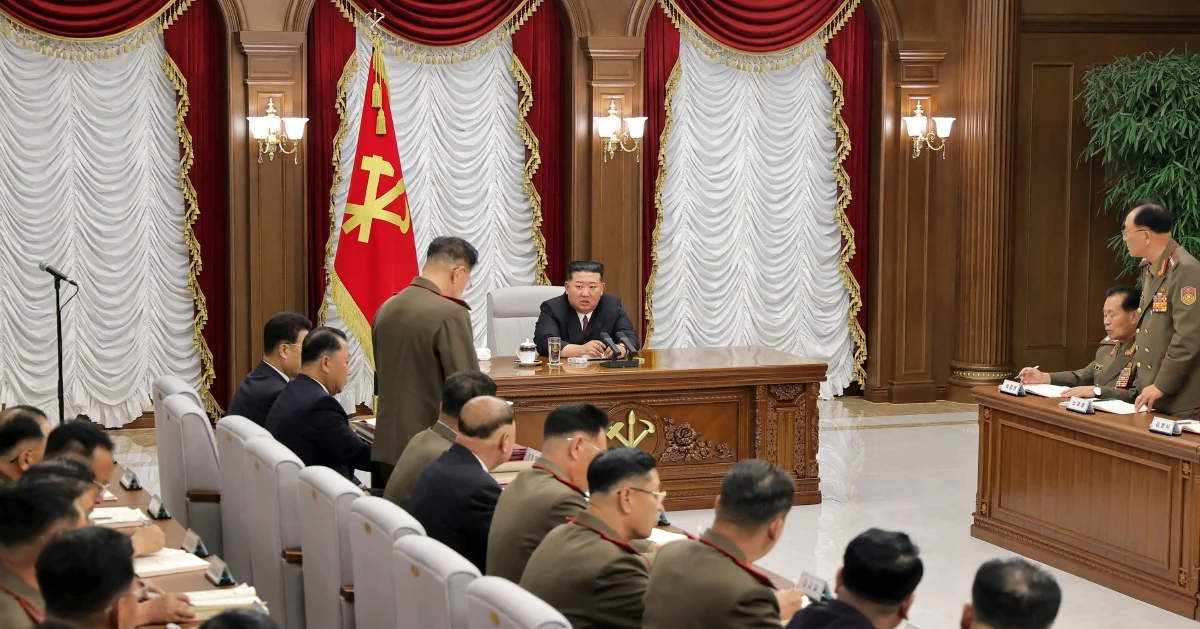
North Korean leader Kim Jong Un has executed a dramatic political purge, removing a senior military official from the ruling party and condemning his alleged corrupt practices as a serious "political crime," according to state media reports issued early Saturday. The move signals Kim's continued willingness to discipline top-tier military figures and suggests that internal corruption remains a persistent challenge within the tightly controlled regime.
The official accusation carries significant weight in North Korea's rigid political hierarchy, where being branded with accusations of graft represents a grave transgression. By publicly characterising the official's conduct as a "political crime" rather than a mere administrative failing, Kim's regime has signalled that the matter extends beyond simple financial impropriety to encompass what it views as fundamental betrayal of party loyalty and state interests.
The expulsion from the ruling party—a consequence severe in North Korea's one-party political system—reflects the regime's approach to maintaining order within its security apparatus. Military officials occupy a crucial position within Kim's consolidated power structure, and any suggestion of disloyalty or self-enrichment must be swiftly and visibly addressed to prevent broader institutional decay. The public nature of this denunciation serves as a warning to other senior officials about the consequences of corrupt behaviour.
Corruption within North Korea's military and government circles has periodically surfaced as an issue despite the regime's propaganda portraying itself as free from such vices. Senior officials sometimes exploit their positions to accumulate wealth or secure advantages for their families, taking advantage of grey areas in the regime's controlled economy. The fact that such cases reach the point of public exposure suggests they have either become too egregious to ignore or represent collateral damage in factional disputes within the regime's elite.
Kim Jong Un inherited a military structure that had grown entrenched under his father, Kim Jong Il, and his grandfather, Kim Il Sung. Since consolidating power following his father's death in 2011, the younger Kim has systematically reshuffled military leadership, removing or executing numerous senior commanders. These actions have served dual purposes: eliminating potential rivals while also projecting an image of decisive leadership that tolerates no dissent or corruption.
The timing of such purges often corresponds with broader policy shifts or periods of heightened international tension. By demonstrating that even senior military figures remain subject to party discipline, Kim maintains psychological control over the security apparatus and reinforces the principle that loyalty to his person supersedes all other considerations. For military officers, the message is unambiguous: personal enrichment or perceived disloyalty invites severe consequences.
For regional observers, including Malaysian analysts monitoring North Korean developments, such internal purges offer insights into the regime's stability and the nature of power dynamics within Pyongyang's elite circles. While the regime presents itself as monolithic, these periodic removals indicate ongoing tensions and factional interests within the military and party structures. Understanding these dynamics helps regional powers assess North Korea's decision-making processes and the extent to which military leaders maintain influence over strategic policy.
The regime's state media machinery plays a crucial role in such purges, using official announcements to craft the narrative around removals and convey messages to both domestic and international audiences. By framing the case as a matter of principle—the protection of party integrity against corruption—North Korean authorities attempt to legitimise the punishment and preempt any perception that the purge reflects factional infighting or arbitrary leadership decisions.
For Southeast Asian nations with diplomatic or trade relations with North Korea, these internal developments carry implications for continuity and reliability in bilateral engagement. A regime preoccupied with internal security matters and leadership consolidation may prioritise military and security concerns over economic development or diplomatic normalisation. The ongoing pattern of senior official removals underscores that North Korea's political system remains volatile beneath its carefully maintained facade of stability.
The broader context of military purges in North Korea reflects a regime perpetually concerned with potential challenges to Kim Jong Un's authority. By making examples of corrupt officials, the leadership seeks to establish a culture of fear and obedience rather than one based on institutional trust or established procedures. This approach, while effective in the short term for maintaining control, carries long-term costs for institutional development and the establishment of predictable governance structures.
Looking ahead, the frequency and severity of such purges may indicate whether the regime faces emerging challenges to stability or whether Kim's consolidation of power has reached a sufficiently secure level that purges become less frequent. Observers of North Korean affairs, particularly those in the region concerned with stability on the Korean Peninsula, will continue monitoring these internal developments as potential barometers of regime health and the military's role in future policy direction.

