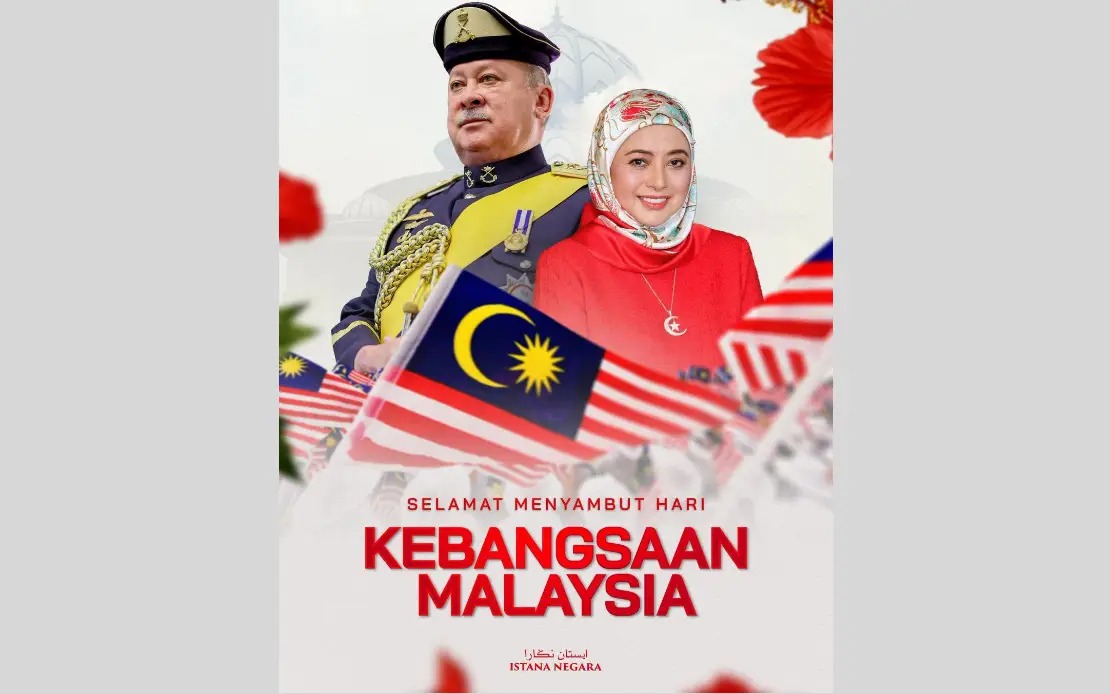
Sultan Ibrahim Sultan Iskandar and Raja Zarith Sofiah marked Malaysia's 69th National Day by extending warm greetings to all Malaysians through an official royal message shared on the King's Facebook page. The gesture underscores the monarchy's continued connection with citizens as the nation commemorates another year of independence and sovereignty.
Their Majesties arrived in Putrajaya at 8 am to officiate the principal National Day celebration, where they received a ceremonial welcome from Prime Minister Datuk Seri Anwar Ibrahim and his wife Datuk Seri Dr. Wan Azizah Wan Ismail. Communications Minister Datuk Seri Fahmi Fadzil, who chairs the National Day and Malaysia Day (HKHM) 2026 Main Committee, also attended the proceedings. The high-level reception reflected the significance government places on the annual commemoration as a unifying national occasion.
This year's celebration carried the thematic banner "Malaysia MADANI: Kesejahteraan Dinikmati" — translating to the wellbeing enjoyed by all — signalling the government's emphasis on inclusive prosperity and citizen-centred development. The theme extends beyond ceremonial rhetoric, embodying policy frameworks the administration has championed since taking office. For Malaysian audiences, it represents a conscious effort to link Independence Day messaging with tangible governance priorities around welfare distribution and social inclusion.
The Putrajaya event commenced with a formal military ceremony, establishing the dignified tone befitting a national commemoration. Following the martial display, the programme pivoted to entertainment and pageantry designed to showcase Malaysia's multicultural character and contemporary aspirations. Stage performances interspersed throughout the day offered cultural representation, while a carefully choreographed parade presented the visual centrepiece of festivities.
The scale of participation demonstrated the logistical complexity of organising such national events. The parade and march-past drew 10,819 participants organised across 76 separate contingents, indicating mobilisation across government agencies, civil society groups, and community organisations nationwide. This breadth of involvement transforms National Day from a government function into a coordinated expression of national identity spanning multiple institutional and social layers.
Military and ceremonial elements formed a substantial component, with 328 assets deployed across land, sea, and air domains. This comprehensive display underscores Malaysia's defence capabilities while providing visual drama to proceedings. The inclusion of 112 service animals — likely military or police units — added an additional ceremonial dimension, reflecting traditional pageantry elements that Malaysian audiences associate with state occasions.
The technological dimension of the celebration emerged through 22 electric vehicles incorporated into the parade sequence. Their presence signals environmental consciousness within national commemoration planning, aligning Independence Day messaging with contemporary sustainability concerns. For a nation positioning itself as a regional climate leader, such symbolic gestures carry weight beyond their surface presence.
Musical accompaniment was provided by 22 brass bands, creating continuous soundscapes throughout the event. These ensembles, typically drawn from military, civil service, and community organisations, added ceremonial grandeur whilst ensuring consistent audio texture across the lengthy parade sequence. The musical component plays a subtle but significant role in shaping emotional resonance with spectators and television audiences.
A particularly noteworthy element was the human graphic display featuring 26 distinct formations arranged on terraces around the venue. This choreographed visual presentation, requiring extensive coordination and rehearsal, explicitly aimed to illustrate Malaysia's multicultural tapestry through human arrangement. The formation-based approach differs from conventional parade structures, offering three-dimensional visual storytelling that celebrates national diversity through embodied participation rather than symbolic representation alone.
For Southeast Asian observers and Malaysian expatriates, the scale and sophistication of these celebrations demonstrate the region's capacity for organising major state events. The coordination required across multiple government ministries, uniformed services, and civil organisations reflects institutional maturity and planning discipline. The event also serves as a visible affirmation of national cohesion during a period when regional politics occasionally generate divisive discourse.
The Malaysia MADANI theme carries particular relevance within the broader Malaysian political context. Launched by the current government, it represents a policy framework emphasising inclusive growth, anti-corruption governance, and social welfare prioritisation. Embedding this agenda within National Day celebrations effectively propagandises government priorities to mass audiences, transforming independence commemoration into advocacy for specific policy directions.
Looking toward future commemoration planning, the integration of sustainability messaging through electric vehicles and human-scale participation represents evolving priorities. Future National Day celebrations will likely continue incorporating contemporary policy agendas, using the symbolic platform of independence marking to reinforce governmental narratives and vision-setting for coming years.

