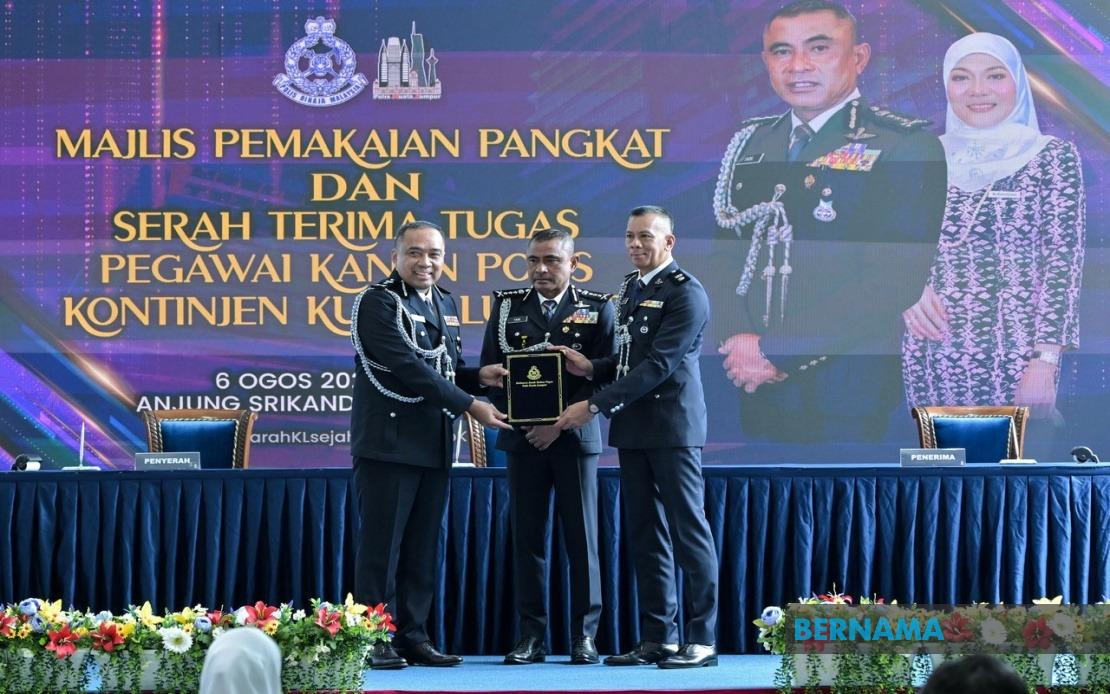
Kuala Lumpur's police contingent underwent a significant administrative restructure when Datuk Fadil Marsus, the city's police chief, conducted a handover ceremony for six senior positions at contingent headquarters. The transfers represent a carefully orchestrated realignment of leadership across the force's most operationally sensitive divisions, from criminal investigation units to neighbourhood policing and intelligence operations. The changes underscore the Royal Malaysia Police's commitment to sustaining institutional momentum while rotating experienced officers into positions where their accumulated expertise can address evolving public order challenges.
The reshuffle touched multiple critical functions within the Kuala Lumpur police structure. Among the reassignments, SAC Zulkarnain Samsudin departed his role as Criminal Investigation Department (CID) head, passing the responsibility to SAC Sazlee Adam. Simultaneously, the Narcotics Crime Investigation Department (NCID) witnessed a transition when SAC Haslah Bachok relinquished the helm to ACP Kee Hang Kee. These two departments form the investigative backbone of the force, handling complex cases ranging from organised crime to drug trafficking—domains where continuity of institutional knowledge and investigative methodology proves essential for operational effectiveness.
District-level command also experienced significant personnel movement. Supt Nuzulan Mohd Din assumed leadership of Dang Wangi district, taking over from SAC Sazlee Adam, who simultaneously advanced from his district posting to head the CID. This cascading structure allowed the force to promote qualified officers while maintaining experienced personnel in positions of growing responsibility. In parallel, Supt Jasni Zolpa transitioned into the Sentul district police chief role, succeeding SAC Basri Sagoni. These district commands represent the operational frontline where police interact most directly with residents and where crime prevention strategies translate into tangible community outcomes.
The intelligence and operations apparatus also underwent restructuring to reflect strategic priorities. SAC Kamaruzaman Md Alib stepped down from his position as Special Branch deputy chief focusing on intelligence and operational matters, handing the reins to ACP Saefuddin @ Mohd Fitri Abdul Rahman. Additionally, SAC Zulkarnain Samsudin transitioned from his secondary role as CID deputy chief for intelligence and operations to allow Supt Ong Seng Keong to assume that responsibility. These intelligence-focused appointments carry particular weight in an era when sophisticated criminal networks, transnational trafficking operations, and security threats require enhanced coordination between investigative units and intelligence gathering.
During his address at the ceremony, attended also by Deputy Police Chief Datuk Mohd Azani Omar, Fadil articulated the philosophical framework underlying these structural changes. He positioned promotions not merely as recognition of individual achievement but as institutional investment—a mechanism through which the force acknowledges proven competence while entrusting officers with expanded mandates. The police chief stressed that integrity, professionalism, and sincerity must accompany advancement, establishing clear expectations that positional elevation demands corresponding elevation in ethical standards and operational rigour.
Fadil emphasised that leadership transitions symbolise more than bureaucratic reshuffling; they represent the continuity mechanism through which institutions sustain themselves across generational change. By rotating experienced officers into fresh assignments and promoting capable subordinates into vacant positions, the force demonstrates its capacity for self-renewal—a critical institutional quality in maintaining public confidence. The chief acknowledged that such movements, while necessary for organisational health, must never compromise the quality or responsiveness of police services to citizens.
The operational context justifying these shifts cannot be overlooked. Kuala Lumpur confronts increasingly sophisticated criminal enterprises, from organised syndicates to drug distribution networks exploiting transnational trafficking routes. The city also faces complex security challenges requiring intelligence coordination and community policing approaches that transcend conventional investigation methods. By strategically repositioning personnel with proven track records in major crime investigation and district-level coordination, the force signals its determination to match organisational structure to the threat environment it confronts.
For Malaysian observers of police administration, the handover demonstrates institutional maturity in succession planning. Rather than ad-hoc transfers responding to immediate vacancies, the coordinated movement of six senior officers suggests deliberate career progression pathways for promising commanders. SAC Sazlee Adam's progression from district chief to CID head, for instance, follows a logical trajectory combining ground-level policing experience with advancement into specialised investigation work. Similarly, the elevation of qualified ACP-rank officers into positions previously occupied by more senior ranks indicates the force's confidence in developing talent within its own ranks.
The transfer of intelligence and operations portfolios deserves particular scrutiny given Malaysia's security environment. The appointment of new leadership to Special Branch intelligence operations and CID intelligence functions occurs at a moment when Malaysian law enforcement increasingly grapples with transnational crime networks, terrorism-related investigations, and cybercrime threats that transcend geographical and jurisdictional boundaries. Having officers with fresh perspectives and contemporary investigative experiences in these roles may enhance the force's adaptability to emerging threat vectors.
From a broader regional perspective, the Kuala Lumpur police restructure reflects patterns observable across Southeast Asian law enforcement agencies. As cities in the region grow more complex and criminal activities become more sophisticated, police forces must continually recalibrate command structures and personnel placement to maintain operational effectiveness. The Malaysian approach, emphasising formal handover ceremonies and public articulation of institutional philosophy, contrasts with more opaque approaches elsewhere and potentially strengthens public understanding of police administration.
For residents and businesses in Kuala Lumpur, these senior-level transitions will eventually manifest through policing priorities and community engagement approaches. New district chiefs bring distinctive leadership styles and strategic emphasis areas. Investigators moving into senior CID and NCID positions will shape case prioritisation and resource allocation. While the immediate impact remains incremental, the accumulated effect of six senior leadership changes across critical functional areas establishes the operational environment for the coming years.
The ceremony itself, conducted with formal dignity and attended by senior deputies, underscores the Royal Malaysia Police's institutional emphasis on orderly succession and transparent leadership transitions. In an era when public institutions face scrutiny regarding accountability and operational legitimacy, such ceremonial acknowledgement of personnel changes—accompanied by the public articulation of institutional values and operational priorities—serves to reinforce the force's commitment to professional standards and ethical conduct. Whether these administrative refinements translate into enhanced public safety outcomes will ultimately depend on how effectively the incoming officers synthesise their prior experience with the fresh challenges their new postings present.

