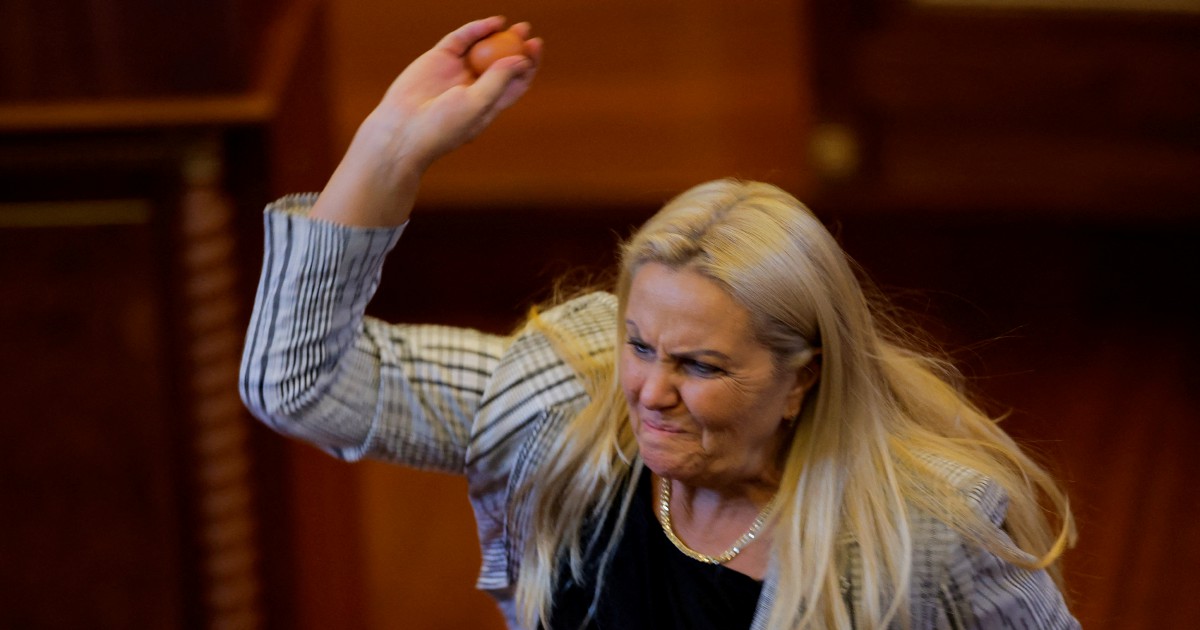
An opposition legislator hurled eggs at Kosovo's caretaker Prime Minister Albin Kurti during Saturday's parliamentary session, forcing authorities to suspend proceedings as the Balkan nation grapples with deepening institutional turbulence. The physical assault, captured in a moment that epitomised the escalating hostility between competing political factions, underscored the fragility of Kosovo's governance structures and raised fresh concerns about the stability of the government's ability to function.
The incident occurred against a backdrop of protracted disagreements between Kosovo's various political blocs, each manoeuvring for advantage ahead of potential new elections. Kurti, who leads the caretaker administration following the collapse of previous coalition arrangements, has become an increasingly polarising figure among opposition parties who view his leadership and policy decisions as illegitimate or counterproductive to Kosovo's interests. The egg-throwing incident, while crude in its expression, reflects the raw emotion and deteriorating civility characterising contemporary Kosovar politics.
The suspension of parliamentary business represents more than a momentary disruption to legislative proceedings; it signals the degree to which political discourse in Pristina has fractured along increasingly intractable lines. Opposition parties have mounted sustained campaigns against Kurti's administration, challenging its mandate and questioning whether caretaker arrangements can effectively govern a nation confronting multiple complex challenges, including economic difficulties, regional tensions, and institutional reform requirements.
Kosovo has experienced repeated cycles of political crisis and snap elections over recent years, as coalition governments have repeatedly collapsed under the weight of internal disagreements or shifting parliamentary mathematics. The possibility of yet another election represents both an opportunity for political renewal and a risk to governmental continuity, particularly given the country's ongoing efforts to consolidate democratic institutions and implement structural economic improvements needed for European Union integration and enhanced international standing.
The targeting of Kurti personally suggests that opposition frustrations extend beyond policy disagreements to questions about his suitability for high office and his approach to governance. Various opposition factions have criticised his administration's handling of economic policy, relations with neighbouring Serbia, minority rights protection, and other salient issues that resonate with Kosovo voters. The parliamentary confrontation, however theatrical, reflects genuine fault lines within Kosovo society regarding the country's direction and leadership.
For regional observers and international stakeholders monitoring Kosovo's development, the incident illustrates persistent challenges in consolidating democratic norms and procedural respect within the young Balkan democracy. International actors, including the European Union and United States, have invested significantly in supporting Kosovo's institutional development, yet political competition continues to strain governmental legitimacy and undermine public confidence in parliamentary institutions intended to represent citizen interests.
The timing of this constitutional crisis carries additional significance given Kosovo's position within broader regional dynamics. Relations with Serbia remain tense despite ongoing dialogue facilitated by international mediators, and Kosovo's political stability directly influences its capacity to engage constructively in regional initiatives and maintain credibility with external partners whose support remains essential for the country's development trajectory and European integration prospects.
Should another snap election materialise, it would represent a significant setback for Kosovo's political maturation. Electoral cycles consume substantial governmental capacity that could otherwise address pressing policy challenges, including unemployment, particularly among youth, pension system sustainability, healthcare provision, and infrastructure development. Additionally, protracted electoral uncertainty complicates medium-term planning and potentially deters foreign investment necessary for economic diversification and employment creation.
The broader pattern of parliamentary dysfunction evident in Saturday's suspension raises questions about whether Kosovo's political elite possess sufficient commitment to democratic institutions and procedural norms necessary for stable governance. Young democracies require not only formally correct constitutional structures but also genuine acceptance by political actors of electoral outcomes, parliamentary procedures, and the legitimacy of opposition roles. When politicians resort to physical confrontation rather than rhetorical or procedural opposition, the gap between formal democracy and genuine democratic culture becomes apparent.
For diaspora Kosovars and international supporters of Kosovo independence, the political turmoil generates frustration with leadership that appears unable to transcend personal rivalries and ideological disputes to govern coherently. Kosovo's independence, recognised by most Western nations but contested by Serbia and several others, derives much of its legitimacy from arguments that Kosovo could develop into a stable, prosperous democracy. Repeated governance crises undermine those arguments and complicate Kosovo's broader international positioning.
The suspension of parliamentary business will likely trigger fresh negotiations among competing political blocs regarding potential coalition arrangements or the sequencing of electoral processes. Such negotiations have historically proved lengthy and difficult, with various parties calculating electoral advantage, ministerial portfolios, and policy priorities rather than focusing on institutional effectiveness or citizen welfare. The coming weeks will determine whether Kosovo's political establishment can restore parliamentary functionality or whether the nation moves inevitably toward fresh elections that most observers view as economically and institutionally costly.
Ultimately, Saturday's incident represents a symptom rather than the underlying disease affecting Kosovo's politics. The egg-throwing reflects deeper questions about Kosovo's political culture, the capacity of institutions to mediate competing interests peacefully, and the commitment of political elites to democratic norms. How Kosovo's leadership responds to this moment—whether through institutional reform, renewed commitment to procedural respect, or further escalation—will significantly influence the country's trajectory and its standing within regional and international contexts.

