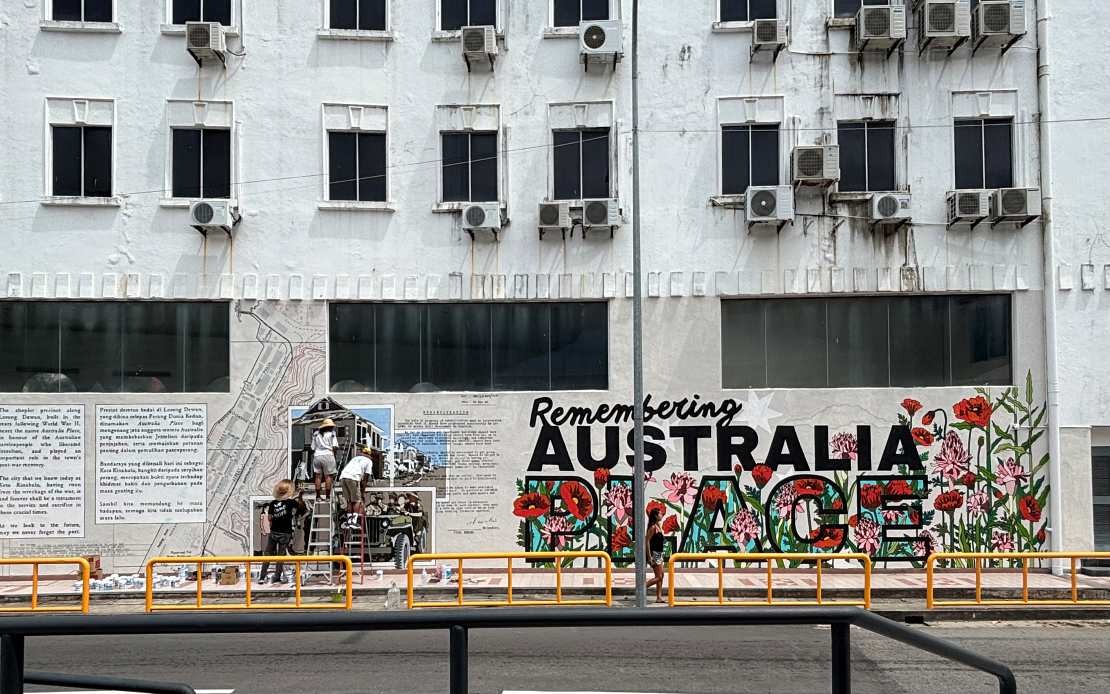
A historic corner of Kota Kinabalu has gained a vibrant visual marker of its deep connections to Australia with the unveiling of a large-scale public mural that encapsulates more than half a century of cultural and diplomatic ties. The artwork, titled 'Remembering Australia Place', was installed at the Wisma Intiutama building within the informal 'Australia Place' district and formally unveiled on Friday, strategically timed to precede Sandakan Day, which commemorates the shared wartime experiences that forged an indelible bond between the two nations.
The mural project represents far more than public art; it is a deliberate effort by Australia's High Commission to Malaysia to cement the narrative of partnership and mutual respect between Australians and Sabahans. Australian High Commissioner to Malaysia Danielle Heinecke, who attended the launch alongside Kota Kinabalu Mayor Datuk Seri Sabin Samitah, framed the artwork as a physical embodiment of friendships, cultural exchanges, and institutional cooperation spanning multiple decades. The presence of parliamentarians, community leaders, and alumni of Australian universities at the event underscored the breadth of connections being celebrated—connections that extend from government relations through educational pathways to grassroots community engagement.
The mural was conceived and executed by Pillars of Sabah, a local community arts organisation whose creative approach transformed abstract notions of bilateral friendship into concrete visual storytelling. Rather than relying on symbolic abstractions, the artists employed narrative imagery to illustrate shared values of resilience, cooperation, and human connection that they identified as the cornerstone of the Australia-Malaysia relationship. This methodological choice to prioritise storytelling over symbolism makes the artwork immediately accessible to diverse audiences, from schoolchildren to diplomats, ensuring that the historical and contemporary significance resonates across demographic and professional boundaries.
The personal dimension of the project adds considerable depth to its significance. Jared Abdul Rahman, co-founder of Pillars of Sabah, carries within his own biography the very story the mural seeks to tell. His father came to Australia as a Colombo Plan scholar, where he met and married Jared's Tasmanian mother—a union that quite literally embodied the people-to-people connections the artwork celebrates. For Jared, directing his artistic talents toward this project represented not merely a professional commission but a profound opportunity to honour both sides of his cultural inheritance and to bridge generations within Kota Kinabalu's community.
The involvement of students and teachers from Sekolah Menengah Kebangsaan Sanzac in the mural's creation demonstrates how the project functioned as an educational intervention as well as an artistic one. By inviting younger generations to participate in reflecting upon and visualising the historical partnership with Australia, the initiative ensures that knowledge of these ties is not confined to official histories or older residents' memories but becomes embedded in the consciousness of those who will carry bilateral relations forward. This intergenerational dialogue, facilitated through collaborative artistic practice, represents a sophisticated approach to cultural diplomacy.
The timing of the mural's unveiling carries symbolic weight. Sandakan Day, commemorated on 24 July and whose observance the mural preceded by approximately three weeks, honours the tragic chapters of World War II history shared by Australia and Sabah. Specifically, it remembers the 2,434 prisoners of war who perished during the Sandakan Death Marches, as well as the extraordinary courage displayed by Sabahans who risked their lives to provide assistance to these prisoners and facilitate escape attempts. This darker historical foundation—involving sacrifice, suffering, and profound human compassion across cultural and national lines—provides the deeper emotional and moral anchoring for the contemporary friendship the mural celebrates.
For Malaysian observers and policymakers, the mural's existence carries several implications worth considering. First, it demonstrates Australia's continued commitment to maintaining and elevating its relationship with Malaysia beyond transactional diplomatic engagement. The investment in public art, community participation, and historical commemoration signals that the relationship extends into the realm of cultural meaning-making and collective memory. For Sabah specifically, whose historical experiences often occupy a marginal position in national narratives, the mural's celebration of local-Australian ties offers an opportunity for greater recognition of Sabah's distinctive international relationships and historical experiences.
Second, the project illustrates how educational pathways, particularly the historic Colombo Plan which facilitated hundreds of Malaysian students' studies in Australia across the post-independence decades, created networks of personal connection that subsequently evolved into institutional and diplomatic frameworks. These human networks remain consequential for bilateral relations even as formal government-to-government interactions continue. The presence of Australian university alumni at the mural's unveiling serves as a living reminder of this educational dimension.
Third, the emphasis on shared values—friendship, resilience, cooperation—points toward a partnership model that transcends the purely strategic or transactional. For Southeast Asia more broadly, where Australia increasingly seeks to demonstrate commitment to the region, such investments in cultural and historical commemoration may serve as templates for deeper regional engagement. The choice to work with local artists and community organisations, rather than imposing external aesthetics or narratives, suggests an approach to cultural diplomacy attentive to local sensibilities and creative agency.
The mural also functions as a spatial marker, transforming an informally designated district into a officially recognised site of bilateral significance. In urban contexts, such markers shape how inhabitants understand and move through their cities, subtly communicating which histories and relationships are deemed worthy of public commemoration. By making 'Australia Place' literally visible through public art, the mural elevates what might otherwise remain an informal or invisible geographical designation into the official landscape of Kota Kinabalu's public memory.
Looking forward, the mural represents a moment of consolidation and celebration of established ties rather than the opening of new diplomatic chapters. Yet art possesses a peculiar capacity to reactivate and renew the meanings it embodies across time. Future generations of Kota Kinabalu residents and visitors will encounter the mural without necessarily knowing the specific circumstances of its creation, yet they will absorb its central message: that Sabah and Australia share a relationship worthy of public commemoration and artistic investment. In this sense, the 'Remembering Australia Place' mural functions as both historical monument and future-oriented statement of commitment.

