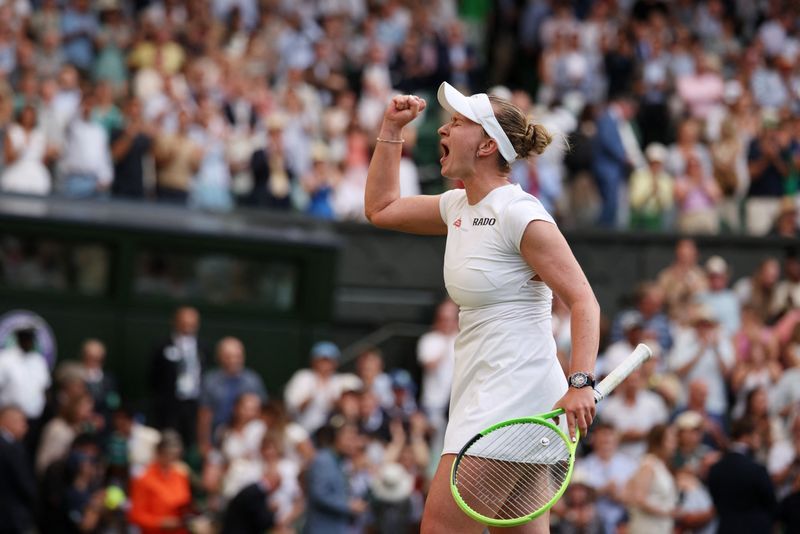
Barbora Krejcikova demonstrated the championship pedigree that has defined her career by recovering from an opening set loss to systematically dismantle fifth seed Mirra Andreeva on Wednesday, securing a hard-fought 4-6 7-5 6-4 victory at the All England Club and progressing to the Wimbledon third round. The Czech veteran's ability to reset after a sluggish stretch proved decisive against the promising 19-year-old Russian, who carried the momentum of her maiden Grand Slam success from the French Open just weeks earlier into their Centre Court encounter.
Krejcikova began the match with considerable attacking intent, establishing a commanding 3-0 advantage that suggested the contest might prove one-sided. However, the momentum shifted dramatically as the former champion's intensity wavered at a crucial juncture, allowing Andreeva to claw back into the set. The younger player's resilience and hunger ultimately carried her through the opener, leaving Krejcikova facing the prospect of an early exit and raising questions about whether the demands of recent competition had dulled her edge. This opening set loss marked a rare vulnerability from a player accustomed to dictating terms against most opponents on grass.
The context of this encounter deserves consideration for regional audiences tracking the evolution of women's tennis. Andreeva's breakthrough at Roland Garros captured global attention, positioning her as a generational talent who appears capable of challenging the sport's established order. Yet Wimbledon's unique conditions present a different examination altogether, and Andreeva's inability to maintain her Paris momentum despite showing flashes of brilliance underscores how grass-court mastery remains a distinct skill set within professional tennis.
Krejcikova recalibrated her approach through the second set, rediscovering the aggressive baseline play that has made her a dual-crown champion at the All England Club and Paris. Rather than becoming discouraged, she systematically elevated her level, breaking through Andreeva's defence to force a decider. The second set epitomised Krejcikova's mental fortitude, demonstrating that experience and adaptability remain formidable weapons even as younger players arrive with extraordinary talent and physical gifts. By the set's conclusion, the trajectory had shifted unmistakably in the Czech competitor's favour.
The deciding set witnessed escalating tension as the two players engaged in relentless baseline exchanges with considerable stakes attached to every point. Andreeva's frustration became increasingly visible as Krejcikova's precision and consistency proved difficult to penetrate, and the Russian even threw her racket in a moment of exasperation that hinted at the pressure both competitors felt. Despite saving six match points through sheer determination and technical excellence, Andreeva ultimately could not withstand Krejcikova's sustained pressure and closed out the contest.
Krejcikova offered gracious remarks following her victory, acknowledging both the quality of her opponent and the significance of the win. The Czech star noted that this represented only her second triumph over Andreeva across five career meetings, emphasising the calibre of opposition she faced and the intensity required to prevail. Her comments reflected genuine respect for a player she recognised as possessing all the attributes necessary for a prolonged career at tennis's highest echelon, suggesting no complacency from the victor despite the eventual outcome.
The champion's reflection on performing on Centre Court carried particular weight, as the grass arena remains tennis's most historically significant stage and a venue where Krejcikova has already etched her name prominently. Her emotion regarding the achievement speaks to the enduring prestige attached to the All England Club, where Krejcikova's successes in 2022 and more recently have solidified her standing among the tournament's modern champions. This victory effectively positioned her for a third-round encounter with fellow Czech Nikola Bartunkova, creating the prospect of an all-Czech matchup within the competition.
Andreeva's exit, while disappointing, should not overshadow her remarkable progress through professional tennis's upper reaches at such a young age. The teenager's rapid ascent from relative obscurity to major championship winner represents the kind of disruptive force that periodically reshapes women's tennis. Nonetheless, her Wimbledon campaign demonstrated that converting early-season success into sustained dominance across different surfaces and conditions remains an evolutionary process requiring further refinement and accumulated experience.
For Malaysian and Southeast Asian observers tracking women's tennis development, this encounter illustrated the intensifying competition at the sport's elite level, where established champions like Krejcikova continue proving capable of delivering under pressure whilst emerging talents like Andreeva force the entire field to maintain extraordinary standards. The match also underscored how individual tournaments demand distinct preparation and adaptation, with grass-court expertise remaining a premium commodity that separates champions from merely talented players.
Krejcikova's progression carries broader significance for Czech tennis, reinforcing the nation's standing as a consistent source of elite female competitors on the world stage. Her ability to perform under the most demanding circumstances at Wimbledon ensures she remains firmly positioned among the tournament's contenders, setting up intriguing matchups as the competition progresses toward its climax. Meanwhile, Andreeva's development continues tracking a fascinating trajectory that will warrant close monitoring throughout the remainder of the season.

