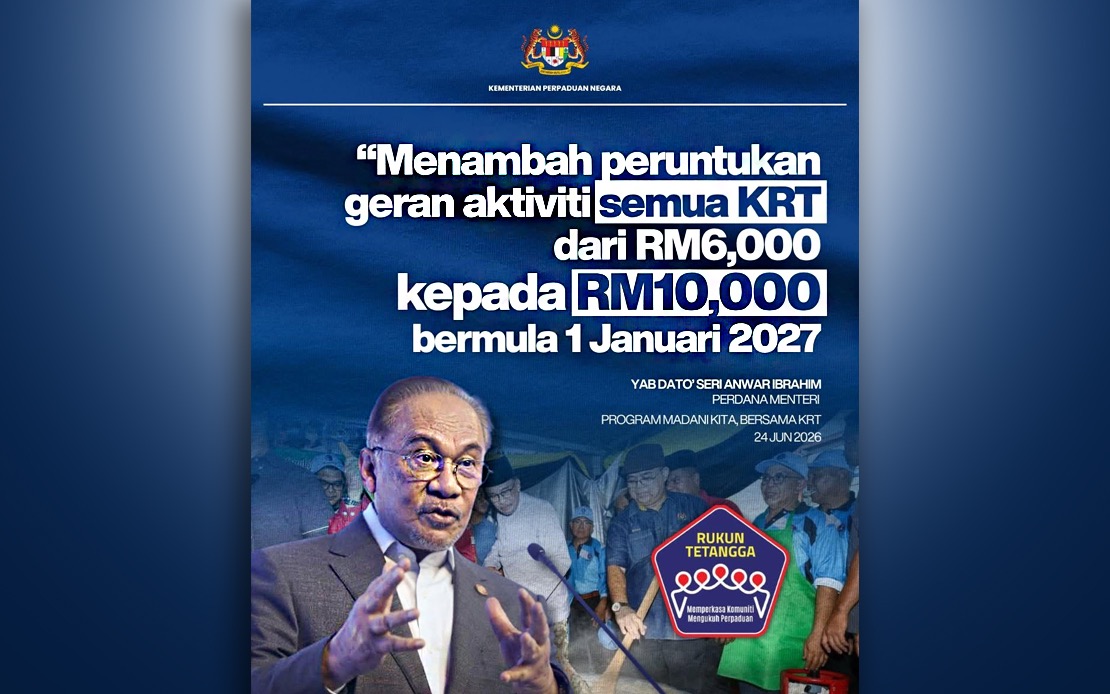
Prime Minister Datuk Seri Anwar Ibrahim has announced a significant boost to community development initiatives, raising the annual grant for neighbourhood watch areas (KRT) to RM10,000 from the previous RM6,000. The increase affects all 8,615 KRT groups operating nationwide and will take effect from January 1, 2027. The announcement was made during the MADANI KITA programme held in Dataran Segamat, Johor, underscoring the government's renewed focus on strengthening grassroots organisations as pillars of social cohesion.
National Unity Minister Datuk Aaron Ago Dagang framed the funding increase as recognition of the KRT's half-century track record in fostering community bonds. Speaking in an official statement, Aaron characterised the decision as emblematic of the MADANI Government's wider commitment to nurturing citizen-led movements that form the bedrock of a united, harmonious society. The minister emphasised that such grassroots organisations represent the authentic foundation upon which national development is built, particularly in an increasingly complex urban and multicultural landscape.
The scale of KRT's reach underscores why this investment matters for Malaysia's social fabric. The network encompasses approximately 250,000 active members distributed across thousands of neighbourhood clusters. These volunteers and community leaders collectively touch the lives of more than 12 million Malaysians through a diverse portfolio of activities. Over the preceding year alone, KRT members orchestrated in excess of 100,000 distinct community programmes, ranging from neighbourhood security initiatives to educational outreach and cultural events that reinforce interethnic understanding.
The enhanced funding is intended to catalyse more ambitious and impactful programming at the neighbourhood level. According to Aaron's statement, the additional resources will enable KRT to expand its scope across multiple domains: unity-building activities that bridge ethnic and religious divides, community development projects tailored to local needs, welfare support for vulnerable residents, educational programmes for youth and families, enhanced neighbourhood safety initiatives, volunteerism engagement, and micro-economic empowerment schemes that boost local livelihoods. This diversified approach reflects recognition that community wellbeing is multidimensional and requires sustained, coordinated effort.
The timing and structure of the announcement carry political significance within Malaysia's current governance framework. By publicly endorsing grassroots movements through tangible fiscal commitment, the MADANI administration signals its intention to distribute developmental responsibility beyond federal and state bureaucracies. This aligns with Malaysia MADANI as a governing philosophy that emphasises shared prosperity and inclusive participation. For neighbourhood groups often stretched thin by voluntary contributions and minimal previous allocations, the increase from RM6,000 to RM10,000 represents a 67 percent uplift—substantial enough to materially change what programmes can be sustained and initiated.
The geographical distribution of these 8,615 groups means the policy reaches urban settlements, semi-urban towns, and rural communities alike. This breadth is crucial because Malaysia's development challenges differ significantly across regions. Urban KRT groups may prioritise migrant worker integration and inter-generational harmony, while rural counterparts might focus on agricultural knowledge-sharing and youth retention. The additional funding flexibility allows groups to customise their spending according to neighbourhood demographics and priorities, rather than adhering to rigid national templates.
Aaron's emphasis on neighbourliness as a cornerstone of national unity reflects a deliberate rhetorical and strategic positioning. In a country composed of Malays, Chinese, Indians and indigenous minorities, with Islam, Buddhism, Hinduism, Christianity and other faiths coexisting, the functioning of neighbourhoods—where people share space, facilities, and daily interactions—becomes the litmus test for national cohesion. KRT groups are uniquely positioned to model peaceful coexistence across identity lines, creating trust-building experiences that insulate communities against polarisation and divisive narratives.
The minister also flagged ministerial oversight of fund utilisation as a priority, suggesting that accountability mechanisms will accompany the grants. This implies that while autonomy is granted to neighbourhood groups, the Ministry of National Unity will likely establish reporting frameworks to ensure funds achieve their intended impact. For Malaysian readers concerned about governance and transparency, this accountability angle differentiates the initiative from purely distributive welfare policies and positions it as part of a monitored, impact-focused development strategy.
The implications for Southeast Asia are noteworthy, as Malaysia's KRT model offers a template that other regional nations—facing similar urbanisation, pluralism, and social fragmentation—might examine. Thailand, Indonesia, the Philippines and Vietnam all grapple with bridging urban-rural divides and maintaining social cohesion amid rapid change. Malaysia's investment in formalised, government-supported neighbourhood organisations suggests one pathway to institutionalising community resilience without creating heavy bureaucratic overhead.
For individual KRT groups, the funding increase should translate into tangible improvements in operational scope. Groups can now sustain weekly or bi-weekly community gatherings rather than ad-hoc monthly meetings; purchase better-maintained safety equipment or first-aid supplies; sponsor youth camps or educational workshops with professional facilitators; and launch small-scale income-generating projects that build local economic capacity. These practical enhancements compound over time, creating positive feedback loops where improved services attract participation, which in turn strengthens group sustainability and influence.
The announcement also reflects broader government strategy to address social fragmentation through preventive means. Rather than waiting for ethnic tensions or crime to spike before intervening, investing in proactive community institution-building aims to reduce incidents before they occur. Sociological research consistently demonstrates that communities with strong internal networks and regular positive interaction across group boundaries experience lower crime rates, better mental health outcomes, and more equitable resource distribution. The KRT funding increase thus functions as an investment in public health and social stability, not merely in administrative support.
Looking forward, the January 2027 implementation timeline provides nine months for the government to establish distribution mechanisms, clarify accountability requirements, and communicate guidelines to all 8,615 groups. This phased approach suggests deliberate planning rather than rushed expansion. KRT leaders will need to anticipate the funding transition and potentially plan expanded programmes well in advance, creating momentum for more ambitious community initiatives even before the new allocation arrives.
The KRT funding increase exemplifies how targeted financial support for grassroots institutions can amplify community agency without displacing local leadership or imposing top-down solutions. By trusting neighbourhood groups to identify and address their own priorities with modest but meaningful additional resources, the government positions KRT as genuine partners in nation-building rather than as passive recipients of government directives. This partnership model, scaled across 8,615 communities and touching millions of citizens, could significantly influence Malaysia's trajectory toward greater social cohesion and inclusive development over the coming years.