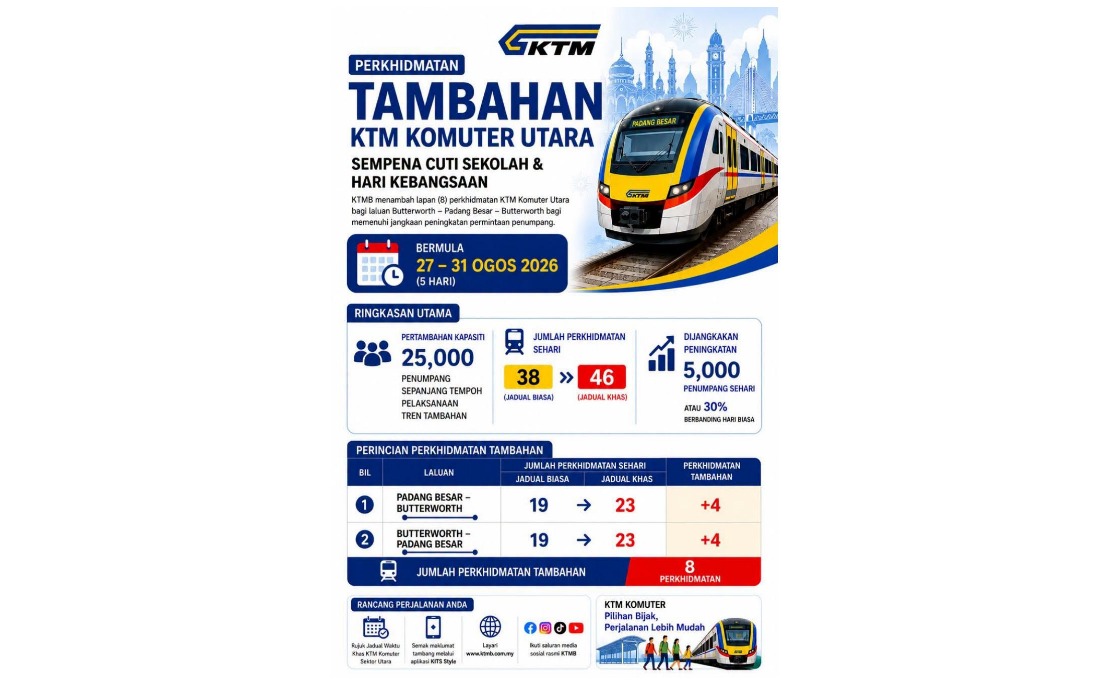
Keretapi Tanah Melayu Berhad (KTMB) is deploying eight supplementary KTM Komuter Utara train services on the Butterworth and Padang Besar corridor from Thursday through Monday (Aug 27-31) to manage anticipated travel spikes coinciding with school holidays and National Day festivities. The enhanced capacity reflects KTMB's strategy to ease pressure on key Northern Sector routes as families across Peninsular Malaysia plan getaways during this extended break period.
The railway operator's decision to activate a special timetable for the Northern Sector underscores the seasonal predictability of holiday travel patterns in Malaysia. During school breaks, commuter rail services typically experience congestion as residents from urban centres venture to Penang, Kedah, and Perlis for leisure and family visits. The addition of these services represents a proactive operational response to demand forecasting rather than a reactive measure to overcrowding.
Under the enhanced schedule, the total number of daily departures on the Butterworth-Padang Besar-Butterworth route will climb from the standard 38 services to 46 services. This 21 per cent increase in daily capacity demonstrates KTMB's commitment to accommodating the surge without fundamentally restructuring its permanent timetable. The distribution of additional services is evenly split between the two directional routes: four extra trains will operate from Padang Besar to Butterworth, and four from Butterworth to Padang Besar.
On the Padang Besar-Butterworth segment, services will increase to 23 daily trains from the usual 19, substantially improving frequency for northbound travellers. Similarly, the Butterworth-Padang Besar direction will also operate 23 services daily, up from the regular 19. This symmetrical arrangement ensures balanced capacity in both directions, reducing potential bottlenecks and distributing passenger loads more evenly throughout the day.
KTMB anticipates that these eight additional services will attract up to 5,000 supplementary passengers daily, translating to roughly 25,000 additional travellers across the five-day implementation window. The operator projects a 30 per cent rise in overall passenger volumes compared to typical weekday figures, a reasonable estimate for a holiday period spanning the August school break and Malaysia Day on August 31. This capacity expansion represents a tangible effort to prevent service degradation during peak demand periods.
For commuters in the Northern Corridor, the timing of this initiative carries broader implications. Penang, as Malaysia's primary tourist and economic hub in the north, regularly experiences influxes of visitors and returning residents during school holidays. Kedah and Perlis, while less densely populated, serve as important transit points and holiday destinations. Enhanced rail capacity between these states not only improves passenger comfort but also encourages mode shift from personal vehicles, potentially easing congestion on the North-South Expressway and reducing road accident risks during high-traffic holiday periods.
The availability of multiple travel time options throughout the day represents a significant quality-of-life improvement for regular commuters and occasional leisure travellers alike. Travellers will benefit from greater flexibility in scheduling their journeys, reducing the need to wait for crowded services or resort to alternative transport modes. This flexibility is particularly valuable for families managing multiple schedules and for tourists unfamiliar with Malaysian rail operations.
KTMB has directed passengers to consult the KTM Komuter Northern Sector Special Timetable for accurate scheduling information. The updated timetable is accessible through the KITS Style mobile application, KTMB's official website, and social media channels, ensuring multiple pathways for information dissemination. This multi-platform approach acknowledges Malaysia's diverse digital literacy levels and communication preferences among commuters ranging from urban professionals to holiday-season leisure travellers.
The Northern Sector's significance to Malaysia's transport ecosystem extends beyond holiday periods. As economic activity continues concentrating in urban centres, reliable commuter rail connectivity between Kuala Lumpur, Selangor, Penang, and northern states becomes increasingly critical for workforce mobility and regional economic integration. Initiatives like temporary service enhancements demonstrate KTMB's understanding of demand dynamics and its flexibility in responding to seasonal pressures.
Looking ahead, KTMB's experience during this August holiday period may inform permanent scheduling decisions for future peak travel windows. If the eight additional services consistently achieve high utilisation rates, the operator might consider incorporating similar capacity enhancements during major school holidays, Chinese New Year, Aidilfitri, and year-end breaks. Data collected from this special timetable implementation will provide valuable insights into passenger behaviour and infrastructure capabilities.
The initiative also reflects broader Malaysian transportation policy priorities centred on promoting public transport usage and reducing dependency on private vehicles. By demonstrating that rail services can flexibly respond to demand fluctuations, KTMB supports government objectives to enhance modal share for trains within the broader transport network. Enhanced regional connectivity through improved frequency strengthens the case for continued investment in commuter rail infrastructure across Malaysia's key corridors.

