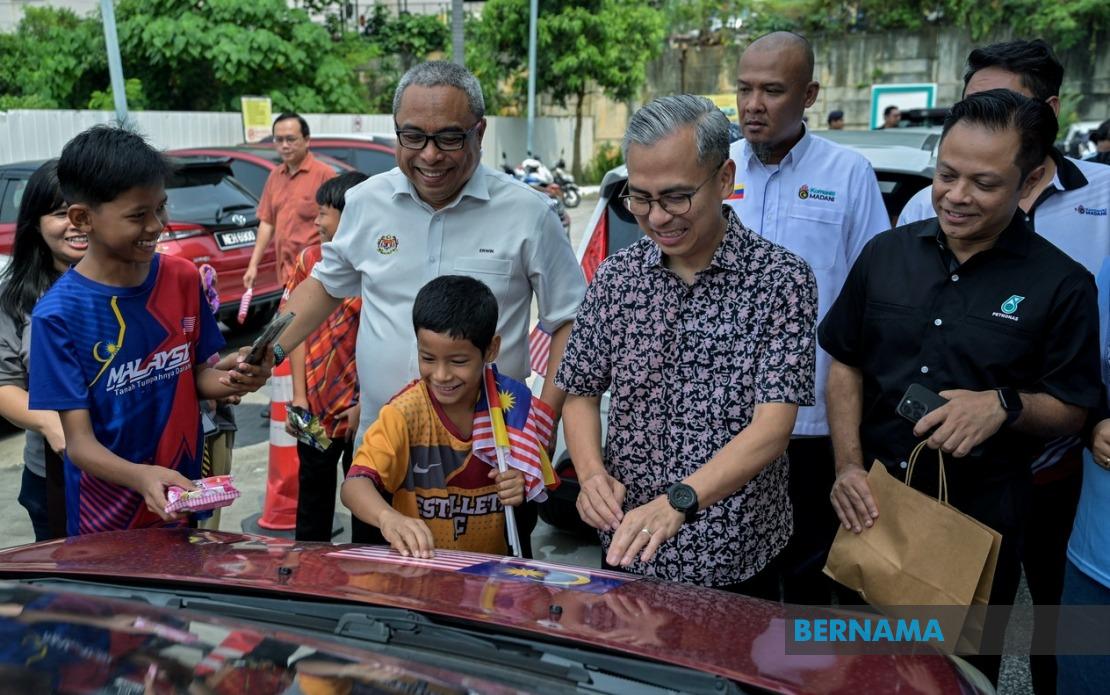
Communications Minister Datuk Seri Fahmi Fadzil has confirmed that the Borneo Convention Centre Kuching (BCCK) in Sarawak will serve as the location for Malaysia Day celebrations in 2026, marking a significant recognition of East Malaysia's role in the nation's continued commemoration of its founding principles. The announcement came during remarks to the media in Kuala Lumpur, following preliminary discussions with key stakeholders tasked with coordinating the event's execution across multiple levels of government.
The selection of BCCK emerged from the inaugural preparatory session convened last Monday, which brought together federal and state-level representatives. Sarawak Minister for Tourism, Creative Industry and Performing Arts Datuk Seri Abdul Karim Rahman Hamzah, who holds the position of co-chairman for the 2026 celebration, participated actively in assessing the suitability of the venue and its capacity to accommodate the anticipated scale of festivities. This collaborative approach reflects the growing emphasis within Malaysia's political establishment on ensuring that national celebrations rotate geographically, distributing both the honour and the logistical responsibility across the federation's diverse regions.
Fahmi highlighted that the BCCK possesses the physical infrastructure necessary to host a national-level event of this magnitude. In his assessment, the venue's spatial dimensions and facilities are comparable to the PICCA Convention Centre in Butterworth, which hosted Malaysia Day celebrations just the previous year. This direct comparison underscores the standardisation effort being undertaken to maintain consistency in the calibre and organisation of these centrepiece national events. The selection process appears to have prioritised practical considerations alongside symbolic significance, ensuring that Sarawak's selection reflects genuine operational capability rather than nominal gestures.
The decision to anchor Malaysia Day 2026 in Sarawak carries broader implications for the nation's unity narrative. Malaysia Day, observed annually on September 16, commemorates the formation of the Malaysian federation in 1963 through the union of Malaya, Singapore, Sabah, and Sarawak. By rotating the primary celebration venue to East Malaysia, the federal government reinforces the constitutional equality and integral place of the Borneo states within the Malaysian framework. For Sarawakians, the hosting of this signature national event within their own borders represents tangible recognition of their state's contribution to the broader Malaysian project and its political legitimacy within the federation.
Preparations for the 2026 event are advancing steadily according to Fahmi's account, with organisers already scheduling the next major coordination meeting for August 24. This subsequent gathering will delve into more granular details regarding logistics, scheduling, and the thematic elements that will characterise the celebration. The establishment of a structured timeline for planning meetings suggests a serious commitment to avoiding the last-minute complications that have sometimes plagued large-scale national events in the past. The involvement of both federal and Sarawak state authorities in these early stages indicates recognition that successful execution requires genuine partnership between different tiers of government rather than top-down mandates from Putrajaya.
In parallel with Malaysia Day planning, the Communications Minister announced complementary developments concerning the National Day celebration scheduled for August 31 in Putrajaya. Prasarana Malaysia Bhd, the government-owned public transport operator, has undertaken to expand its service provision throughout the festival period, extending operations to a continuous 24-hour cycle. This commitment represents a marked departure from traditional arrangements and directly addresses a perennial complaint from citizens who have found themselves stranded or facing prohibitively expensive alternative transport options after celebrations conclude late in the evening.
The extension of Prasarana's service hours reflects evolving administrative thinking about the relationship between national celebrations and citizen accessibility. By guaranteeing round-the-clock public transport, the government acknowledges that attendance at these events should not impose financial or logistical hardship on ordinary Malaysians. The measure is particularly significant for those travelling from distant locations who would otherwise require costly private hire services or accommodation to manage the journey safely. Such thoughtfulness about the mechanics of public participation suggests a maturing approach to event management that prioritises inclusive access alongside ceremonial grandeur.
Fahmi's reference to improvements in associated infrastructure at Putrajaya extends beyond transport to encompass broader facility enhancements. While specific details remain to be articulated, the indication that multiple infrastructure initiatives are underway suggests a comprehensive approach to preparing the capital for heightened visitor numbers. From road resurfacing and signage improvements to enhanced sanitation and parking facilities, these systematic upgrades aim to transform the celebration experience from functional to genuinely welcoming. The emphasis on making the return journey as straightforward as the arrival underscores recognition that citizen satisfaction encompasses the entire event cycle, not merely the highlight moments.
For Malaysian readers and policymakers alike, these developments carry noteworthy implications. The rotation of Malaysia Day to Sarawak acknowledges that national identity and commemoration cannot remain permanently anchored to peninsular geography. Such gestures, though primarily symbolic, accumulate in shaping long-term perceptions of federal inclusivity and respect for regional contributions. For Sarawak, the 2026 hosting opportunity presents both a platform for showcasing the state's tourism infrastructure and a moment to reinforce its political significance within Malaysian federalism.
The expansion of public transport services during National Day celebrations demonstrates administrative responsiveness to citizen feedback. Many residents of peripheral regions have previously experienced genuine inconvenience attending Putrajaya festivities due to transport constraints. By removing this barrier, the government effectively widens the constituency of potential participants and reduces the likelihood that economic circumstance will determine access to national celebrations. This democratisation of celebration attendance aligns with broader principles of inclusive governance.
Looking forward, the August 24 preparatory meeting will prove crucial in translating these initial decisions into concrete operational realities. Questions regarding the specific programme content, participation by different cultural and community groups, and the symbolic narrative that the 2026 Malaysia Day will emphasise remain to be addressed. Given current political dynamics and Sarawak's increasing assertiveness within federal negotiations, the 2026 celebration represents an opportunity for the state to articulate its vision for Malaysian unity while showcasing its distinct cultural identity.
The staggered approach to planning these major national observances reflects broader institutional learning within Malaysia's public administration. Rather than rushing to finalise arrangements, the deliberate spacing of preparatory meetings permits thorough vetting of proposals and iteration based on practical experience from recent events. This measured pace, while occasionally frustrating for those seeking immediate clarity, typically yields more robust outcomes than compressed timelines. As Malaysia continues to grapple with questions of national unity and regional equity, how these celebrations are organised and perceived will carry significance extending well beyond ceremonial considerations.

