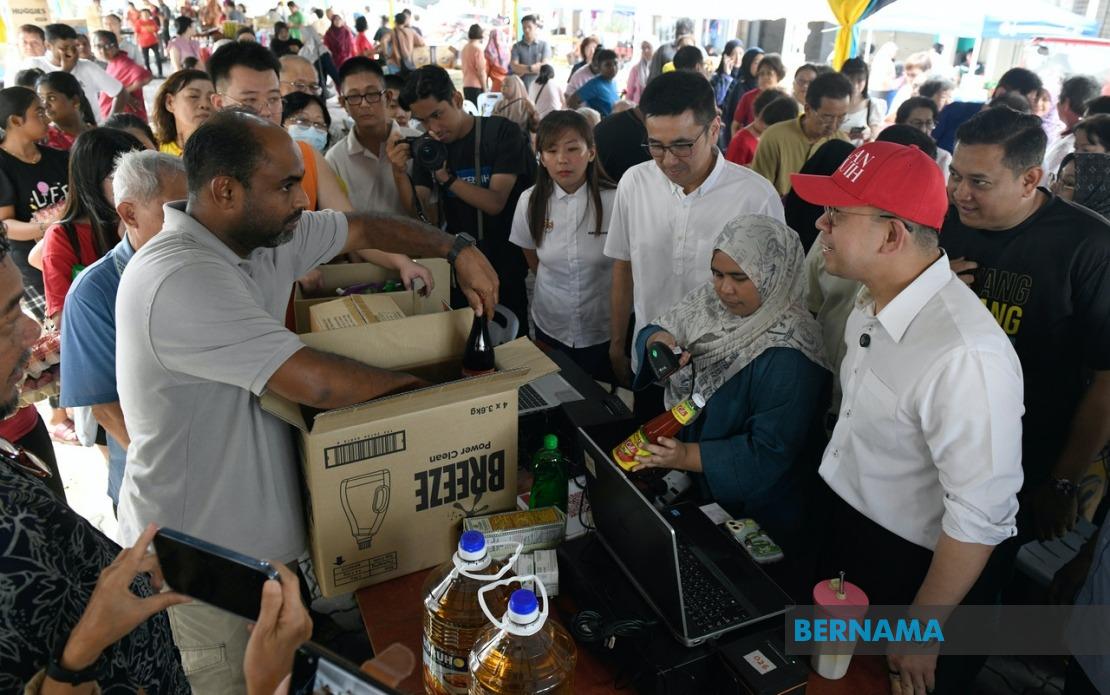
The Ministry of Entrepreneur and Cooperatives Development (KUSKOP) is intensifying its grassroots push to strengthen micro, small and medium enterprises across Malaysia's wholesale and retail landscape. During an engagement at the Jualan MADANI KUSKOP programme in Nibong Tebal's Jawi constituency, Minister Steven Sim Chee Keong outlined the government's commitment to ensuring that local businesses and cooperatives can capitalise on expanding market opportunities in this strategically important sector.
The timing of this initiative aligns with encouraging economic data. According to the Department of Statistics Malaysia, the wholesale and retail trade sector recorded sales valued at nearly RM175 billion in April 2026, representing a robust year-on-year increase of 15.3 per cent. This sustained expansion reflects underlying strength in domestic consumption patterns and signals meaningful opportunities for smaller players seeking to broaden their market footprint.
Sim attributed the sector's resilience to coordinated efforts spanning government policy, private sector engagement, and community-led economic activities. The government's focus on moderating living costs, stabilising commodity prices, and supporting wage growth has fostered conditions where consumer spending remains relatively robust. For MSMEs and cooperative enterprises, this environment creates an opening to reach new customer segments and establish stronger commercial relationships.
What distinguishes KUSKOP's approach is its emphasis on ground-level engagement rather than centralised programme delivery. By working directly with entrepreneurs, cooperative organisations, and small business operators, the ministry aims to tailor support mechanisms to suit local contexts and individual business requirements. This decentralised strategy acknowledges that retail and wholesale enterprises operate within diverse regional ecosystems, each with distinct competitive dynamics and consumer preferences.
The broader context underscores why this support matters for Malaysia's economy. As a nation with an open economy model, Malaysia faces exposure to global trade volatility, including ongoing tariff disputes, supply chain realignment, and geopolitical uncertainties. Yet despite these headwinds, domestic commerce has maintained forward momentum, suggesting that local purchasing power and business confidence remain relatively intact.
For Malaysian entrepreneurs, particularly those operating at the grassroots level, the challenge has often been accessing capital, training, market information, and distribution networks that larger retailers take for granted. KUSKOP's programmatic focus seeks to narrow these capability gaps through targeted interventions. Whether through financing facilities, business advisory services, or cooperative frameworks that enable collective purchasing and marketing, the ministry recognises that small businesses require ecosystem support to compete effectively.
The emphasis on cooperatives deserves particular attention in the Southeast Asian context. Cooperative structures allow individual proprietors to pool resources, negotiate better terms with suppliers, and achieve economies of scale that would be impossible operating in isolation. In Malaysia, where family businesses and single-proprietor enterprises form the backbone of retail and wholesale commerce, strengthening cooperative networks can unlock meaningful competitive advantages.
Min Sim also highlighted that ensuring equitable distribution of economic growth benefits remains central to government policy. While headline growth figures are encouraging, translating these gains into improved livelihoods for small business operators requires deliberate intervention. The proliferation of large retail chains and e-commerce platforms has intensified competition for traditional wholesale and retail players, making government support programmes increasingly vital for preserving entrepreneurial opportunity.
The Jualan MADANI KUSKOP programme itself represents a practical manifestation of this philosophy. By organising marketplace events that bring together consumers, retailers, and cooperative members, the initiative reduces intermediation costs, enables direct transactions, and builds brand awareness for participating businesses. Such interventions, when scaled across constituencies and states, can meaningfully expand market access for smaller enterprises.
Looking ahead, KUSKOP's strategy suggests recognition that sustainable economic growth cannot rely solely on large corporations or imported goods. Local entrepreneurship and cooperative enterprise contribute to employment creation, wealth retention within communities, and supply chain resilience. By investing in these foundations, the government positions Malaysia's economy to withstand external shocks while ensuring that prosperity reaches beyond corporate boardrooms.
For Malaysian consumers, the success of these initiatives carries practical implications. A vibrant ecosystem of local retailers and wholesalers fosters competition that can moderate prices, improve service diversity, and support neighbourhood commerce that many Malaysians depend upon. Similarly, for the estimated hundreds of thousands of Malaysians engaged in small-scale entrepreneurship, KUSKOP's commitment signals that government recognises their contribution to national economic wellbeing.
The ministry's continued emphasis on supporting MSMEs and cooperatives reflects an understanding that Malaysia's economic resilience hinges partly on the health of its grassroots commercial sectors. Amid global uncertainty and rapid technological change, nurturing local entrepreneurial capacity remains both economically rational and socially important. The wholesale and retail sector's proven growth trajectory provides a compelling foundation upon which to build this broader vision of inclusive economic development.

