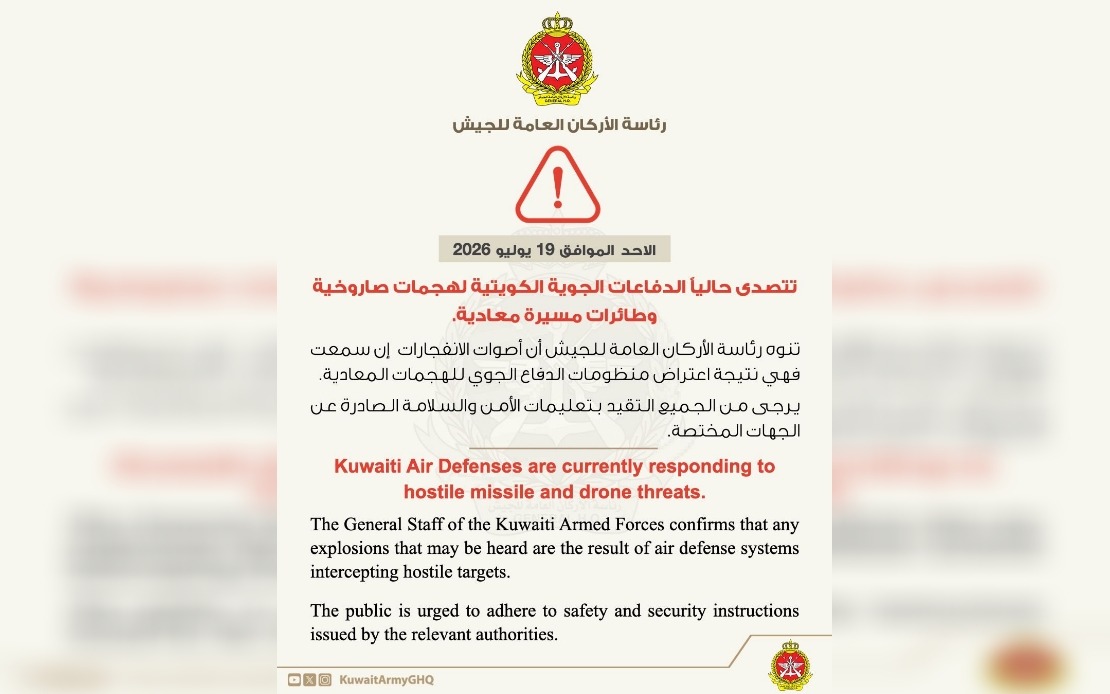
Kuwait's armed forces have activated their air defence systems to counter what military officials describe as sustained hostile missile and drone threats originating from Iran. The Kuwaiti army confirmed on Sunday that explosions residents may have heard across the country were the result of active interception efforts by the nation's defensive infrastructure. Authorities have simultaneously appealed to the public to remain vigilant and adhere to security protocols issued by government agencies as the situation develops.
The military's statement comes amid an unprecedented escalation of cross-border attacks that has transformed the geopolitical landscape of the Arabian Gulf. For nearly a week, United States forces have conducted intensive bombing campaigns targeting Iranian military installations and weapons facilities within Iranian territory. Tehran has responded with retaliatory strikes aimed at American military infrastructure and allied positions across the region, extending far beyond Iran's borders to affect multiple nations hosting US assets.
Kuwait finds itself in a precarious position as a frontline state in this unfolding confrontation. The country hosts substantial American military presence, including forward-operating bases and personnel, making it an inevitable target in Iran's broader strategy of regional deterrence. The frequency and sophistication of the Iranian attacks underscore the escalation's intensity, moving beyond isolated incidents to coordinated waves of coordinated assaults that have forced multiple Gulf nations to activate comprehensive air defence networks.
The deteriorating security environment presents particular challenges for Kuwait, a smaller Gulf state heavily dependent on regional stability for economic prosperity and security. The diversification of Iranian strike capabilities—employing both cruise missiles and unmanned aerial systems—requires multi-layered defensive responses that stress national resources. The situation also threatens commercial aviation, international shipping, and the broader regional economy that remains sensitive to military escalation and uncertainty.
What complicates the current crisis is the apparent failure of diplomatic initiatives that only weeks earlier appeared promising. In June, Pakistan brokered a memorandum of understanding between Washington and Tehran with explicit objectives of terminating their military conflict and establishing durable peace arrangements. The document's rapid obsolescence demonstrates the fragility of Gulf security architectures and the limited effectiveness of third-party mediation when underlying strategic interests remain fundamentally misaligned. The agreement's collapse suggests deeper structural tensions continue driving both parties toward confrontation rather than compromise.
The escalation reflects longstanding rivalry between Iran and the United States that periodically erupts into direct military confrontation despite their nominal acceptance of restraint agreements. Each side interprets the other's military activities through a lens of existential threat, creating action-reaction cycles that progressively lower thresholds for military engagement. The pattern of successive waves of strikes—rather than isolated incidents—indicates both parties may be pursuing graduated escalation strategies designed to demonstrate resolve without immediately triggering all-out regional conflict.
For Southeast Asian nations like Malaysia, the intensifying Gulf crisis carries significant implications despite geographic distance. Regional crude oil prices respond immediately to supply disruption fears, affecting energy import costs across Asia. The potential disruption of international shipping lanes through the Strait of Hormuz—through which substantial Malaysian trade transits—could disrupt supply chains and increase logistics costs for the broader region. Malaysian companies operating across the Gulf, whether in construction, manufacturing, or services sectors, face mounting operational uncertainties and potential evacuation scenarios.
The broader geopolitical realignment also matters for Malaysian foreign policy considerations. As Southeast Asian nations seek to maintain balanced relationships with both Western and Middle Eastern powers, escalating Iran-US confrontation forces uncomfortable strategic choices. Malaysia's historical non-aligned posture becomes increasingly difficult to maintain when regional powers demand explicit positioning. The situation could potentially pull Southeast Asian nations into taking stronger positions on Iranian-American disputes, complicating their carefully calibrated diplomatic approaches.
The timing of this escalation during an already volatile period raises questions about whether either Washington or Tehran genuinely seeks conflict limitation. Intelligence assessments regarding each side's actual military objectives versus their public posturing remain contested. The involvement of multiple regional actors—each possessing their own strategic interests separate from the primary bilateral Iran-US antagonism—adds unpredictable variables that could rapidly transform a localized exchange into broader regional conflagration.
Kuwait's measured public messaging, while appropriately reassuring residents about defence capabilities, masks underlying vulnerabilities in its national security posture. The country relies substantially on international coalition support for meaningful air defence against sophisticated Iranian weapons systems. The requirement to depend on American protection while hosting the very military facilities Iran targets creates a complex vulnerability matrix that no diplomatic initiative has yet successfully resolved. Kuwait's situation exemplifies how smaller regional states become trapped between powerful contenders regardless of their own policy preferences.
The sustainability of current escalation patterns remains uncertain. Both Iran and the United States face domestic political pressures that could either de-escalate or intensify the confrontation. Miscalculation risks increase exponentially when military operations proceed without active diplomatic channels or confidence-building mechanisms. The failure of Pakistan's mediation effort suggests that restoring dialogue will require substantial shifts in either Washington's or Tehran's strategic calculus—unlikely without significant developments that alter their current cost-benefit assessments regarding continued military operations.
Regional actors monitoring this situation understand that the present trajectory, if sustained, threatens broader destabilization across the Middle East and consequent global economic disruption. The imperative for renewed diplomatic engagement has become urgent, yet political conditions for productive negotiations appear decidedly unfavourable. Without decisive intervention by external powers or dramatic changes in circumstances on the ground, the cycle of attack and retaliation may continue escalating through the coming weeks and months.

